Star chefs urge Japanese government to establish protection of marine resources
Star chefs from Michelin-starred restaurants and other establishments called for marine resources to be protected in a proposal submitted to the heads of the Fisheries Agency and the Agriculture, Forestry and Fisheries Ministry earlier this month.
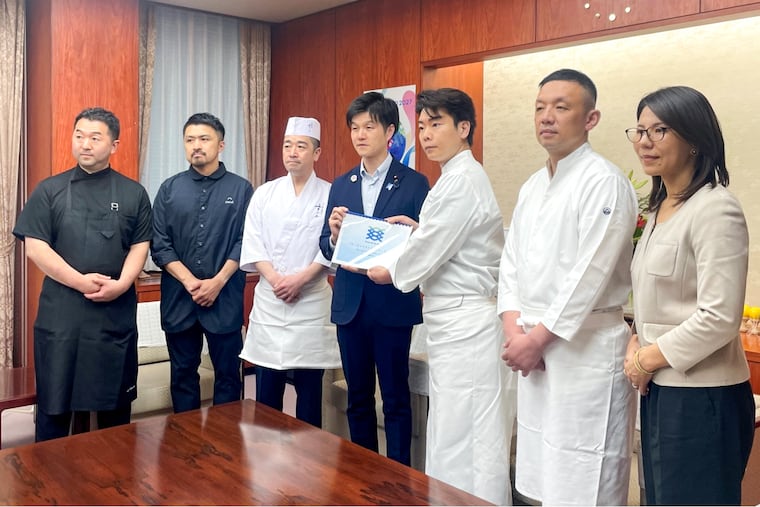
Star chefs from Michelin-starred restaurants and other establishments called for marine resources to be protected in a proposal submitted to the heads of the Fisheries Agency and the Agriculture, Forestry and Fisheries Ministry earlier this month.
Freshly caught coastal fish is integral to Japan’s culinary culture, yet this heritage is facing a crisis, with the chefs fearing that one day sushi may become unavailable.
Passing down skills harder
“Many overseas visitors come to Japan looking forward to eating Japanese fish,” Takaaki Sugita, owner of Nihonbashi Kakigaracho Sugita, said in an appeal to Agriculture, Forestry and Fisheries Minister Norikazu Suzuki on May 18. “If we have the fish, we can serve dishes that deeply impress them, but the fish are really scarce.”
Even Sugita, a renowned Edomae-style sushi restaurant, is facing a fish shortage and a decline in quality product, the owner said. As a result, he explained that it is becoming increasingly difficult to pass down the techniques for preparing wild-caught coastal fish.
Sugita was among five chefs from the general incorporated association Chefs for the Blue who visited the ministry along with the association’s representative, Hiroko Sasaki.
Founded in 2017 by chefs concerned about the future of fish consumption in Japan, the association now has 42 members, including owner-chefs from some of the country’s leading restaurants.
Seafood dishes are a major pillar supporting Japan’s food service industry.
According to Sasaki, restaurants specializing in sushi, tempura and other traditional Japanese cuisine account for about 65% of the 339 eateries in Tokyo, Osaka and Kyoto that have earned Michelin stars.
Japanese food is not the only cuisine that utilizes seafood, with many French, Chinese and Italian restaurants also featuring seafood in their signature dishes.
Shuzo Kishida, owner-chef of the three-Michelin-star French restaurant Quintessence in Tokyo, echoed the concern: “We’re celebrating our 20th anniversary, and it’s not only that prices are soaring now; we’re also finding it harder to source high-quality fish year after year.”
Is self-regulation enough?
Last May, Sasaki and others asked restaurants nationwide about their fish and seafood procurement situation. Of the 1,301 valid responses, 95.2% said the amount of seafood they procure had “decreased significantly” or “decreased” compared to 10 years ago. Meanwhile, 72.7% answered that they felt “increasingly alarmed” over the future.
The chefs, who share the same concerns, urged the government to take action to protect wild-caught fish - especially in coastal fisheries.
Currently, among the 62 types of seafood commonly used in Edomae-style sushi, such as red sea bream, bluefin tuna, flounder and bloody clam, only nine are subject to national catch limits to prevent overfishing. With most species left to fishermen’s self-regulation, catch volumes have declined.
“There seem to be few effective, scientifically grounded initiatives aimed at restoring fish stocks,” said Sasaki.
Feed, fish oil or fertilizer
Surprising figures also reveal that the majority of the catch of Japanese sardines and mackerel are not actually consumed. For instance, only 18.8% of Japanese sardines shipped from 32 major ports are allocated for the Japanese food market. For mackerel, the figure is 40%.
The fish are often caught while they are still immature and fatty, and most are used as feed in aquaculture and as bait or processed into fish oil and fertilizer. Some are exported to Asia and Africa. This explains why Norwegian mackerel is commonly seen on supermarket shelves.
“Japan has what is considered the world’s finest fish-eating culture, yet the reality is that local fish are not available in supermarkets,” said Ryohei Hayashi of the Japanese restaurant Tenoshima. “I think more people need to understand the value of wild-caught fish.”
The government is focusing its efforts on creating new initiatives, such as land-based aquaculture, food tech and scallop exports, but its response to resource management seems somewhat sluggish.
Suzuki even said, “Our officials don’t eat much wild-caught fish.”
The Fisheries Agency reportedly said, “We leave coastal fisheries management to local municipalities.”
“Japan’s seafood culture, which attracts global attention, can serve as a major force for earning foreign currency,” said Sasaki. “The fisheries sector, including distribution, processing and employment, constitutes a significant value chain that creates substantial added value. To maximize that value, we want [the government] to consider a sustainable form of fishing.”
Behind the difficulty in procuring wild-caught fish lie various factors, not just resource management, but also changes in marine conditions, due to such things as global warming and the rise of direct-to-consumer distribution, which bypasses established markets.
Last year, too, chefs submitted proposals calling for factor analysis and countermeasures related to the fisheries industry, but the government’s response has been slow, with the fish stock decline showing few signs of having been curbed.
Eventually, Edomae-style sushi using wild-caught fish may become unavailable even at top-tier restaurants in Japan. Action must be taken before such a bleak future becomes a reality.