‘I’m alive because I participated in a cancer research experiment.’ Advocates fear funding cuts will jeopardize cancer research.
A news conference, organized by the American Cancer Society Cancer Action Network and held on Independence Mall, highlighted cancer researchers and patients who benefited from federally-funded trials.
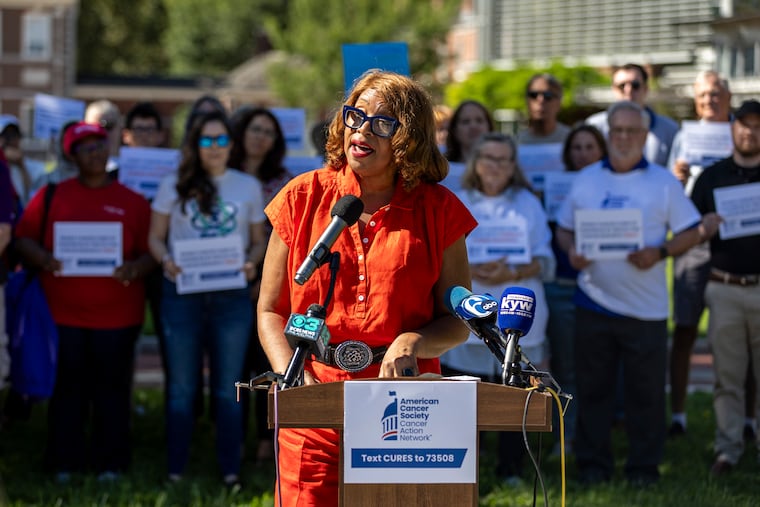
Lynne Alston is alive because of a clinical trial.
Eleven years ago, Alston discovered a golf-ball-size lump in her breast and started treatment at Temple Health’s Fox Chase Cancer Center, part of a network of treatment and research facilities across the country funded by the National Cancer Institute.
While undergoing chemotherapy, she received an experimental treatment through a clinical trial that is still ongoing. Today, she is cancer-free, serves as the cochair of Fox Chase’s community advisory board, and credits her survival to the trial.
That’s why she felt compelled to speak out Tuesday against President Donald Trump’s proposed cuts to the National Institutes of Health, the government agency that oversees the NCI, advocating for its importance alongside others with similar stories.
Speakers at a news conference, organized by the American Cancer Society Cancer Action Network and held on Independence Mall, highlighted cancer researchers and patients who benefited from federally funded trials.
“Because of research that was federally funded, I am standing here today,” Alston said. “Survival is what research makes possible, and survival gave me a new purpose. I now champion the very clinical trials that once gave me my second chance.”
Trump’s proposed budget would cut 40% of NIH’s budget in fiscal year 2026. These cuts would be in addition to a haphazard series of cuts this year to NIH-funded grants. In particular, grants targeted for termination include those funding research relating to diversity, equity, and inclusion initiatives; LGBTQ health; and examining health disparities tied to social factors like race and income.
Trump has said he is targeting wasteful federal funding, especially for DEI programs that his administration considers discriminatory against white people.
Lawsuits over those cuts have resulted in some money being returned to Philadelphia-area researchers, although the ongoing legal fight recently saw the Supreme Court overturn a judge’s order that had halted some grant terminations.
But uncertainty and confusion remain over the future of research initiatives. Alston said she is in touch with several women whose clinical trials have been paused or are at risk of being halted because of federal research cuts.
Last month, the Senate Appropriations Committee voted to increase funding for the NIH by $400 million in the coming fiscal year. Advocates in the region have been urging lawmakers in the House of Representatives to do the same as they consider the budget proposal.
One of the speakers at Tuesday’s event, Kurt Weiss, a cancer surgeon at the University of Pittsburgh Medical Center’s Hillman Cancer Center, was diagnosed with osteosarcoma, a rare bone cancer, as a teenager. He was successfully treated after enrolling in a clinical trial.
“I’m alive because I participated in a cancer research experiment. That’s a pretty cool story, but it’s hardly the only one of its kind,” he said.
Now he worries that funding cuts could slow opportunities for future scientists and their work.
“I’m going to retire, but my work can’t stop,” he said. “If we don’t have the resources to bring up that next generation of cancer scientists, if the pipeline slows or stops, I do not think cancer research can survive that.”
Cutting cancer research would also harm the state’s economy, speakers said, with billions of federal research dollars supporting tens of thousands of jobs here.
Cutting NIH resources is comparable to a football team eliminating its offensive and defensive lines, said Anthonise Fields, who heads the Philadelphia-based E3 NexHealth, which works to improve equity in healthcare, in part by helping researchers recruit diverse pools of study participants.
“We would not tolerate that on the field. Why would we tolerate that with our health?” said Fields, who previously worked as a researcher at pharmaceutical companies Merck, Johnson & Johnson, and Bristol Myers Squibb.
Others said the prospect of significant cuts to federal research dollars felt like a step backward, especially in communities that have historically been underrepresented in medical research.
At Enon Tabernacle Baptist Church in Cedarbrook, associate pastor Leroy Miles and his fellow clergy have been mobilizing against proposed cuts to federal research funding and to government-funded health coverage through Medicaid and other social service programs.
The church regularly hosts health professionals and researchers to speak about their work.
At Tuesday’s news conference, he said it was a “moral imperative” to continue funding cancer research.
“We felt like, in the last few years, we’ve been making progress. There was trust that was being built between healthcare and the community. We were talking about social determinants of health,” he said. “This feels like the rug’s being pulled from underneath us.”