Penn immunologist David Fajgenbaum receives prestigious John Scott Award
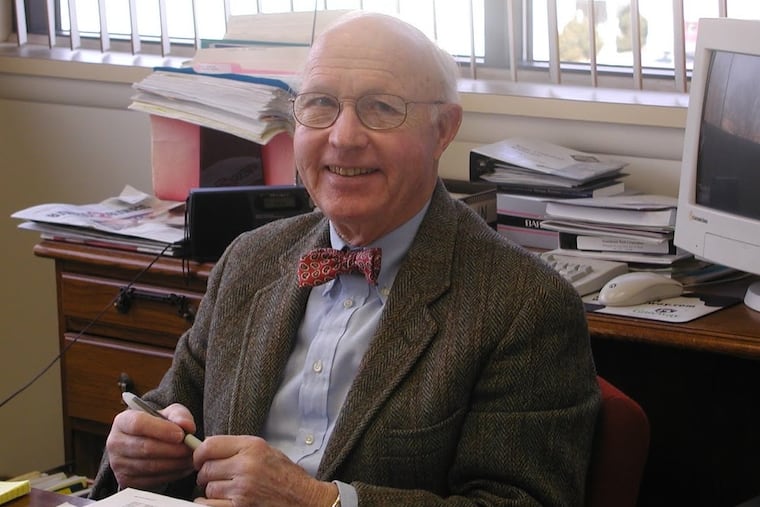
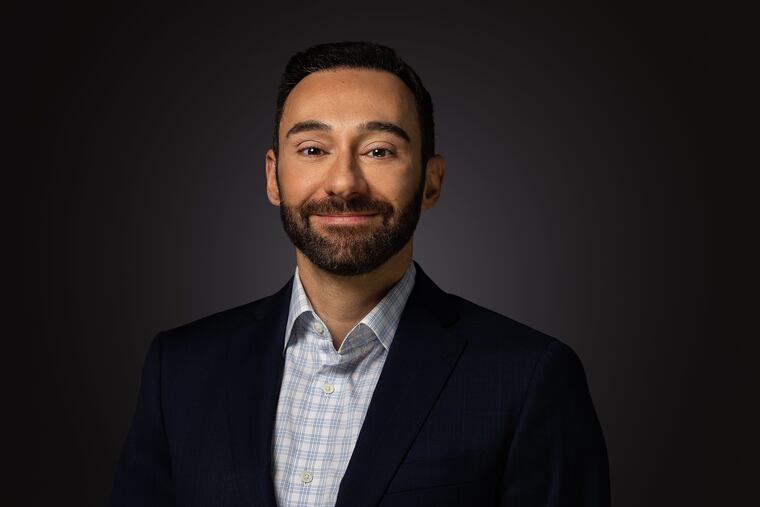
Fajgenbaum, a Penn immunologist who will receive the John Scott Award, gained notoriety for finding a way to treat himself for Idiopathic Multicentric Castleman’s Disease, a rare and deadly condition.
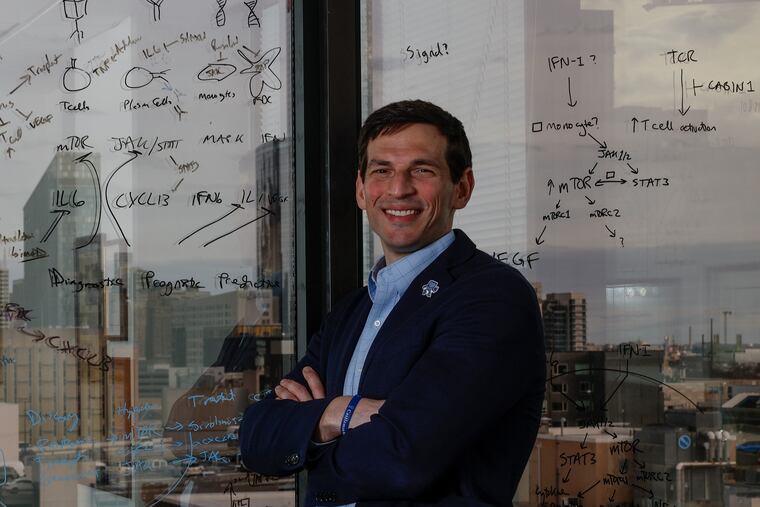
David Fajgenbaum, a Penn Medicine immunologist who saved his own life by repurposing an existing drug, will be among three scientists honored with a prestigious science award next month.
The John Scott Award, one of the oldest science awards in the United States, will be presented in November by the Philadelphia-based American Philosophical Society, which was founded by Benjamin Franklin in 1743. The award includes a $10,000 cash prize for each recipient.
This year’s award is being given to three scientists whose work has led to inventions that improve public health: Bonnie L. Bassler, a molecular biologist at Princeton University; Robert K. Prud’homme, a chemical engineer at Princeton University; and Penn’s Fajgenbaum, whose nonprofit organization, Every Cure, uses artificial intelligence to identify new uses for existing medications.
Fajgenbaum first delved into the topic 15 years ago, as a third-year medical student at Penn, after he was diagnosed with a rare and deadly condition called Idiopathic Multicentric Castleman Disease.
Fajgenbaum started storing vials of his blood in a campus lab fridge and testing them for abnormalities.
He had learned in class about a drug given to organ transplant recipients that suppresses a protein he found was off the charts in his own blood tests. Fajgenbaum convinced his doctors to let him try the drug, and it worked.
Fajgenbaum’s memoir about the experience, “Chasing My Cure” is being made into a movie.
He later founded the nonprofit Every Cure to continue the work of repurposing existing medications for rare diseases with few treatment options. The nonprofit uses AI technology to scan databases of information about diseases and available drugs to identify new matches.
Matches can then be studied and tested by researchers, to determine if the drug can safely and effectively be used to treat a disease it wasn’t designed for.
Typically, finding such matches are done one disease and drug at a time, a process that can take years to show results, if any match is ever found. With AI, researchers can scan dozens or even hundreds of drugs and disease profiles at a time, quickly searching for shared characteristics that could lead to a match.
“The truth is that our system of creating new drugs is extraordinarily impressive but also very expensive and time-consuming,” Fajgenbaum said. “It takes more than a billion dollars and 15 years to create a single new drug, but repurposing one of these drugs for a new disease can be done for less than one percent of the cost and much more quickly. It’s just not profitable to anyone, so it’s rarely done.”