Federal legislation would increase pathogen testing for infant formula following botulism cases
A Bucks County family is suing a formula maker after their infant developed botulism.
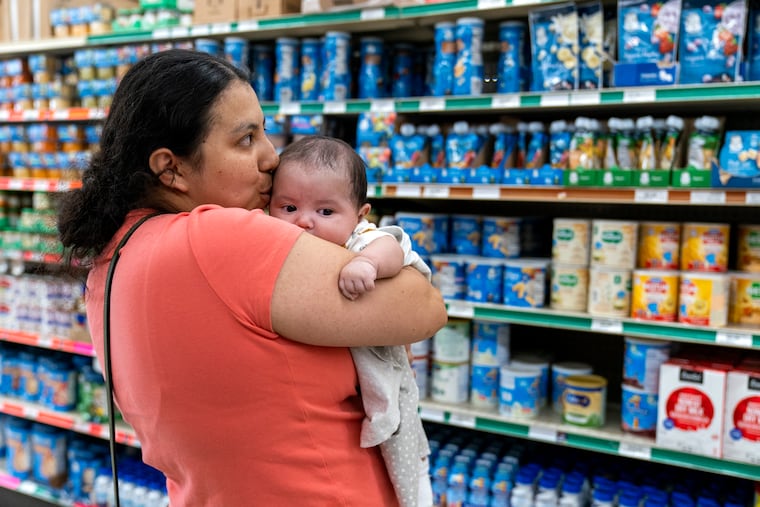
A 2-month-old Bucks County infant was struggling to swallow and could hardly hold his head up.
He was diagnosed last month with infant botulism, a rare, potentially deadly infection that affects the nervous system and can lead to paralysis.
The family and their lawyer believe the baby, now recovering at home, ingested the bacteria that causes the infection from an infant formula subsequently recalled by its manufacturer, Nara Organics, over contamination concerns.
Federal legislation proposed this spring could protect babies by requiring formula manufacturers to test for more pathogens. The bill, HR 7867, is awaiting hearings in the House Committee on Energy and Commerce.
“I want responsible manufacturers, responsible industry partners, who say we know there is a risk of this and we’re going to be ahead of the game,” said U.S. Rep. Madeleine Dean, a Montgomery County Democrat and cosponsor of the bill.
When asked for comment on the proposed legislation, Nara Organics pointed to safety protocols posted on its website saying the company exceeds the U.S. Food and Drug Administration’s current requirements.
The New York-based company said it voluntarily recalled all of its infant formula on June 13 “in an abundance of caution,” after the FDA and the Centers for Disease Control and Prevention reported three cases of infant botulism in babies who had consumed Nara formula.
As of July 6, a fourth case had been confirmed, and FDA testing identified the botulism-causing bacterium C botulinum in some of the company’s formula, according to an update posted on the company’s website.
Nara Organics did not comment directly on the proposed regulations. When asked for its position on the legislation, the Infant Nutrition Council of America, which represents manufacturers, said its members “share the goal of ensuring families have access to safe, high-quality infant formula.”
“Infant formula is among the most highly regulated foods in the United States, and INCA supports science-based, risk-based improvements that strengthen infant formula safety,” the organization said in a statement.
The push to bolster regulations comes several years after federal regulators and lawmakers started looking more closely at infant formula safety in 2022, when a massive recall for a non-botulism bacterial contamination left shelves bare for months.
But two recent infant botulism outbreaks linked to formula show the inadequacy of the steps that companies are already taking, said Bill Marler, a Seattle-based food safety lawyer who is representing Erica and Micky Goldfin, the Yardley couple whose son developed botulism after being fed Nara Organics formula.
“We need to do more to protect these kids,” Marler said.
A dangerous infection
Infant botulism occurs when babies ingest C botulinum in foods or dust and dirt particles. The bacteria’s spores colonize in the large intestine and release a toxin that affects the nervous system.
Symptoms include changes in facial expressions, such as smiling less, slow feeding, constipation, and low energy. Untreated, the toxin can spread and cause paralysis, making it hard for babies to breathe and eat.
Infants are at greatest risk of illness because their digestive systems are still developing and less able to fight off infection.
Nationally, 181 cases of infant botulism were reported in 2021, the most recent year for which CDC data are available.
The Goldfins’ baby, identified by the initials W.G. in court records, spent two nights in the intensive care unit at the Children’s Hospital of Philadelphia, where he was treated with BabyBIG, the botulism antitoxin that is manufactured by the California Department of Public Health. The medication’s antibodies bind to the toxin and neutralize it, improving symptoms within 48 hours.
On June 6, he returned home, where he is feeding well again, and regaining movement in his arms and legs. He is receiving weekly physical therapy for developmental delays in his gross and fine motor skills, according to the lawsuit.
Testing challenges
Federal regulators began looking more closely at infant formula in 2022, after Abbott Nutrition issued a massive recall over concerns of non-botulism bacterial infections.
Abbott temporarily shut down one of the largest formula manufacturing plants in the country while it investigated the cause of the contamination, leaving families scrambling to find the formulas they relied on for their infants and medically fragile children.
Pinpointing the exact source of contaminants can be challenging.
The bacteria that causes botulism, for instance, could have been present in the Nara Organics’ powdered milk formula, in dust that settled on the packages during transportation, in the water used to mix it, or on the hands of those preparing the food, said Molly Potter, a senior clinical dietitian with Nemours Children’s Health in Delaware.
According to its website, Nara Organics tests its formulas throughout the manufacturing process, first testing raw ingredients, then during production, and again with the final product.
The tests the company uses include so-called sulfite-reducing clostridia (SRC) enumeration, which a leading international food-safety group recommends for identifying spores of the bacteria that causes infant botulism.
But research published in June in the medical journal Frontiers in Microbiology found that SRC enumeration testing suggests that test wasn’t sufficient to consistently detect the bacteria.
Researchers from IEH Laboratories & Consulting Group, a Washington-based firm that specializes in laboratory testing and analysis for the food industry, worked with ByHeart to analyze its infant formulas that had been linked to at least 28 cases of infant botulism this year and last.
Improving safety
Dean said she hopes the proposed legislation will open up more conversation about how best to improve infant formula safety.
The bill tasks the FDA with developing a list of pathogens that formula companies should test for, and working with manufacturers to begin any tests they aren’t already doing.
The FDA would also set a schedule for how often manufacturers need to test for the new list of pathogens.
Under the legislation, companies would be required to report contamination results within a day, and retain records of positive test results.
Dean is among more than two dozen lawmakers to sign on as cosponsors. Rep. Jefferson Van Drew, who represents South Jersey’s 2nd District, is one of two Republican cosponsors.
Potter, the Nemours dietitian, said she hopes increased testing will help families feel more at ease.
In the meantime, parents can reduce the risk to their children by only purchasing formula from reputable stores, checking expiration dates, and storing powdered formula canisters properly. Caregivers should make sure to mix formula in clean equipment, and wash their hands before preparing and feeding it to a baby.