Main Line Fertility has settled with a patient after a doctor mistakenly injected acid into her. Court records reveal how it happened.
Court records detail how cascading events led to a type of medical error known as a “never event,” because it is preventable and should never happen.
The ultrasound technician at Main Line Fertility’s Havertown office grabbed a bottle of what she thought was saline from a cabinet in an exam room and poured the clear liquid into a green bowl.
The room was now ready for a patient arriving for a routine procedure in which saline is injected into the uterus to check for fallopian tube blockages.
But moments after the procedure ended, it became clear that something had gone horribly wrong. The patient writhed in agony, saying her reproductive organs felt on fire.
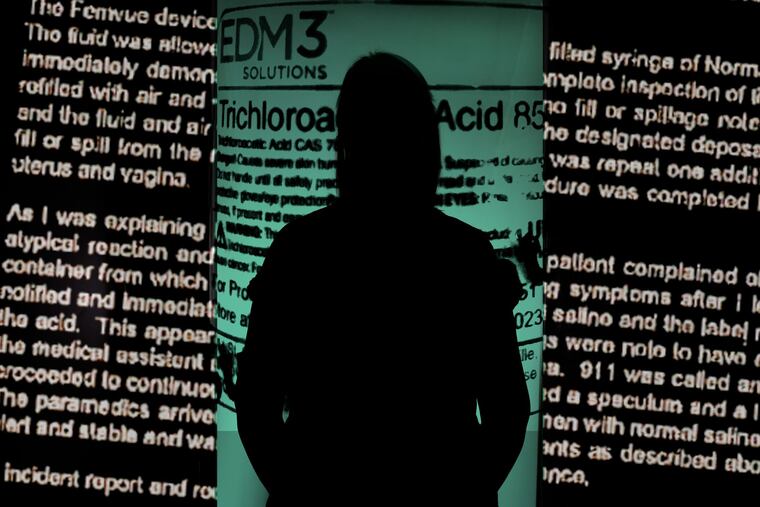
Puzzled, the technician examined the bottle that she had assumed was saline. The label read: Danger! Causes severe skin burns and eye damage. Suspected of causing cancer.
A dangerous and highly caustic acid solution had been injected into the patient.
“My stomach hit the floor,” the technician later testified in a deposition as part of a 2023 medical malpractice lawsuit filed by the patient and her husband.
The court records detail how cascading events led to a type of medical error known as a “never event,” because it is preventable and should never happen. State law does not require fertility clinics to report such errors, and the public rarely learns about them. In this case, depositions from the clinic staffers involved reveal how inadequate safety protocols, cost-saving practices, and a lack of physician oversight contributed to a systemic breakdown.
Simple safety precautions could have prevented the December 2022 mistake, clinic workers and experts testified. Main Line Fertility officials said they subsequently enacted protective measures across the company’s Philadelphia-area offices.
The case was settled last month in Philadelphia Common Pleas Court for an undisclosed amount. Main Line Fertility, through its parent company, Inception Fertility, declined to comment.
The patient, then 33, suffered second-degree burns that permanently scarred her reproductive organs, thighs, and legs. Doctors weren’t sure if she could get pregnant or carry a baby to term.
She declined to comment through her lawyer. The Inquirer is withholding her full name because of the intimate medical details involved.
“I’m heartbroken, despondent, and in constant fear that I will never be the same,” she told doctors who treated her wounds, according to a case study they later published on her experience. “All I wanted was a family, and all I got was scars for life.”
Toxic enough to etch metal
Since acid is never used in fertility care, the hazardous liquid was not typically stored at the Havertown location or at any of Main Line Fertility’s other five clinics in Philadelphia, Bryn Mawr, West Chester, Fort Washington, and Reading.
However, during the 2020 pandemic, Main Line Fertility hired a nurse-practitioner to provide gynecology care at the Havertown clinic three days a week. The move was intended to make use of empty exam rooms after the shutdowns curtailed elective fertility treatments.
Main Line Fertility ordered supplies for the nurse-practitioner that included trichloroacetic acid, or TCA, which is used in gynecology at a high 85% concentration to treat genital warts and other lesions.
TCA is so toxic that federal regulators phased out its use as a herbicide to kill certain grasses and weeds harmful to crops in the early 1990s. It is still used to etch metal surfaces, and a diluted form, at 30% concentration, is sometimes used to remove tattoos.
At the Havertown clinic, a junior staffer had placed the acid in an unlocked cabinet in an exam room. The gynecology supplies generally were kept on one side of the cabinet, while items for fertility treatments, including saline, were kept on the other side, depositions show.
That violated Main Line Fertility’s policy requiring harmful chemicals to be stored separately in a designated space.
Under state and federal law, Main Line Fertility was further required to alert its employees to chemical hazards through signs and safety data sheets.
But no warning sign got posted outside or inside the cabinet doors.
The clinic also failed to provide employees with the manufacturer’s safety instructions that include: “Store locked up,” and “avoid contact with skin and eyes.”
Both the federal Occupational Safety Health Administration (OSHA) and the Pennsylvania Department of Labor’s health and safety division required Main Line Fertility to share this information with employees.
No one at Main Line Fertility talked about TCA storage safety, according to the nurse-practitioner, Tara Bussett.
“I have nothing to do with the supplies,” Bussett said in a deposition. “I don’t unpack them. I don’t put them in their place.”
Michael Glassner, the fertility doctor who hired Bussett as the clinic’s then co-owner and was her supervisor, said he counted on her to safely store the TCA.
Glassner and his lawyer did not return phone calls and emails from The Inquirer. Bussett declined to comment for this article.
Bussett used TCA on her patients at least 14 times between October 2020 and June 2022. She testified that she dipped the wooden end of a Q-tip into the acid, rather than using the cotton end, to use it as sparingly as possible. She applied it with careful dabs, turning the lesion white as it destroyed tissue.
The only fertility doctor working out of the Havertown office, Allison Bloom, testified that she shared exam room space with Bussett, but had no idea the acid was there.
A failure to read the label
On the Monday before Christmas in 2022, the patient arrived at the Havertown office. Christine was scheduled for testing to assess if a fallopian tube blockage was causing her infertility.
She was scheduled for a saline tubal perfusion, or STP, using ultrasound to see if liquid could flow through her fallopian tubes.
The procedure involves filling a syringelike device, called a FemVue, with harmless saline and air bubbles, which is injected into the uterus.
Bussett was not working that day, so the exam room was free. An ultrasound technician, Meg Mattison, who rarely worked out of the Havertown office, was filling in for a sick colleague and prepped the room.
The tech who was out sick had left a previously saline-filled FemVue in the room’s supply cabinet. A few days earlier, a different patient’s procedure had been canceled, so the tech put it back for future use.
The FemVue device comes in sterile packaging for one-time use. It is meant to be discarded after each patient procedure.
But Mattison and the other tech said it was common practice at Main Line Fertility to recycle unused, saline-filled FemVue devices from canceled procedures.
Bloom described it as a cost-saving measure. “There’s no need to waste supplies if it has never been used,” she said.
The reuse put the patient at increased risk, according to experts hired by the injured woman’s lawyer. Had Mattison filled the FemVue herself, she may have noticed the bottle’s label read “Trichloroacetic Acid 85%.”
Instead, Mattison opened the cabinet, took out the prefilled device, and grabbed a bottle of what she thought was saline, pouring it into a bowl in case the doctor needed to repeat the procedure.
Mattison cried as she testified that she failed to read the label, but she had no reason to think that acid would be stored in the same cabinet.
“I worked at Paoli Hospital for 15 years — ultrasound techs do not have access to fluids that can harm patients,” Mattison said.
The fertility doctor, Bloom, also testified that TCA was never stored in exam rooms at the hospitals where she provided gynecology care prior to joining Main Line Fertility.
“None of this would have happened if I would have just read the label before I poured it,” Mattison said in testimony. She hung up on a reporter seeking her comment earlier this month and did not respond to a follow-up message left on her cell phone on Thursday.
‘I am not at no fault’
Saline and acid are clear liquids, indistinguishable to the eye once poured. But acid has a distinct sulfur smell, like rotten eggs.
Bloom said she smelled “an odor” when she walked into the room, but thought the patient had passed gas.
She told Christine that she might feel some cramping during the procedure. She then used the FemVue to inject the saline-bubble mixture into Christine’s uterus.
Bloom repeated the process two more times. But on the second and third injections, she unknowingly drew acid into the FemVue from the bowl, then injected it into Christine’s vagina, cervix, uterus, and fallopian tubes.
Bloom testified that she took no steps to verify the bowl’s contents — a critical best practice to prevent errors.
“I am not at no fault,” Bloom said.
However, she said she must rely on her team: “I cannot oversee every process of patient care from the start to finish. It’s impossible. No physician can,” she said.
When the patient complained of burning during the procedure, the doctor was not worried.
“I thought it was just a different pain response,” Bloom said, adding she would have never left the room if she thought “the patient was in any danger.”
Bloom and her lawyer did not return phone calls and emails seeking comment.
‘Everybody was panicking’
When Christine got up from the exam table, liquid poured out. “It’s burning. It’s burning,” she told Mattison.
Mattison examined her inner thighs and genital area and saw abnormal white streaks.
“When I saw her skin, I thought, ‘Something is not right,’” she said.
She opened the cabinet and saw two bottles. “I turned them both around and one was saline and one was acid.”
Mattison darted into the hallway and found a medical assistant to stay with Christine while she went to get Bloom.
The medical assistant testified that Christine was “hunched over,” complaining of stomach pain, crying, and repeating, “Something is wrong.”
Acid drips had left bleach-like splotches around the exam table and on the sink in the attached bathroom.
Mattison found Bloom in her office and showed her the acid bottle.
“‘This is what I filled the bowl with,’” Bloom recalled Mattison telling her.
“I was in complete shock,” Bloom said. “I was scared for the patient.”
Bloom called another doctor with Main Line Fertility to get his advice. He advised her to try to flush the acid with saline.
Bloom returned to the exam room and called for as many bottles of saline as possible.
“Everybody was panicking,” the assistant said.
Bloom said she told a front desk staffer to call 911.
Apologizing, Mattison hugged Christine and held her hand.
Bloom said she told Christine that they had mistakenly injected something other than saline but did not reveal it was acid.
“At that moment in time, there was no reason to escalate the way she was feeling, create more anxiety,” Bloom said.
When paramedics arrived, Christine’s blood pressure and respiratory rate were high; and her pain was “10 out of 10,” according to the EMS report.
A paramedic told Christine about the acid mix-up while en route to the burn unit at Crozer-Chester Medical Center in Upland.
“I felt like I was giving up,” Christine said in a deposition. “I was laying there helpless.”
The fallout
Doctors who treated Christine’s acid-burn injuries later wrote a case study about the mistake.
Outpatient clinics are less likely than hospitals and surgical centers to follow best practices to avoid errors, they noted in the 2024 article published online in the Cureus Journal of Medical Science.
In addition to safe storage, preventive steps include requiring medical staff to double-check labels and performing “time outs,” or a mandatory pause to run safety checks, prior to procedures.
Bloom and Glassner both testified the incident was “preventable.” Bloom said the first problem — having acid in the clinic — created a “domino effect.”
Main Line Fertility has since adopted new protocols. The FemVue device is no longer prefilled or kept for reuse. A new bottle of saline is opened by the ultrasound technician in front of the doctor. Both must verify that the solution is saline before filling the FemVue and the bowl.
Four days after the acid error, Bussett lost her job. Main Line Fertility administrators testified that her “termination” was directly related to the acid incident. Bussett testified that she was not fired, but rather simply told that Main Line Fertility no longer wanted to offer gynecology care, without mention of the incident.
Mattison was demoted from director of ultrasound operations to ultrasound technician with a pay cut. She was barred from patient care for 30 days and required to pass a patient-safety course, court records show.
In the days after the error, Bloom left voicemail messages for Christine and her husband “to check on her and express my apologies,” according to her notes in the patient chart. They did not return her calls.
“I never want to see something like this happen to anybody,” Bloom testified, crying at times. “I’m here to help people and build families. Like, the thought of hurting someone is just horrible.”
‘A miracle’
Doctors who treated the patient at Crozer-Chester described internal scarring as so extensive that her vaginal walls appeared “leathery,” the case study notes.
“They had no idea what recovery would be. They went back and forth of what creams, what lotions, what would work, what wouldn’t work,” Christine testified.
When she returned to her job teaching preschoolers, she couldn’t sit on the floor during story time, so she sat on an aerobics ball. She couldn’t pick up the kids.
She and her husband went to a new fertility clinic, Shady Grove Fertility. Doctors there were not sure if her damaged uterine lining would allow an embryo to implant.
For months, she applied prescription estrogen cream multiple times a day to help regrow the lining in her uterus. In August 2023, Christine had an embryo successfully implanted.
“A miracle,” Christine said her doctor told her.
She gave birth to a baby girl. She’ll soon turn 2.