Another Main Line hospital has received an anonymous $1 million donation to help nurses pay off student loans
Every acute care hospital in the Main Line system has now received a donation to offset student loan costs for its nurses - a total of $4.26 million that sent up to $3,600 to 706 nurses.
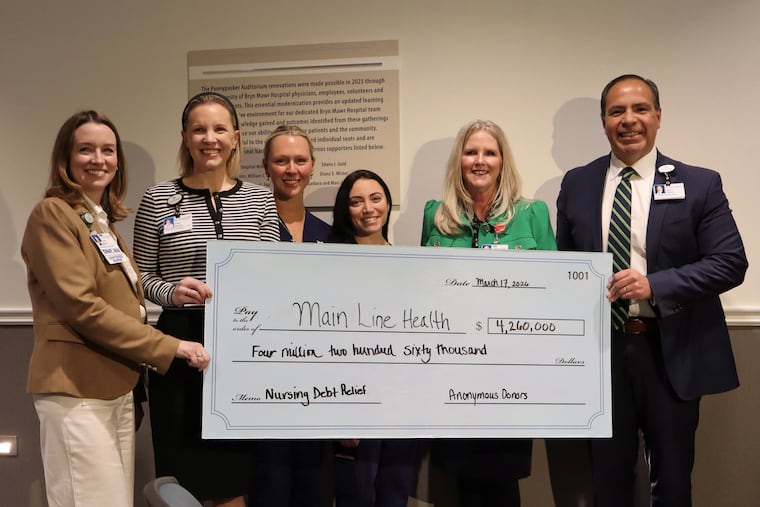
Bryn Mawr Hospital announced this week that it has received $1 million from an anonymous donor to help its nurses pay off student loans — the fourth hospital in the nonprofit Main Line Health system to receive such a donation in the last year.
The donations began in summer 2025, when a longtime Lankenau Medical Center patient anonymously contributed $1 million toward student loan payments for nurses at the Wynnewood hospital.
Then, another donor read an Inquirer story about the contribution and sent $1 million to nurses at Paoli Hospital. Late last year, the original Lankenau donor was so moved by thank you letters from nurses that they decided to contribute another $1 million to the hospital.
Early this year, an anonymous donor sent $260,000 toward nurses’ student loan costs at Riddle Hospital in Media. Most recently, the nurses at Bryn Mawr hospital received a similar $1 million donation.
Every acute-care hospital in the Main Line system has now received a donation to offset student loan costs for its nurses — a total of $4.26 million worth up to $3,600 each to 706 nurses.
“Without the coverage [the Inquirer] did in 2025, I am confident this ripple effect would not have happened,” said Karrie Borgelt, Main Line’s senior vice president for development, noting that the only hospital in the system that has not yet received a donation toward nurses’ student loans is Bryn Mawr Rehab Hospital.
“It’s very contagious — donors get motivated by other donors. It was really the power of our community and the philanthropists in our community who care about community healthcare.”
‘It feels like I can take a breath’
Bryn Mawr surprised its nurses on Tuesday with news that all of the 173 eligible nurses who applied for the program received a grant. (Payments were capped so the nurses could avoid paying additional taxes.)
“Whoever did this — it’s such a nice act of kindness,” said Bianca Abate, an emergency room registered nurse. “It feels like I can take a breath.”
Abate has been a nurse for six years and owes $30,000 in loans. At first, taking on debt was overwhelming, she said. But Abate was certain she was meant to become a nurse — and is motivated by the patients she meets in the ER.
“I enjoy all my patients. Every one has a different story,” she said. “It’s tough work, you’re doing a lot, and it’s very rewarding. It truly is.”
Nurses often take on substantial amounts of debt for their studies. Main Line Health officials cited a study in Health Affairs Scholar that surveyed Michigan nurses in 2022 and found that their median loan balance was $30,000. Some had more than $100,000 in student loan debt.
Still, many nurses willingly take on the burden.
“I think what unites all of us that work in healthcare — certainly the nurses — is their commitment to making sure they provide care to patients,” said Borgelt, who leads Main Line Health’s fundraising efforts. “It’s a selfless act they do.”
A life-changing grant
Allyson Smyth, a registered nurse in the neonatal intensive care unit, has a special connection to the hospital: She was born there in 1995 and was treated in the NICU with her twin brother, William. The two were delivered at 26 weeks; William died at one day old. “He’s my little guardian angel,” Smyth said.
Smyth spent three months in the NICU and grew up hearing positive stories from her parents and grandparents about the care she received at Bryn Mawr.
“They called me a miracle baby. It wasn’t a direct line to becoming a NICU nurse, but it probably shaped my philosophy growing up,” Smyth said.
Growing up in a big family, she knew she wanted to work with children and got a job in the Bryn Mawr NICU after graduating from nursing school. Some of her colleagues on the floor had treated her as a baby.
“It’s such a special place. To be able to work with some of the doctors and nurses that still work there over 30 years later is remarkable and speaks to culture we have in our unit and hospital and health system,” she said.
She takes pride in trying to ease the worries of families with premature babies, so they can get to “a place of learning and joy and confidence.”
Smyth, too, had tens of thousands of dollars in student loans that she worked to pay off over the years. The Bryn Mawr donation came at just the right time: It’s almost enough to pay off her last remaining debt.
The loan, she said, “was always in the back of my mind; $3,600 is definitely a life-changing amount of money for most people. I feel super lucky and blessed.”