Pennsylvania health officials address measles outbreak: ‘We will not slow down until this ... is over.’
Vaccination is the best defense against the highly contagious disease, health officials stressed at a Friday news conference in Lancaster.
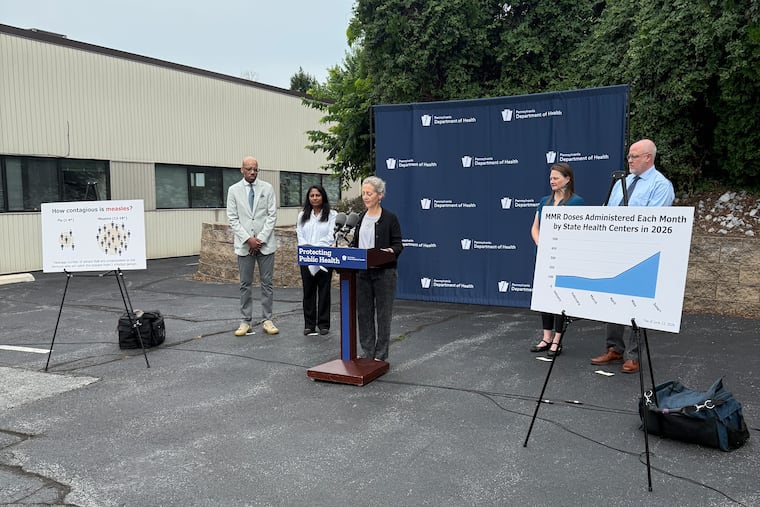
Pennsylvania health officials and doctors on Friday said several people have been hospitalized amid a growing measles outbreak that has spread to six counties in the southeastern and central parts of the state.
At a news conference in Lancaster on the outbreak, which has sickened 72 people in the area since April, health officials stressed that vaccination was the best defense against the highly contagious disease.
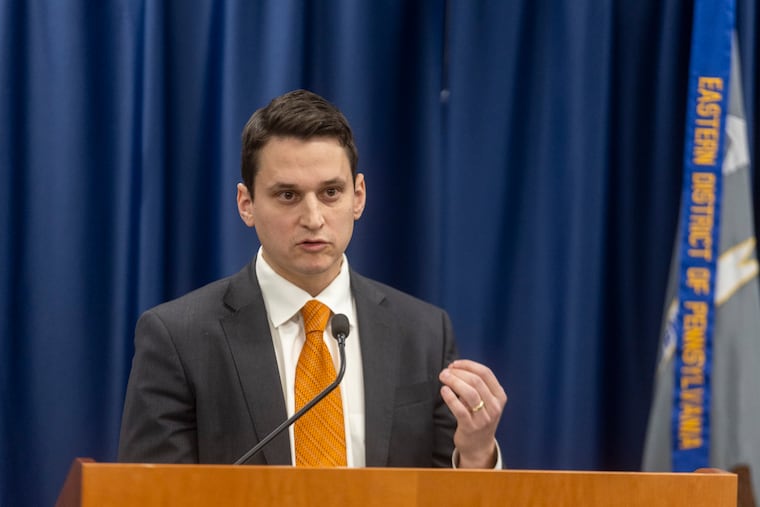
Secretary of Health Debra Bogen said she could not comment on the exact number of people hospitalized to protect their privacy, as the number was still relatively small.
About one in 10 people who contract measles will require hospitalization, and three people were treated at hospitals in Lebanon County at the onset of the outbreak in late April.
Fahmida McGann, an infectious disease doctor at Penn State Health, said the health system’s Lancaster Medical Center has treated patients who needed to be hospitalized for several days with symptoms including serious electrolyte abnormalities and liver and kidney dysfunction.
Measles can infect up to 90% of unvaccinated people who come into contact with the disease, which can linger in the air for up to two hours.
Newborns and young children are at higher risk for serious complications, but adults can also experience them, especially if their immune systems are weakened. Doctors at Friday’s news conference said they had treated both adults and children in hospitals.
The state response
In the current outbreak, state officials have recorded 41 cases in Lancaster County, 20 in Lebanon County, six in Northumberland County, two each in Berks and Dauphin Counties, and one in York County.
Overall, the state has seen 84 measles cases this year, more than five times the cases recorded in all of 2025.
The outbreak is spreading largely among people who are unvaccinated, Bogen said.
“These are not numbers,” Bogen said. “They are children, parents, neighbors and friends.”
The health department is conducting contact tracing to detect cases, and working with local healthcare providers and community organizations to ensure residents have access to vaccines and accurate information on their efficacy and side effects.
Health providers in Lancaster have said they believe there were more cases in the area than officials were aware of. Bogen said the department was working with community members to build trust and ensure that cases get reported.
“People who are part of the community are really the key to the response, because we want people to know that if they call the department, we are here to help them,” she said.
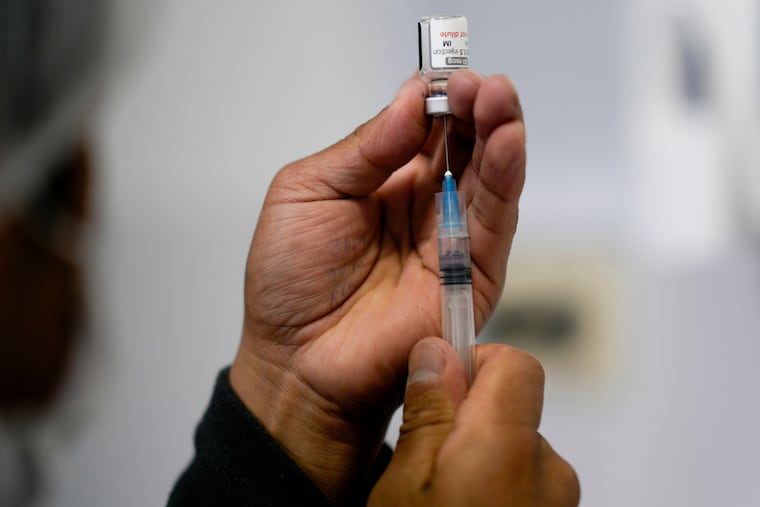
The department has vaccinated more than 430 people at pop-up clinics in the region in the last two months, she said, and state-run health centers around Pennsylvania have administered more than 1,300 measles, mumps, and rubella vaccine doses this year.
“We’re not sitting back and just watching the virus spread,” Bogen said. “We will not slow down until this outbreak is over.”
It’s crucial that residents get vaccinated, she said, to protect people who cannot safely get the vaccine, like newborns and pregnant women, and people whose immune systems are weakened, like organ transplant recipients and cancer patients.
On Wednesday, the department recommended that physicians vaccinate infants and young children against measles early, beginning at 6 months, in affected areas. The same precautions should be taken by families with infants traveling to these areas.
The department has also hosted webinars for hundreds of healthcare providers across the state. Measles was considered eradicated decades ago, and many doctors practicing today have never seen a case, Bogen said.
Jeffrey Martin, a physician at Penn Medicine’s Lancaster General Hospital, said he last encountered a measles case 30 years ago, as a medical student in Colorado.
“I still remember that patient, a child with a high fever, red eyes, and the classic rash we learned about in textbooks. At the time it was an illness we were trained to recognize,” he said. “None of us imagined that one day measles would become so rare that most physicians would go their entire careers without ever seeing a case.”
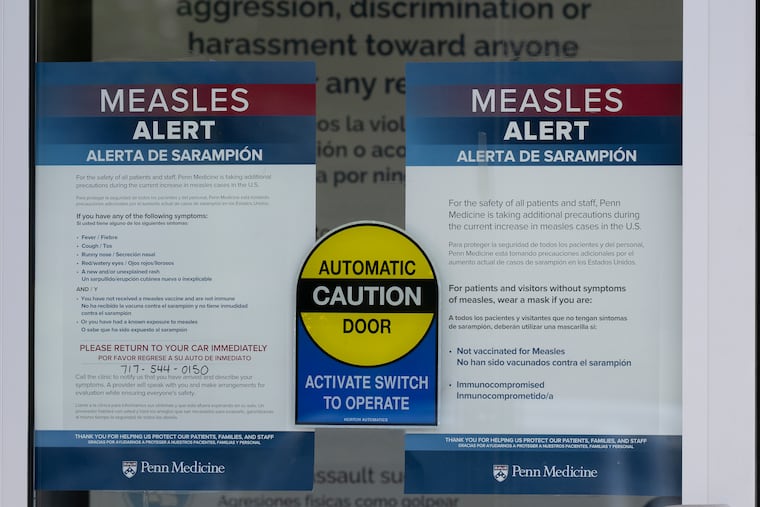
Now, he said, physicians in Lancaster must keep measles in mind when they’re treating patients with respiratory symptoms. The virus’s early symptoms include a fever, a cough, and a runny nose — similar to other respiratory diseases — before patients develop a telltale rash.
“It underscores the importance of being especially thoughtful about how we identify and respond to possible cases,” he said.
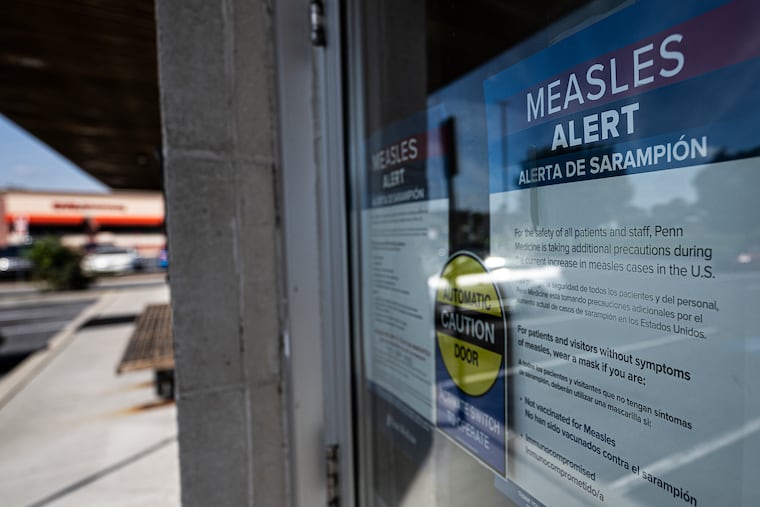
It’s also key for families to call ahead to doctors’ offices if they’re experiencing measles symptoms, so physicians can prepare to treat them without exposing other patients, Martin said.
Lower vaccination rates
Vaccination rates among kindergarteners have decreased across Pennsylvania in recent years, and some counties affected in the current outbreak have particularly low rates, including Lancaster, where about 88.5% of kindergarten students are vaccinated.
Health experts say 95% of a community must be vaccinated to prevent the spread of the disease.
The state is working with schools to increase vaccination rates, Bogen said Friday.
After The Inquirer and the Pittsburgh Post-Gazette published analyses on low vaccination rates at individual schools across the state, health officials announced that they would soon publish a public database of school-level vaccination data. (Previously, the state published county-level vaccination data on its website.)
Bogen said she hoped the new database would encourage schools with lower vaccination rates to reach out to healthcare providers to ensure students have access to vaccines.
“We want to make sure as a public health department that we’re ensuring that anybody who wants access to a vaccine has that,” she said.
Encouraging vaccination
Martin, the Lancaster General physician, said the area was welcoming and helpful to people in need.
“It is a defining characteristic of our community to help others, especially the most vulnerable, during times of crisis,” he said.
Residents now have an opportunity to help protect vulnerable people from measles by getting vaccinated, raising awareness about the disease, and helping doctors decrease exposures in care settings, he said.
“When vaccination rates are high, the virus has very little opportunity to spread. When gaps emerge, even small ones, measles can find a way back in because it is so contagious,” Martin said. “Ultimately what keeps measles rare is not luck. It’s the choices we make together to protect those who cannot protect themselves.”