Passional Boutique on South Street gets warning letter from FDA for selling breast binders for gender-affirming care
Passional Boutique on South Street sells breast binders, mostly to trans men, online and at the store. The FDA says the store is violating its regulations because it's not registered to sell them.
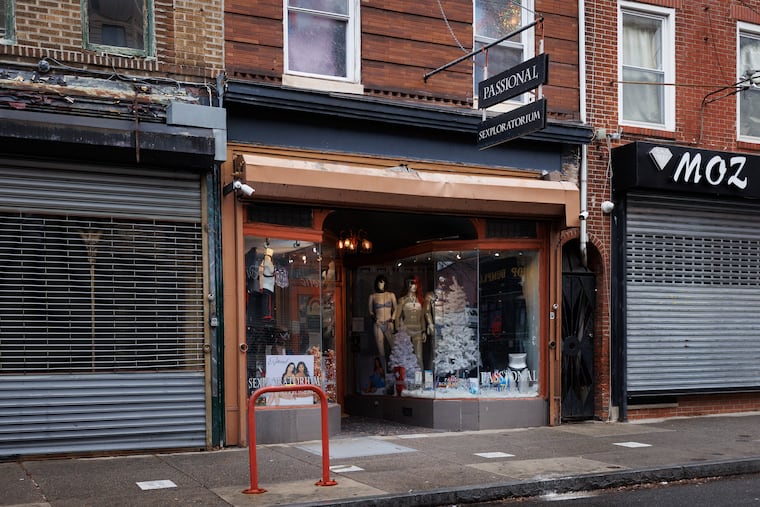
Passional Boutique & Sexploratorium displays mannequins in leather handcuffs, vibrators, and posters of women in lingerie in its storefront windows along one of Philadelphia’s main shopping drags.
But the adult store — a South Street staple of fetish and fantasy fashion and sex toys for about two decades — is now under scrutiny by President Donald Trump’s administration for selling an undergarment tucked away on the shop’s second floor: breast binders.
On Dec. 16, the U.S. Food and Drug Administration sent a warning letter to Passional stating it was illegally selling breast binders. Most purchasers are trans men — individuals who are assigned female at birth but identify as male.
The FDA classifies breast binders, which compress chest tissue, as a medical device. Businesses that distribute them in the United States must be registered with the FDA or face fines and other enforcement action.
Passional’s operations manager, Ashly Booth, said it’s “a paperwork issue” that pertains to the overseas manufacturer, not to the Center City retailer. Passional will continue to sell those breast binders in its store but not online, she said.
The FDA’s warning sparked outrage within the region’s transgender community.
Naiymah Sanchez, 42, who described herself as “a proud woman of transgender experience,” said she believes the Trump administration wants to ban gender-affirming care for everyone, not just children and teens.
Breast binders can help treat gender dysphoria, a medical condition in which a person’s body does not match their gender identity.
“This is an adult store, so now you’re attempting to restrict our access — adult access — to the things we need so that we can exist‚" said Sanchez, a senior organizer for the ACLU’s Pennsylvania chapter. “They are trying to double down on making it illegal to be trans in the United States.”
Protecting ‘children’?
Passional was one of only 12 businesses across the nation and overseas, including companies in Singapore and the Netherlands, that received a warning letter. All 12 companies sell, distribute, or manufacturer breast binders to buyers in the United States, primarily through online sales. They included Seattle-based Tomboyx, which uses the tagline “Be Exactly Who You Were Born to Be — No Apologies," and Manhattan-based For Them, a queer and trans-owned company.
The language in each FDA letter was largely boilerplate.
During a Dec. 18 news conference, FDA Commissioner Martin Makary said the 12 companies were illegally marketing breast binders for children as treatment of gender dysphoria.
“Pushing transgender ideology in children is predatory, it’s wrong, and it needs to stop,” Makary said.
However, none of the violation letters specifically mention children or marketing of breast binders to minors. The FDA declined to comment Friday, referring a reporter to the letter sent to Passional.
Passional employees said they do not market breast binders to minors. Customers must be 18 or older to shop there. A teen may enter and try on a breast binder, but only when accompanied by a parent or guardian, they said.
Makary’s comments were part of a Trump administration announcement of proposed rules to cut off federal Medicaid and Medicare funding from hospitals that provide gender-affirming care to children. The administration wants to restrict the use of puberty blockers, hormone therapy, and surgical interventions for transgender people under the age of 18.
“It’s based on a medical dogma, sadly, that the normal, sometimes stressful experiences of boys and girls growing up is a pathology that requires medical intervention,” Makary said.
Several states have prohibited gender-affirming care for minors, but it remains legal in Pennsylvania, New Jersey, and Delaware. The American Academy of Pediatrics and other major medical associations, citing research, widely accept such care as safe, effective, and medically necessary for the patients’ mental health.
Makary said breast binders are a “Class 1 medical device” designed to help women recover from cancer-related mastectomies.
“These binders are not benign,” he said. “Long-term usage has been associated with pain and compromised lung functions.”
‘A paperwork issue’
Passional carries a line of breast binders distributed by UNTAG, originally Trans-Missie B.V., a company based in the Netherlands. UNTAG says on its website that “chest binding plays a vital role in reducing gender dysphoria” and it offers “kids binders.” Passional does not sell child sizes.
“We offer a selection of domestic and imported binders from sizes XS through 3XL,” Passional’s website says. “Whether you are binding for gender identity, cosplay, drag performance or nonsurgical body sculpting, we offer a range of styles and price points to help you achieve your desired expression.”
Under FDA regulations, manufacturers and distributors of Class 1 — generally meaning low risk — medical devices must register annually with the government. The regulation is designed to help the FDA track devices and quickly respond to safety concerns or recalls.
The FDA defines medical devices, including breast binders, as “intended for use in the diagnosis of disease or other conditions or in the cure, mitigation, treatment, or prevention of disease, or to affect the structure or any function of the body.”
The FDA issued warning letters to both Passional and the Dutch company. The letters say separate government reviews of Passional and UNTAG’s websites found “various breast binders for sale” with claims to help “reduce gender dysphoria” in violation of the Federal Food, Drug, and Cosmetic Act.
The letters gave each 15 business days to respond and provide corrective measures.
In an email to The Inquirer on Wednesday, UNTAG, based in Amsterdam, replied that it would keep a reporter informed of any next steps.
Booth, Passional’s operations manager, said the regulations do not apply to in-store retail sales. However, Passional will stop selling UNTAG breast binders on its website, she said.
“One specific producer of the binders that we have here in Passional now did not register themselves as a medical device company,” Booth said. “It was more of a paperwork issue on the side of the manufacturer.”
Passional, she added, would not pull breast binders from its brick-and-mortar store “for the simple fact that there is a need for them.”
Teens need parental consent
Passional customers must be 18 or older to enter the store. Employee Aizlyn Kraus said she will ask for identification if a patron looks under age.
However, teens who want to get fitted for a breast binder and possibly purchase one may come in, but they must be accompanied by a parent or guardian. In those cases, Passional temporarily closes the store so the teen can quickly get upstairs, where there’s a dressing room. Typically, parents call or email ahead of time to set up an appointment, according to Kraus and Booth.
“We can get them up there without them seeing anything they don’t need to see, without them knowing anything they don’t need to know, and they walk out with something that helps them in their lives,” Kraus said.
Kraus, who is transgender and identifies as a woman, said “dysphoria affects everyone differently. Some people know at a really early age and when they begin to go through puberty, it’s really distressing. There are so many trans kids who either think about self-harm or engage in self-harm. It’s disheartening.”
In the last six months, “two or three parents” have come in separately with their teens to try on breast binders, Booth said.
Kraus said Passional does not market or advertise breast binders to minors, and the majority of purchasers are adults. Passional employees are trained how to properly fit people in breast binders, making sure they are not too tight and advising customers not to wear them for longer than eight hours a day.
Kraus, 33, said breast binders offer an alternative to top surgery. “It’s a whole lot cheaper and easier to do, rather than just jump right into surgery,” Kraus said.
Passional, known for its queer and trans inclusivity, sells many items to help people “feel better about their body,” including waist-tightening corsets, penis “extenders,” and “tucking” or “gaff” undergarments to minimize penile bulge — all forms of gender-affirming care, Kraus said.
Kraus added that some men with gynecomastia, or an enlargement of breast tissue in males due to hormone imbalance, will buy breast binders.
‘It’s just insane’
Prior to undergoing top surgery, 34-year-old Simon Parsons wore a breast binder for a flattened appearance, likening it to Spanx body-sculpting wear.
Parsons, who identifies as a nonbinary transgender Philadelphian, said: “This is going to create a chilling effect for anyone who needs a breast binder. It’s all just to open the door to eventually say, ‘Trans people are not allowed to exist.’”
Parsons said after breast-removal surgery, the hospital provided a chest compression vest to reduce swelling, but it looked nothing like the ones sold by Passional. It had a padded front zipper and Velcro shoulder straps for easy release.
Passional’s breast binders look like sports bras or nylon crop tops.
Parsons and others described the FDA action as a government overreach at best and erosion of civil rights at worst.
“It’s just insane,” said Corie Bosman, 34, of Bensalem.
Bosman, who is nonbinary transgender and whose stage name is “Mister Right,” has worn breast binders while performing as a drag king. Bosman was the 2025 winner of Mr. Philly Drag King, or Mr. PDK, a pageant-style competition organized by the Philly Dyke March.
Bosman and Parsons, who had purchased their breast binders online, said they are concerned that transgender people, especially minors, will resort to potentially harmful practices, like binding their chests with duct tape, if the Trump administration restricts access to breast binders.
“It opens up the window for people to hurt themselves by just trying to be themselves,” Bosman said.
