In frigid temperatures, service providers work to get Philadelphians out of the cold
The city's "Code Blue" designation has opened additional shelter beds, warming centers, and other resources.
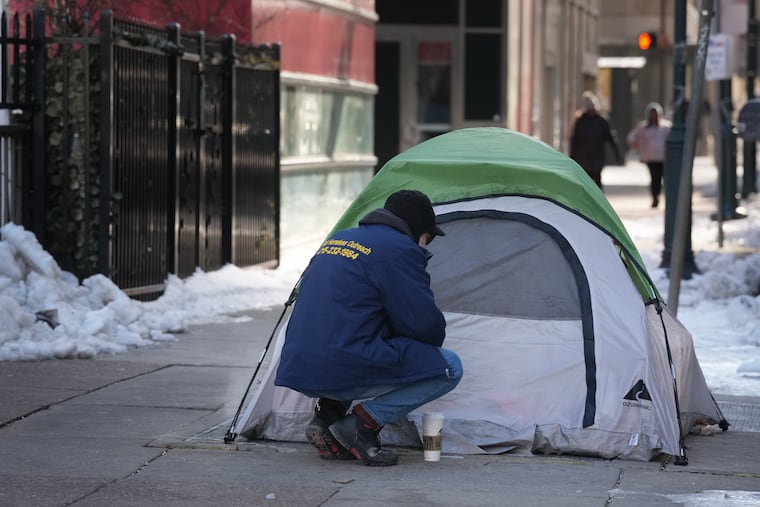
As Philadelphia endured another day of historically frigid temperatures, outreach workers on Friday fielded hundreds of calls for shelter as warming centers filled with people seeking respite from the cold.
In the mazelike concourse at Suburban Station, a Project HOME outreach worker hugged clients and encouraged them to head inside.
At the Hub of Hope, the nonprofit’s drop-in center in the concourse for people experiencing homelessness, dozens lined up for hot meals. Later that night, as they had for the last several days, staff would set up cots for up to 80 people with nowhere else to go.
Typically, the Hub closes in the early evening. But amid the ongoing freeze, it’s open 24-7 as city officials and homeless services providers work to keep vulnerable Philadelphians safe.
Last month, the city declared a “Code Blue,” a designation that opens additional shelter beds and other resources. Ever since, the nonprofit’s hotline has fielded more than 6,000 calls, an average of more than 500 a day.
Normally, it receives about 140 a day.
“Many calls are concerned citizens who see someone who is homeless and want a team to go and check on them. Some are people who are literally homeless right now and need a place to go. Some are facing eviction and scared, reaching out for their options,” said Candice Player, the nonprofit’s vice president of advocacy, public policy, and street outreach.
“The extreme cold challenges us and pushes us even harder.”
City officials navigate a lengthy cold snap
When the wind chill makes it feel like it’s 20 degrees outside or lower for more than three days, the city can declare what is called an enhanced Code Blue. The distinction opens up further resources, including daytime and nighttime warming centers.
Cheryl Hill, executive director of the Philadelphia Office of Homeless Services, describes these periods as an all-hands-on-deck situation. Hill said that “every city entity can be outreach” during this time, and that work can also be aided by members of the public, who have been quick to call for help.
“We are all basically helping our neighbor, in essence — we see them out on the street, we want to help,” Hill said. “As a result, outreach is getting a lot more calls to go and check on those individuals.”
Philadelphia declared an initial Code Blue on Jan. 18 and an enhanced Code Blue on Jan. 20.
The city has about 3,500 shelter beds, which can become open as people get placed in longer-term housing.
If the beds reach capacity, the city has additional overnight spaces at warming centers, primarily in recreation centers. People who spend the day at warming centers that close overnight can receive transportation to a nighttime center.
People who need a ride to a warming center can ask for transportation at their local police district, city officials said.
On average, the overnight warming centers have provided shelter to about 300 to 400 people across the city per night. Last Monday night, after 9.3 inches of snow had blanketed Philly, warming centers sheltered just shy of 450 people.
Last year, peak usage of warming centers hovered around 150 people, Hill said.
Still, helping the city’s most vulnerable off the streets can be difficult even in the best of circumstances.
On Friday afternoon, a sign posted at the South Philadelphia Library informed people visiting to get out of the cold that they could eat and sleep in a section designated as a warming center. Librarians and community support groups collect and provide snacks, along with hand-warmers and other essentials, for those who need them.
Even so, only a handful of people sat in the area. A woman yelped in pain as she rubbed a blackened toe. Children played with blocks in another corner of the library as others checked out books.
The homeless services office tries to have medical staff at warming sites, but more serious cases get sent to the hospital.
In extreme cold, as a last resort, people with serious mental illnesses who refuse to come inside and are underdressed could be involuntarily committed.
Homeless services providers said they are working around the clock to care for clients exhausted by the struggle of simply staying warm.
“The experience of being homeless in this brutal cold is awful, and the folks who come in are just worn down,” Player said.
At shelters run by the Bethesda Project, staff are trying to keep residents’ spirits up and encouraging them to stay inside as much as possible, said director of shelter Kharisma Goldston. “One of our guests was doing haircuts last night,” she said. “We try to do a lot so guys don’t feel like they’re trapped inside.”
Staffers set up additional beds to accommodate more clients, she said.
“We do our best to set up however many beds we can,” she said. “When it’s this cold, it takes a very short amount of time for hypothermia to set in.”
Rachel Beilgard, Project HOME’s senior program manager for outreach, said that outreach teams have encountered several people suffering from frostbite who were involuntarily committed. Some, she said, risked limb amputations if they had stayed outside any longer.
But many people who typically refuse offers for shelter from outreach teams are now accepting help, Beilgard said. “We’ve had a lot of folks this winter who say, ‘Once it starts snowing, come find me,’” she said.
New data show rise in homelessness
Amid the cold snap, the city released new data from its annual point-in-time count that suggest homelessness rose between 2024 and 2025, even as the New York Times reported homelessness had dropped in several other major cities.
The count, taken every year at the behest of federal housing officials, happens over one night in January; city workers and volunteers fan out across the city to physically count people sleeping on the street and those in shelters. Federal officials use the count to gauge funding allocations, and city officials look to it to understand the needs on the streets.
The Jan. 22, 2025, count was also taken during a Code Blue, although temperatures were not as frigid as they were last week. It found that homelessness rose by about 9% between 2024 and 2025, after a 38% jump the year before. In Kensington, the number of homeless, unsheltered people dropped by about 17%.
The number of people experiencing chronic homelessness rose by 49%. This is a designation tightly defined by the federal government as a homeless person with a disability who lives in a shelter or in a place that is not meant for habitation, and who has been homeless for a full year, or homeless at least four times in the last three years for a total of 12 months.
The category also includes people who fit these criteria but have entered jail, rehab, or another care facility in the last three months. Most of Philadelphia’s chronically homeless residents were living in emergency shelters.
City officials and providers said a number of factors likely contributed to the increase.
People with substance use disorder and mental health issues are vulnerable to becoming chronically homeless, especially in Philadelphia, where a toxic drug supply causes wounds and intense withdrawal that keep many from seeking shelter. But a lack of affordable housing, low wages, job loss, or a major health issue can also put residents at high risk for homelessness, stressed Crystal Yates-Gale, the city’s deputy managing director for health and human services.
Hill also said that in recent years, Philadelphia has lost bids to receive competitive housing funds from the federal government.
“We’ve been working really intentionally to make sure that our programs will get funded” in the future, Hill said.
Yates-Gale also pointed to Mayor Cherelle L. Parker’s December executive order directing city officials to add 1,000 beds to the shelter system by the end of January. As of last week, the city had added 600 winter shelter beds that are crucial during the enhanced Code Blue and will eventually become available year-round, she said.
Anecdotally, neighborhoods have reported decreases in homelessness since last year, Hill said, although officials will have to wait until February to conduct the count this year.
The count had originally been set for Wednesday, but the city canceled it due to the cold — and because too many outreach staffers were at work getting people inside.
Editor’s note: This article has been updated to reflect that library staff and supporters provide people using daytime warming centers with snacks.