Selling blood plasma for money is becoming a side hustle as more Philadelphia-area residents try to make ends meet
How much you make depends largely on your weight and the volume of plasma extracted. Some donors can make an extra $500 or more each month if they sell their plasma twice weekly.
Maleka Evans waited outside Octapharma Plasma in South Jersey at 8:30 on a recent sweltering morning, sweat beading on her face. A dozen other prospective donors had arrived before her, and the line was still growing a half hour before doors opened.
One woman sat on an overturned shopping cart pilfered from the nearby Walmart. Another brought her own folding chair. A man held a bicycle tire, removed to protect his bike from being stolen once he was inside and hooked up to a machine that extracts antibody-rich blood plasma needed for medical treatments.
Every Monday and Friday for the last three years, Evans has trekked to the Audubon strip mall for what she considers her second job. She takes a 45-minute bus ride from her Willingboro home to Camden, then walks another 45 minutes to the donation site with a slogan posted in its window: “When it pays to give hope. That’s plasmagic.”
The 37-year-old single mom has noticed the lines growing in the last year, as others are seeing at donation sites elsewhere in the Philadelphia region and across the nation. The for-profit business is booming as more and more Americans, both poor and middle class, struggle to straddle the gap between stagnant wages and increased living costs.
Evans relies on the $50 that she typically earns for each plasma donation — loaded onto a prepaid debit card — to help with bills that she cannot cover with her $18-per-hour job packing boxes at a warehouse.
“Prices for everything — food, rent, transportation, electricity — are just getting higher and higher,” Evans said. “You have to work two jobs to make ends meet, and you’re still living paycheck to paycheck.”
The U.S is one of about a dozen countries where it is legal to pay donors for plasma. It is among only three countries where people are allowed to donate two times over seven days, though not on back-to-back days, per U.S. Food and Drug Administration regulations.
Nearly 70% of the world’s plasma comes from donors in America, fueling a multibillion-dollar global industry. Plasma, a straw-colored liquid in blood, contains antibodies and other proteins used for treating a wide range of patients with immunodeficiencies, neurological conditions, kidney disease, and bleeding disorders.
Last year, U.S. donors produced 62.5 million liters of plasma — the highest volume ever collected and an 8% increase from the previous year. That trajectory has continued into this year, according to Georgetown University professor Peter Jaworski.
Plasma donation has become a side gig, like driving for Uber or DoorDash, said Jaworski, who studies the global economics and ethics of the plasma industry.
He characterized it as a “shadow safety net.”
“When the price of most staples goes up, so does the amount of plasma donations,” Jaworski said. “If I fell on hard times, the very first thing I would do is become a regular plasma donor.”
» READ MORE: How plasma donors rescued a Philly-area man with a rare disease
An extra $520 a month
Donating plasma is widely considered low-risk, with millions of people doing it each year without reported health problems. However, the long-term health effects of donating twice weekly for years have not been well-studied. Safety concerns raised by the deaths of two people in Canada who had recently donated at for-profit clinics run by the healthcare company Grifols have prompted an investigation there.
In the U.S., an FDA investigation into 34 deaths of people who had donated plasma between 2016 and 2020 did not find a link between donations and fatalities.
Some donors experience lightheadedness, fatigue, bruising, bleeding, or dehydration. Drinking water and eating foods high in iron and protein can help alleviate those side effects, according to U.S. health guidance.
Security guard Danny Morales of North Philadelphia said he feels “tired” after donating. But that has not deterred him from heading to CSL Plasma in the city’s Olney neighborhood twice a week, as soon as he finishes his overnight shift at 6 a.m.
Morales can earn $520 a month donating plasma, which helps to offset rising expenses that have the 35-year-old father feeling ever more drained: The cost to fill up his Honda Civic’s gas tank jumped from $30 to $80 in the last year; a package of ground beef increased by $8; and even the brand of mac and cheese that his 8-year-old daughter and 2-year-old son enjoy costs about $1 more, he said.
“It’s just getting worse and worse,” said Morales, whose plasma donations supplement his $18 hourly security job wage. “Stuff is just getting so expensive. Groceries are ridiculous.”
CSL opens at 6 a.m., but a line starts to form around 4:30 a.m. In late July, it snaked past the building, wrapping around the corner. The sight caught the attention of nearby Olney resident Tony Reed.
“There’s always a line there, especially toward the end of the month and definitely on Monday mornings,” Reed said. “People are broke.”
Inside the booming industry
On a recent Wednesday afternoon at B Positive Plasma in Montgomery County, a steady stream of donors checked in at kiosks in the lobby.
After filling out an extensive health history questionnaire, each new donor undergoes an on-site medical exam by a licensed practical nurse. Repeat donors must get annual exams. At each visit, a medical tech checks their vitals, including blood pressure, pulse, and temperature, and performs a finger prick to test their blood for protein and iron levels. Donors must weigh at least 110 pounds.
“We make sure they’re healthy and well,” said Ben Ruder, founder and CEO of B Positive Plasma, noting that the plasma itself is tested for HIV and hepatitis B and C before being sold.
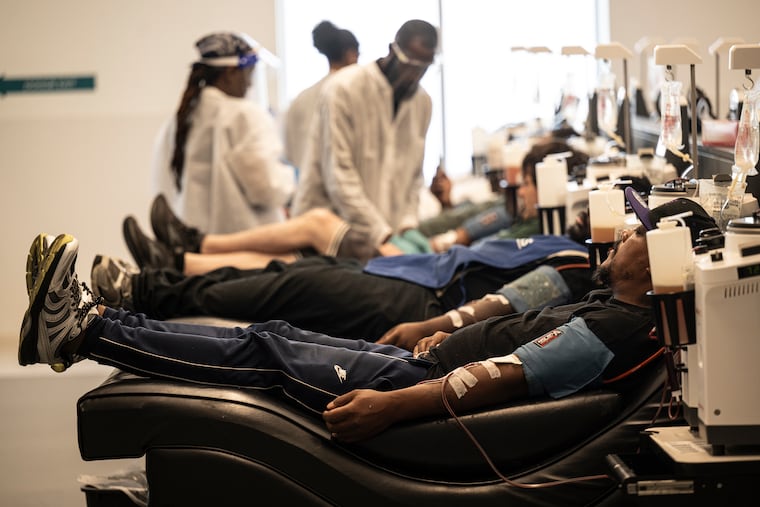
Next, plasma donors are hooked up to a machine that draws out blood, spins off the plasma, and then returns the red blood cells back to the donor, a process that typically takes 45 minutes to an hour.
At 2 p.m., 18 of the 24 cushioned recliners at the Wyncote location on Cheltenham Avenue were occupied by donors, each with a needle in one arm. They included a Philadelphia police officer who had donated more than two dozen times since May 2025; a casino cleaner who earns $120 a week donating to support his young daughter; and a home health aide who donates twice a week to help cover his $750 monthly apartment rent.
Plasma donation differs from whole blood donation, a faster process that relies on unpaid volunteers who can donate only once every 56 days in the U.S.
B Positive Plasma is on track to see a record year, with 180,000 donations, peaking this holiday season, when people need extra money for gifts. Last year, the company saw 150,000 donations at about 1 liter per person.
Ruder, 42, who lives in Center City, opened his first plasma donation center in Cherry Hill in 2012 and rapidly expanded to 12 locations in New Jersey, Pennsylvania, and Delaware. He plans to open two more sites in Maryland next year and another in Allentown later this year.
B Positive Plasma, like other plasma companies, structures payments to incentivize twice-weekly donors. For instance, donors whose weight and physical health yield the maximum amount of plasma — 1,001 to 1,200 milliliters — will receive $45 for the first visit and another $90 if they return that same week. Plus, the company offered a $50 bonus for anyone who donated eight times in August.
Phlebotomist Donyele Wilkins works 12-hour shifts, four days a week, at B Positive Plasma.
For Wilkins, the paycheck is not the only benefit of working there.
The 48-year-old Northeast Philadelphia resident suffers from lupus, an autoimmune disease in which the body’s immune system attacks its own tissues and organs. Wilkins said she relies on plasma-derived medication, infused through an IV every four to five months, to help control symptoms like inflammation and joint pain.
Knowing how plasma is processed makes her feel “safe,” she said. She also likes getting to know “the regulars” who donate.
“It makes me feel like I know exactly where it’s coming from, and I know the people who are doing it,” Wilkins said. “A lot of them really need the money, so they’re helping me, on top of me helping them.”
‘Blood money’
Paying donors for plasma has sparked ethical debate, with some accusing the industry of exploiting poor people.
In her 2023 book, Blood Money: The Story of Life, Death, and Profit Inside America’s Blood Industry, Kathleen McLaughlin, a Montana-based journalist, found that donors in many U.S. regions are disproportionately Black and brown people.
McLaughlin, who has a rare autoimmune disease treated with monthly plasma-derived infusions, said today’s rise in donations is “a symptom of our broken economic system.”
While the FDA regulates health safety at plasma centers, the pay rate is set by the companies, McLaughlin found. She thinks donors should be paid more and the amount should be standardized.
“Right now, it’s a capitalist free-market system, where the pricing isn’t transparent,” McLaughlin said. “The profit margins are crazy for these plasma companies, and it’s gamified to make you donate twice a week, every week, in perpetuity.”
Jaworski, the Georgetown University professor, said donors are compensated fairly. A donor who sits for an hour and a half makes “significantly more than” New Jersey’s $15.92 minimum hourly wage and Pennsylvania’s $7.25. Plus, he stressed, donors save “hundreds of thousands of lives.”
Recently published research suggests that communities can benefit when a new plasma center opens, because fewer young people take out high-interest payday loans and area crime drops, mostly driven by decreases in property and drug-related offenses.
“It helps you from having to do something wrong,” plasma donor Wallace Smith said.
When Smith was in his late 20s, he got arrested for selling drugs. Now 45, he is still struggling to find a job that pays a living wage, he said.
Smith, of Upper Darby, works three days a week, earning $15 an hour, as a home health aide. He earns $130 a week donating plasma, which helps pay for cigarettes, his phone bill, and rent, he said.
Like many donors, Smith said he likes the win-win of earning extra cash and helping patients who depend on plasma.
“They say there’s a job’s out here for everybody, but when you become a person who made mistakes in life, then they look at your background, so there’s only certain jobs you can do,” Smith said as his blood flowed into a spaghetti-thin clear tube at B Positive Plasma.
“With that being said, you don’t go back to your old ways,” he said. “You find better resources like this.”
Beach boardwalk fun
At Octapharma Plasma in South Jersey, the wait time can be as long as three hours, donors said. When a sewer pump broke and bathrooms stopped working earlier this year, the company trucked in a row of porta-potties to accommodate donors and staff.
On a recent August morning, Brittany Barr, 36, and her three sons — 5-year-old twins and a 6-year-old — waited outside Octapharma as her husband donated. The family had walked roughly two miles from their Gloucester City home.
When Barr learned her friend had kidney failure and needed plasma infusions, she wanted to help. Barr was unable to donate plasma because she is anemic, so her husband agreed to do it.
In the month since Barr’s husband started donating, the family has earned more than $500. It has helped with groceries and their phone bills to supplement her husband’s income as a shipping manager.
“With only one income, money is tight these days,” Barr said. “Everything is messed up.”
The boys, clad in their bathing suits, climbed up on Barr as she sat on a tipped-over shopping cart. They were headed next to Atlantic City for a beach day.
“This week, the money is going toward fun. They’re going to play arcades and have ice cream or whatever their little hearts desire,” Barr said. “Next week, it’s going to school supplies.”
