Federal substance abuse and mental health grants were cut and then restored with little explanation
SAMHSA abruptly rescinded funding for thousands of grants dealing with mental health and addiction treatment late Tuesday with little explanation.
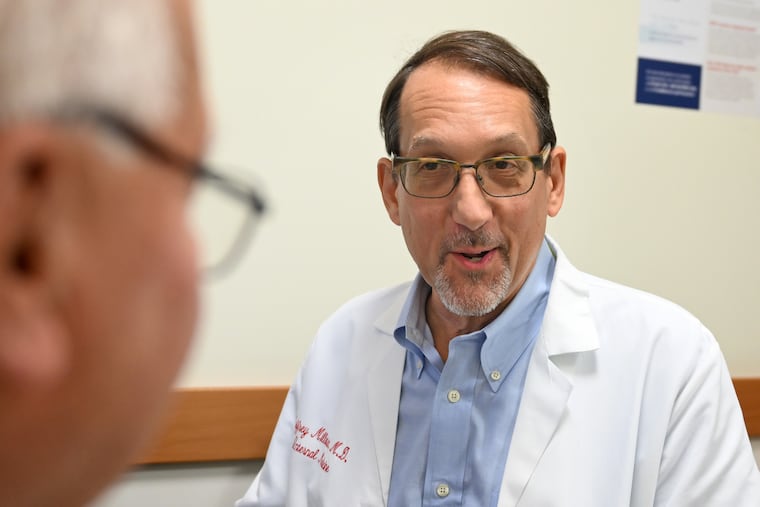
Physicians Zsofi Szep and Judy Chertok have spent the last three years working to connect Penn Medicine patients with addiction treatment — with the help of a federal grant that they learned was terminated in a form letter Tuesday.
They rushed to find a way to keep caring for their patients, many with HIV or hepatitis C and needing supports such as housing and food after treatment. The salaries of two staffers helping to connect people with such resources had been entirely grant-funded.
“To stop this from one day to the next was obviously devastating,” Szep said. “It’s not possible to stop patient care. We continued to do what we were doing.”
The Substance Abuse and Mental Health Services Administration had abruptly rescinded funding for thousands of grants dealing with mental health and addiction treatment, only to reverse itself a day later with little explanation.
NPR reported that some $2 billion in grants were cut off, and grantees like Szep and Chertok received form letters that said only that their projects no longer aligned with agency priorities.
The move sparked immediate outrage from providers and legislators alike. U.S. Rep. Madeleine Dean (D., Montgomery) helped marshal 100 congressional representatives to sign a bipartisan letter to Health and Human Services Secretary Robert F. Kennedy Jr., demanding the funding be restored.
By Wednesday night, it had been, The Associated Press reported — still with little explanation from federal officials. HHS did not return a request for comment Thursday. The agency also declined to answer questions about the reasons for the rescissions from The Associated Press.
But providers at the programs affected by the whiplash of rescinded, then restored, funding said they were shaken by a chaotic 24 hours and worried about what the move signaled.
Since President Donald Trump took office last January, his administration has fired thousands of federal workers and attempted to slash federal grants at unprecedented levels, creating chaos among researchers, health providers, and nonprofits.
As of late Thursday, one Philadelphia provider who receives SAMHSA grants said she had not yet received notice from the agency that funding had been restored.
“It’s a message that what we’re doing is not important,” said Barbara Schindler, the medical director of the women’s addiction treatment program Caring Together.
“The people that work day to day on the front lines, we’re dealing with folks that are living on the edge and need all the help they can get. To feel like your rug can get pulled out from underneath you at any one point, both as a provider as well as a participant, is very upsetting.”
Uncertainty amid attempted cuts
It’s unclear how many programs in the Philadelphia area were affected.
Gaudenzia, an addiction treatment provider with locations across Pennsylvania, Maryland, and Delaware, had grants rescinded, then restored, that were related to expanding treatment access, addiction prevention, and support services, a spokesperson said.
Gaudenzia’s president and CEO, Deja Gilbert, said she understood the need for “fiscal responsibility at the federal level,” but funding changes should be made in collaboration with providers.
“Abrupt funding actions — even when reversed — create uncertainty for providers and the people we serve," she said in a statement.
Szep and Chertok’s program at Penn, which has served about 125 patients over the last few years, is aimed at some of the health system’s most vulnerable patients, connecting patients in the hospital or outpatient clinics with addiction treatment.
“It’s a very sick and complicated group of patients, who are specifically referred to an extra-specialized team,” Chertok said.
They were relieved when their funding was restored on Thursday but remain worried about the future.
“So many other people have similar grants in our city through SAMHSA — the amount of people that are getting care through these types of programs is really dramatic, and we don’t have other ways of getting them care,” Chertok said.
Schindler, a professor of psychiatry and pediatrics at Drexel University, said SAMHSA funding through two grants allows her 36-year-old clinic to support medication for women with opioid use disorder and a reentry program for women incarcerated for drug-related crimes.
“It allows us to have more addiction counselors and staff that can address the incredible needs these ladies have,” she said. “It really enhances the program.”
She said she was “on pins and needles” waiting to hear that her funding had been restored.
‘Incompetence and cruelty’
Dean said she learned of the cuts when a staffer pulled her aside to share a news article, reporting that SAMHSA had abruptly rescinded $2 billion in funding from more than 2,000 grants. Almost immediately afterward, the head of a Pennsylvania network of addiction treatment providers called her.
They began working to determine how many local grants had been affected, an effort that’s still ongoing.
“Immediately, what I thought was, this will cost lives. People will die as a result of this level of incompetence and cruelty,” Dean said.
She said she had not received answers from the administration on the reasoning behind the cuts.
Dean called the terminations hypocritical, noting that President Donald Trump has justified military operations in Venezuela as an effort to combat drug trafficking even as his administration attempted to cut billions in drug treatment funding at home.
“It’s incompetent, illegal, unconstitutional, and we got no notice,” she said.
Dean said she was pleased that programs were seeing their funding restored, although she was still unsure what had prompted the decision, and was concerned about the precedent the move set.
“I’m of the mind that it will happen again. And there is real harm — I don’t care if the interruption is 24 hours,” she said. “Interruptions can have large impacts.”