Inside a Kensington wound care clinic
Xylazine, which was never approved for human use, has wreaked havoc in Kensington. Amputations among opioid users have more than doubled.
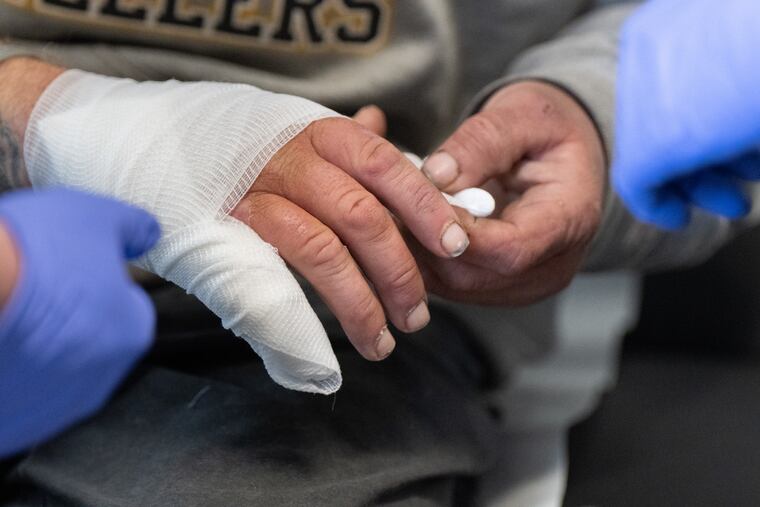
In a small clinic room at Mother of Mercy House on Allegheny Avenue in Kensington, Emma Anderson unwrapped a bandage from a man’s swollen hand.
“It hurts really bad in the cold,” the man said, wincing at the inflamed wound that covered most of a right-hand finger.
Cleaning it with saline solution proved so painful that Anderson, an EMT and St. Joseph’s University student, let the patient take the lead, wiping carefully at the yellowish-white tissue at the center of the wound.
It was his second time attending the wound care clinic at Mother of Mercy, the Catholic nonprofit that twice a week opens its doors to people with addiction dealing with the serious skin lesions, caused by the animal tranquilizer xylazine, that can develop into wounds so severe the only treatment is amputation.
Called “tranq” on the streets, xylazine was never approved for human use and has wreaked havoc across the city since dealers began adding it to fentanyl to extend the opioid’s short-lived high.
In the five years since it emerged as a threat, amputations among opioid users have more than doubled. The Philadelphia drug supply is now changing again, and though emergency rooms in the last year have treated fewer xylazine wounds, the crisis is far from over.
The man who visited Mother of Mercy’s clinic on a recent Tuesday, who gave only his first name, Steven, because of the stigma surrounding drug use, noticed the alarming wound on his hand a few weeks ago.
Steven had seen people sleeping on the streets with flies hovering around their gaping wounds. He had hoped that he could avoid a wound himself: He smokes fentanyl, instead of injecting it, and knows that injection drug users are generally at a higher risk for skin infections. But, like many people who smoke their drugs, he had developed a wound anyway.
“Believe it or not,” Steven said, between deep breaths during the painful cleaning, “I actually was an EMT myself at one point.”
‘How did we let it get this bad?’
Mother of Mercy, founded in 2015 in Kensington, partners with St. Joseph’s Institute of Clinical Bioethics to host the clinics. The institute, headed by Father Peter Clark, a Jesuit priest and a bioethicist at several area hospitals, has long held a monthly health clinic at the nonprofit’s Kensington headquarters.
In the last year, they expanded the program to offer more wound care opportunities to a community increasingly in need of them.
“To be physically down here in the heart of it, and seeing it on a weekly, monthly basis, it opens your eyes. How did we let it get this bad?” said Steven Silver, the assistant director of research and development at St. Joseph’s, who was welcoming clients at the door on a recent clinic day.
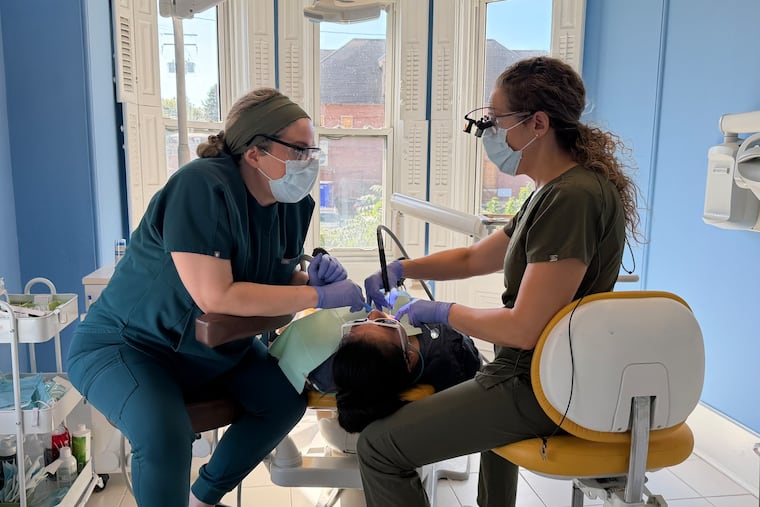
The program is staffed by medical students and undergraduates, all trained in wound care. Many say the work they do at the clinic is unlike any medical training they’ve been offered at school.
Undergraduates like Anderson and Ean Hudak, who takes shifts at the clinic in between applying to nursing schools, say they’re hoping to use their experience as they pursue careers in the medical field.
On Tuesdays and Thursdays, organizers serve hot meals and wait in the small clinic room for patients to trickle in, usually about 20 a week.
Once a month, the team takes to the streets with wound care supplies, such as bandages, saline sprays, and antiseptic cleansers. They look for people on the streets who may not be able to reach the clinic.
Clark said the clinic stepped up its hours in an effort to help patients keep their wounds clean more consistently — and hopefully prevent more amputations. “It’s increasing [patients’] ability to know what to do and how to keep the wounds clean — hopefully to help them out,” he said.
The trust factor
This year, medetomidine, another animal tranquilizer that causes severe withdrawal, has supplanted xylazine’s dominance in the Philadelphia area drug supply. Fewer patients addicted to opioids are visiting emergency rooms with soft-tissue damage, according to city data.
But it’s unknown how medetomidine affects those wounds, and there are still enough people suffering from them in Kensington, the epicenter of the city’s opioid crisis, that the clinic felt it necessary to increase its hours.
Hosting more frequent clinics also deepens relationships with patients. “People are coming back, which is good,” Clark said. “The trust factor is a huge issue.”
Many of the clinic’s patients avoid hospitals, fearing long waits for care: “At the ERs, they wait eight hours and they sign themselves out, or they’re coming down from a high, and nobody’s taking care of the withdrawal,” Clark said. “It’s a big mess.”
At the clinic, staff are regularly on the phone with wound care physicians at Temple University Hospital, who can flag patients with xylazine wounds and get them prompt care before they enter withdrawal, he said.
They also connect patients with housing, inpatient rehabs, and hospital care, for those with wounds too serious for the clinic to handle.
Several weeks ago, they called an ambulance to get a man with a wound that exposed his bone to the hospital.
Staff collect data to share with area hospitals so physicians can get a better understanding of the situation on the street — measuring patients’ wounds, collecting demographic data, and asking patients about which drugs they use.
Each leaves the clinic with a hospital bracelet documenting the care they’ve received so staff can keep track of their care from week to week.
‘It’s always an uphill battle’
Not all patients at the clinic are suffering from xylazine wounds. On a recent weekday, one man asked for help bandaging scrapes on his knuckles. He’d tried to fight someone who was stealing his belongings.
Another man said he’d been robbed and pepper-sprayed and asked staff to help wash the last traces of Mace out of his eyes.
As staffers looked for eyedrops among their medical supplies, Clark poked his head into the room. “We need someone with Narcan,” he said, referring to the opioid overdose-reversing spray.
Across the street, a man was slumped on a stoop, unresponsive.
Clark and Hudak dodged cars on Allegheny Avenue, knelt down by the man, and managed to gently shake him awake.
Slowly, he revived enough to speak a bit and showed them a wound on his leg, which they cleaned and wrapped in gauze. “You have some cracked skin — do you want us to put some moisturizer on your hands?” Hudak asked.
With temperatures dropping, the team is worried that patients’ skin will dry out, making their wounds more painful. (The summer months present a different challenge, with wounds leaking fluids.) And many patients may be too cold to travel to the clinic, making the monthly street rounds even more crucial.
“It’s always an uphill battle,” Hudak said.