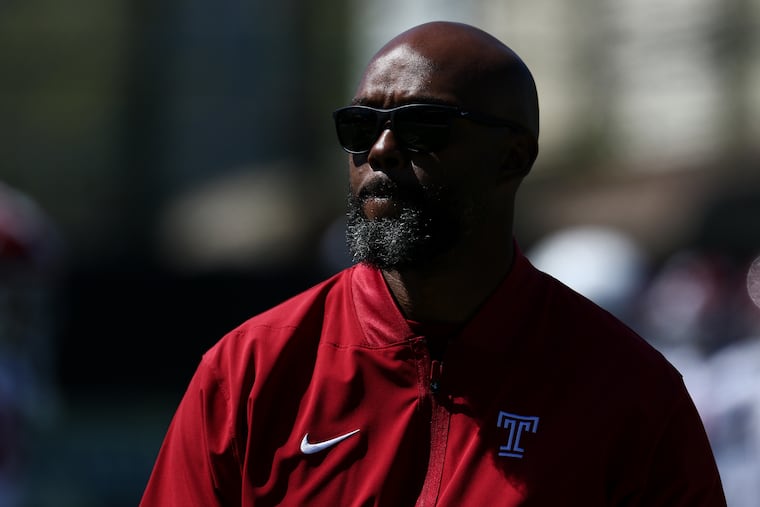
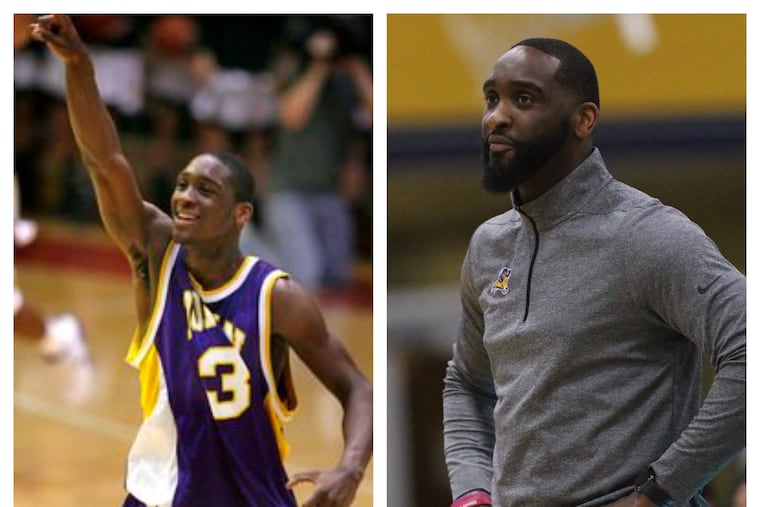
Roman Catholic alumnus Brian Wanamaker has an incurable cancer. It hasn’t stopped him from turning Texas Wesleyan into a winner.
A former star at Roman along with his twin brother Brad, Brian Wanamaker has been leading a successful NAIA college team while enduring the fight of his life.
About once a month, Brian Wanamaker drives to a cancer treatment center near his home in Crowley, Texas. He sits on a hospital bed as nurses inject needles into his arm and stomach; one for chemotherapy, the other to boost his immune system.
He can be there anywhere from one to four hours. Wanamaker is asleep throughout, but he doesn’t wake up rested. His stomach burns. His body feels fatigued.
After it’s over, he often goes straight to the gym at Texas Wesleyan University, where the North Philadelphia native coaches the NAIA men’s basketball program. Sometimes, he even beats his players to practice.
Since 2022, when Wanamaker was diagnosed with multiple myeloma, he has been balancing his job with the limitations of an incurable cancer. It is not easy. The head coach takes six pills a day to keep the disease in remission for as long as possible.
His doctors advise him not to engage in stressful activities (even if running a college basketball team is antithetical to this). Then, there is the matter of his schedule. Texas Wesleyan plays games mostly on Thursdays and Saturdays.
» READ MORE: Grieving Roman Catholic coach and his family find solace in their football community
It doesn’t allow much time to undergo chemotherapy and fully recover. But the coach has an answer for that, too. He receives treatment early on Mondays, so he doesn’t feel sick later in the week.
If the Rams are on the road, he’ll reschedule.
“It’ll come back,” Wanamaker said of multiple myeloma. “But right now, I do maintenance.”
The 36-year-old doesn’t talk like someone who is worried about the future. If anything, his job has helped him stay grounded in the present. Coaching was a lifelong goal of Wanamaker’s, ever since he was a boy playing in the Sonny Hill League.
This is where he and his twin brother, Brad, first saw how basketball could change a life. Their coach, Rasool Hajj, was an alumnus of and former volunteer assistant coach at Roman Catholic High School. He helped the twins connect with the program, and they enrolled in 2003.
The Wanamaker brothers quickly became standout players. In 2007, they led Roman to a Catholic League championship under coach Dennis Seddon. After that, their careers took divergent paths.
Brad starred in college at Pittsburgh en route to a seven-year stint in Europe, followed by a four-year stretch in the NBA. Brian struggled with injuries in college and bounced around, eventually finding a permanent home as a player at Texas Wesleyan.
He spent a few years playing overseas but returned to the school as an assistant coach in 2019. The Philadelphia native was named head coach in 2024 and has made an immediate impact, leading the Rams to a 38-20 record since taking over.
» READ MORE: Kobe Bryant turned Chester-Lower Merion into a decades-long basketball rivalry: ‘The history will never fade’
He models his approach after Hajj’s. He checks on players’ mental health before berating them for a mistake. He routinely asks how things are going at home and at school.
The team is encouraged to be vulnerable and learn from one another, rather than to react in real time. Wanamaker tells the players to focus on “the person,” because everyone is going through something.
“But I also talk to them about reality,” Wanamaker said. “Yes, everybody wakes up with an excuse they can use, and it’s real. But you can either use it or you can fight through it. You know?”
A North Philly upbringing
Brian and Brad grew up in a three-story house on 19th Street between Norris and Diamond. They were the second and third of five siblings — Brad is 1 hour, 11 minutes older than Brian — and shared a bedroom on the top level.
This had its shortcomings. The roof had holes, so when it rained, the boys put pots on the floor. Their neighborhood was perilous at times, and from an early age, they became aware of the poverty, gun violence, and drug use around them.
But their childhood was still full of joy. Nineteenth Street was home to a lot of young kids, many of them Brian and Brad’s age. They rode bikes, played tag, and staged impromptu football games outside.
Basketball was their favorite sport. The twins ventured to courts all over the city in search of the fiercest pickup battle: 16th and Berks, 16th and Susquehanna, 25th and Diamond, 22nd and Norris.
» READ MORE: For 31 years, the late Carl Henderson ran Carl’s Cards with joy and selflessness. Now, his family is keeping it alive
They’d shoot hoops before and after school. Local elders would organize basketball tournaments between blocks with trophies for the winners. In seventh grade, a friend, Saleem Elam, asked if they played AAU basketball.
Neither brother knew what that was. But they soon attended a tryout, held their own against more experienced players, and made the team. Before long, they were playing in leagues throughout the area — Gustine Lake, Sonny Hill, Belfield.
The Sonny Hill League was where they met Hajj, who seemed to be part basketball coach, part social worker. He allowed the twins to reimagine the bounds of what a coach could do, a template they’d lean on later in their careers.
“He helped a lot of kids, but also a lot of families,” Brian said. “He helped parents get jobs. He would give people money if they needed it for something. He was always there. He was almost like a big brother to us.”
Hajj became a mentor to the twins. At the time, they were attending Gillespie Junior High School, which closed in 2011. Brian and Brad seemed to learn all the wrong lessons, like how to cut class and replace it with extra gym time.
Teachers wouldn’t enforce the rules, so to the twins, there was no reason to follow them.
“There wasn’t a lot of learning,” Brad said. “Not a lot of structure. I’d go to one class — Ms. Brown, because she knew my dad. So, I’m like, ‘I got to make sure I go to her class.’
“I’d go to homeroom and get marked absent for the day. Then I’m in my brother’s class, I’m at his lunch, I’m playing cards [with him].”
Hajj, who recognized the twins’ untapped potential, introduced them to Seddon and the other Roman Catholic coaches. That break altered their lives.
The high school brought a level of discipline that the Wanamakers weren’t used to. And when they arrived as freshmen, it was a tough adjustment.
Brian walked through the doors in September 2003 and looked at the students around him.
“We wanted to leave because we didn’t know it was an all-boys school,” Brian said. “We was like, ‘What? There’s no girls in the school?’ We were so confused.”
They racked up demerits for every conceivable offense, from untucked shirts to facial stubble. Both brothers failed a class in their first semester and were ruled ineligible for the first half of the basketball season.
Because they were on academic probation, they had to go to summer school, wearing slacks, long-sleeved collared shirts, and ties in the sweltering heat. The lesson stuck.
“It just was like, ‘We got to be doing the right thing,’” Brad said.
In sophomore year, Brad started on varsity, and Brian on JV (with some varsity appearances mixed in). They fed off each other in practice and in games.
The players had different strengths. Brian, a 6-foot-2 combo guard, was a better defender and three-point shooter. Brad, a 6-4 shooting guard, was a “laid-back killer” who could score from midrange.
» READ MORE: Inside ‘The Simpsons’ last-minute addition of late writer Dan McQuade’s likeness to its Philadelphia episode
Brian showed all of his emotion. He wasn’t above “mugging a player,” in Brad’s telling, and wasn’t afraid of getting a technical foul. He’d scream and yell. Brad, by contrast, was quiet.
But occasionally, he would give his brother some in-game feedback.
“He’d be like, ‘Hey, play your role!’” Brian said. “He’d be like, ‘Pass it to me. Pass me the ball, and you play defense!’”
Added Brad: “He’d go, ‘Shoot the ball!’ And I’d tell him, ‘Calm down! I need you out here!’ Because sometimes he gets too emotional. And I’m like, ‘Before you get a technical foul, I need you to calm down.’”
The brothers racked up accolades, especially in 2006-07, their senior season. Brian was named second-team All-Catholic and All-City, as well as Defensive Player of the Year. Brad was named the Daily News’ Player of the Year, and was first-team All-State, All-City and All-Catholic as well.
The Cahillites parlayed this success into a historic campaign. The twins led Roman Catholic to a 28-3 record and its first Catholic League championship since 2000.
Rival Neumann Goretti, the No. 1 seed from the Catholic League South, came into the final favored. And the game, played at the Palestra, was close until the very end.
Brad had to sit for a stretch midway through the third quarter after picking up his fourth foul. Without its best player, Roman was at a disadvantage. Brian made sure everyone knew their defensive assignments, so the undermanned Cahillites could stay within striking distance.
His brother returned early in the fourth quarter, and spurred his team to a 17-4 run. With just over a minute remaining in the game, Brian hit a layup to widen Roman’s lead to 58-54. It finished with a 59-56 comeback win.
“I think [Brian] pointed to our student section,” said Brad, now the head coach at Roman Catholic. “We still have the picture at my mom and dad’s house. It was in the newspaper. It was a moment.”
Coaching through chemo
After graduating, Brad played for Pitt when it was one of the top men’s basketball programs in the country. Brian bounced around; first to Central Connecticut State, then to Lon Morris Junior College in Jacksonville, Texas, and, finally, to Texas Wesleyan in 2009.
He struggled with foot injuries almost every year of his college career. This made it difficult to get steady playing time. But at Wesleyan, he found a fit.
A former coach had recommended the school to him, and Wanamaker initially was skeptical. He’d never heard of it. The campus was in Fort Worth, Texas, about 1,500 miles away from home.
“I didn’t know what Texas Wesleyan was,” he said. “My first semester, I played basketball, stayed in my room, and didn’t talk to teammates, coaches, anyone. I was just like, ‘Why am I here?’”
» READ MORE: Johnny Gaudreau’s dream was to be an Olympian. His family lived it for him, in a moment fit for a ‘movie.’
By his second semester, he realized this would be his last opportunity to play in college. So he decided to embrace the program and was happy he did. Wanamaker felt he could be himself in a way he couldn’t at his previous two stops.
During the summer of 2010, Brian visited Brad at Pitt and trained with him and his teammates. He returned to campus in the fall more confident than ever.
That season, he was named a first-team NAIA All-American and Red River Athletic Conference Player of the Year, averaging 19.1 points, 5.7 rebounds, and 5.0 assists.
The combo guard was drafted into what then was the NBA D-League and ended up playing six seasons in Germany and Lithuania. He returned to Texas Wesleyan in 2019 to finish his degree and work as an assistant coach.
In late 2021, during his second season coaching, Wanamaker started to feel back pain. At first, he thought it was workout-related. Maybe he’d pulled or strained a muscle.
But the pain worsened, to the point where he had to stop exercising. He couldn’t sleep in a bed anymore because it would hurt his back, so he would lie flat on the floor.
Wanamaker underwent all sorts of testing, but the doctors didn’t find anything. They hypothesized that his pain was stress-related.
“And I would tell them,” he said, “‘I’m not stressed.’”
In September, after a litany of visits, his primary care doctor received MRI results that showed tumors all over Wanamaker’s back. He went to the hospital for further testing, and was told he had multiple myeloma, a cancer formed in plasma cells that is treatable but has no known cure.
He was a statistical anomaly. The disease is predominantly diagnosed in people 65 years or older. According to the American Cancer Society, only 1% of cases are found in those younger than 35.
Wanamaker was 33.
“That was really hard,” he said. “Because, obviously, when you hear cancer, you think death. And then you hear, ‘No cure.’ It was hard for me to process.”
The next day, the coach started seven months of chemotherapy. Many on the team assumed he would be out for the rest of the year.
But Wanamaker was back in the gym that week, helping at practice and eventually sitting on the bench during games.
He had little energy and often felt sick. His immune system was at a higher risk than usual. But Wanamaker felt he needed to do it. So every day, he’d drive to Texas Oncology for his treatment, and would head to Texas Wesleyan afterward.
“I was probably more than half-asleep,” he said. “I was going through what I was going through, but I knew as a coach, players are going through stuff, too. It was just being there for them.”
» READ MORE: A coach, a promise, and chicken and rice: How Father Judge became king of the Catholic League
Guard Akili Vining had recently lost his father to cancer. Point guard Matthias Nero had gotten into a severe car accident, which led to the death of his close friend.
Wanamaker was acutely aware of their struggles and those of other players. He decided to pour himself into his team.
“Coach B would probably text me every day,” Nero said. “He would make sure I was in the right headspace, to see if I needed help. He’d pull me aside and just tell me, ‘If you need anything — this isn’t about basketball. This is about the future and your mental health.’”
Wanamaker received a blood transfusion in May 2023. His father and brother visited him in the hospital shortly after. Seeing him hooked up to a cluster of machines was difficult.
“It was like, ‘I can’t lose my brother,’” Brad said. “‘Not the person I came into this world with.’”
Eventually, Brian’s chemotherapy schedule was reduced from daily to monthly treatments. Through it all, he rarely missed a practice or a game, which became a source of inspiration for his team.
The players could see their coach had changed. He’d lost hair and weight, and his skin looked dull. Sometimes, he’d arrive with a bandage on his arm to cover a needle mark.
But he was showing up, just like they were.
“If he can fight though chemo,” Vining told a local TV affiliate, “I can fight through practice.”
‘People are going to say I cared’
In April 2024, Wesleyan’s head coach, Brennen Shingleton, resigned to work for a business in Fort Worth. Wanamaker was named interim coach but also applied for the full-time job.
He wasn’t alone. Athletic director Ricky Dotson said he received “a ton” of applications, from former NBA assistants to former Division I head coaches. He narrowed it down to four finalists, interviewing them throughout the spring.
Despite the high caliber of candidates, Wanamaker still set himself apart. It wasn’t just that he was familiar with the team. It was that the players respected him, and looked to the Philadelphia native as a role model.
Dotson knew the coach’s character. He could see that this would not be a surface-level job for him. By the end of the interviews, he was convinced that Wanamaker was the best choice, even with the uncertainty about his health.
“I just never really doubted that he would be able to do it,” Dotson said. “And he’s moved right on through.”
That June, Wanamaker was officially named head coach. He immediately got to work, targeting bigger, more athletic players in hopes of building a hard-nosed, physical team.
One such player was Khalil Turner, a 6-8 guard from Northeast Philly who had shuffled through four colleges before taking a two-year hiatus. Like Wanamaker, Turner was a Hajj disciple in need of a new home.
The former Sonny Hill coach was confident that Wesleyan would be the right fit.
“Listen, man, I got a place for you,” Hajj told him. “It’s a Philly coach. He’s going to treat you like family. All you’ve got to do is just go out there and put the work in, and everything is going to fall into place.”
The two initially butted heads, usually over inconsequential things. Turner said that one day, in practice, they almost got into a physical fight. But Wanamaker never gave up on him. He didn’t suspend Turner or revoke his scholarship.
Eventually, the guard began to open up about his personal struggles. He had a family member who was sick at home. He told the coach that he needed a job to make some extra money. Wanamaker found him one at a local laundromat.
Now, Turner says they are “best buds.” Last year, when the incoming freshmen arrived on campus, the senior guard was the first to explain Wanamaker’s predicament.
“We told them, ‘Hey, Coach is dealing with this,’” Turner said. “‘So from time to time, he might be a little moody. But this is why he’s moody. He’s worried about his chemo. So don’t stress him out too much.’
“The vets feel like if Coach is giving his all, with his chemo, we should give it our all every day in practice,” Turner added, “and every day on the court. He’s going above and beyond for us, so we should do the same.”
After consecutive losing seasons, the Rams now look like a different team. They have adopted some of Wanamaker’s characteristics, playing a faster, tougher brand of basketball.
They set hard screens and make hard cuts. They dive on the floor for loose balls and swarm opposing offenses. And they are seeing results.
In 2024-25, Texas Wesleyan went 19-11, earning an NAIA National Tournament berth. This year, it is 19-9.
But Wanamaker isn’t just focused on the numbers.
He knows his players have changed as people, too. They are more emotionally available. They are better able to communicate their feelings. They are less reactionary than when they first arrived.
And to the Philadelphia native, that is more valuable than anything.
“It gives me my purpose,” he said. “And no matter what happens, I know that, when it’s all said and done, people are going to say I cared.”