Abraham Lincoln’s funeral train drew thousands of mourners on this week in Philly history
The procession route was designed to be long and circuitous, snaking through what we now call Center City.
The nation wanted to see him.
Weeks after an assassin gunned down President Abraham Lincoln in a Washington theater, a train pulled his body across a war-pocked United States.
The “Lincoln Special” journeyed for nearly two weeks, from Washington to Springfield, Ill., stopping in Philadelphia so the martyred president’s body could be interred at Independence Hall.
The funeral train arrived at 5 p.m. on April 22, 1865, a Saturday, at the depot at the northwest corner of Broad Street and Washington Avenue. The site is now home to Lincoln Square, a mixed-use development anchored by a Sprouts market and a small-format Target store.
“Half a million of sorrow-stricken people were upon the streets to do honor to all that was left of the man whom they respected, revered and loved with an affection never before bestowed upon any other, save the Father of this County,” The Inquirer reported from the scene. “Universal grief was depicted on the faces of all.”
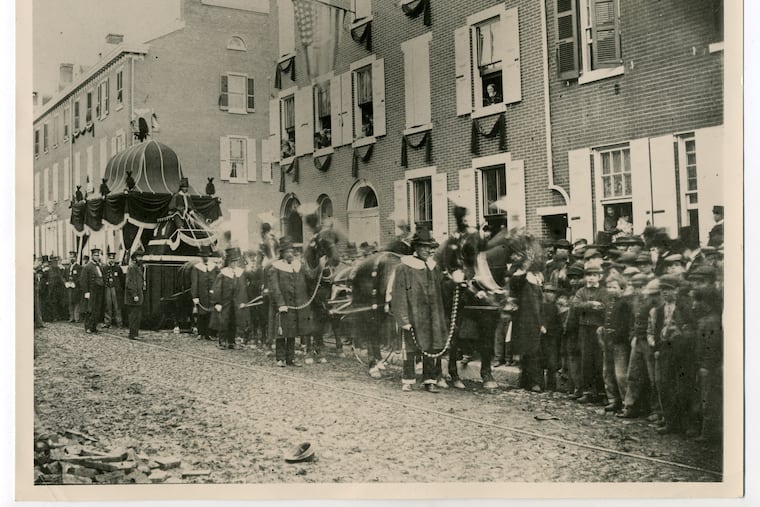
Lincoln’s coffin was placed on a special funeral chariot made for the occasion, and processed through the cobblestone streets of a grieving city.
The procession route was designed to be long and circuitous, snaking through what we now call Center City, allowing as many mourners as possible the chance to pay their respects.
The procession ended at Independence Square, which was illuminated with 60 calcium lights glowing red, white, and blue.
Members of the Union League received the coffin, and acting as Philadelphia’s pallbearers, carried his body between lines of the black-clothed and white-gloved League members. Their lapels were adorned with mourning ribbons.
In the same Assembly Room where the Declaration of Independence was signed, Lincoln’s coffin was placed on a catafalque.
A private viewing was held from from 10 p.m. to midnight on the Saturday of his arrival.
The public viewing began on Sunday, April 23, at 6 a.m. and ended at 1 a.m. Monday, with the lines of mourners stretching eastward to the Delaware River and westward to the Schuylkill River.
Nearly a century after the Founding Fathers birthed the Constitution, hundreds of thousands of residents were able to walk into the iconic building to pay their respects to Lincoln, who holds the dubious distinction of the first sitting U.S. president to be killed in office.
At 2 a.m. on April 24, Lincoln’s coffin was escorted by honor guard to the train depot in Kensington, and was met with thousands of Philadelphians, who wanted one last chance to say goodbye.