A statue of a civil rights activist who spent much of her life in Philly now stands in the U.S. Capitol
Barbara Rose Johns led a high school walkout that contributed to Brown v. Board of Education. She later graduated from Drexel and worked as a Philly school librarian.
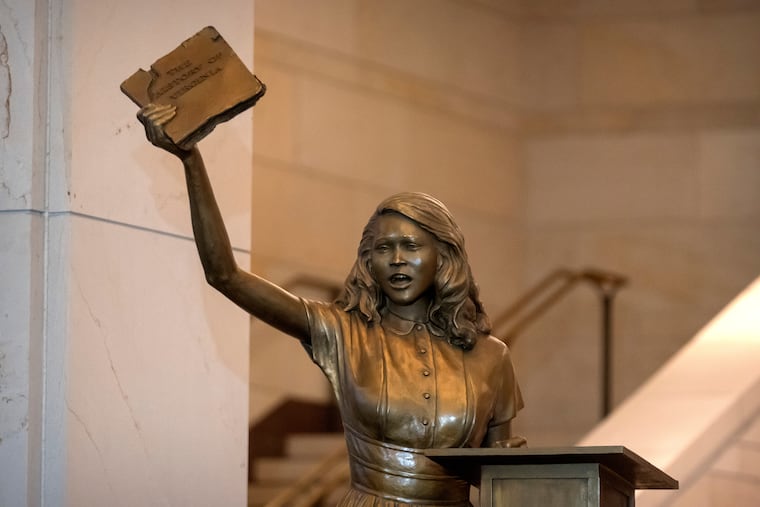
Back in 1951, a teenage Barbara Rose Johns led a walkout at her segregated high school in Virginia that would go on to contribute to the U.S. Supreme Court’s landmark decision in Brown v. Board of Education. Now, a statue of her is on display in the U.S. Capitol, replacing a sculpture of Confederate Gen. Robert E. Lee.
“The Commonwealth of Virginia will now be properly represented by an actual patriot who embodied the principle of liberty and justice for all,” House Minority Leader Hakeem Jeffries (D., N.Y.) said at a ceremony Tuesday unveiling the statue. “And not a traitor who took up arms against the United States to preserve the brutal institution of chattel slavery.”
And while Johns today is remembered as a seminal civil rights figure who hailed from Virginia, she spent much of her adult life in Philadelphia.
Born in New York City in 1935, Johns as a child moved to Prince Edward County, Va., where she lived on a farm with her grandmother. The county’s public schools were segregated, and in the late 1940s, she began attending an all-Black high school in Farmville known as Robert Russa Moton High School.
Johns, according to the Moton Museum, became frustrated with the poor conditions at the school, which lacked resources and was overcrowded compared with white facilities. In April 1951, when she was 16, she led a walkout with hundreds of other students to protest the conditions, ultimately gaining the support of NAACP lawyers, who filed a lawsuit that challenged the practice of segregated education.
Known as Davis v. Prince Edward, the lawsuit went on to become one of the five cases that the U.S. Supreme Court reviewed in Brown v. Board of Education. The high court’s landmark 1954 decision declared “separate but equal” public schools unconstitutional. Despite resisting the court’s decision, Prince Edward County schools were ultimately integrated by the mid-1960s.
Following the walkout, Johns’ parents were worried for their daughter’s safety and sent her to live in Montgomery, Ala., where she resided with her uncle, the Rev. Vernon Johns, who was a pastor and civil rights leader in his own right. She completed high school there and studied for a time at Spelman College in Atlanta, according to the Farmville Herald, Farmville’s local newspaper.
In 1954, she married the Rev. William Rowland Powell, and the pair later moved to Philadelphia. As a resident, Johns continued college at Drexel University, from which she graduated in 1979 with a bachelor’s degree in library science, according to the 2018 book Recovering Untold Stories: An Enduring Legacy of the Brown v. Board of Education Decision.
Johns would go on to have five children, and worked for more than 20 years as a librarian for the Philadelphia School District. Public information about her time in Philadelphia is scarce, and neither Drexel nor the school district immediately responded to requests for comment.
On Sept. 25, 1991, Johns died in Philadelphia following a battle with cancer. Her family, the Farmville Herald reported, knew little of activism and her involvement in the Moton walkout, only learning of it late in her life.
The statue of Johns is part of the National Statuary Hall Collection at the Capitol, in which each state can contribute two statues. The other statue representing Virginia is of George Washington.
The National Statuary Hall displays 35 of the statues. Others are in the Crypt, the Hall of Columns, and the Capitol Visitor Center. House Speaker Mike Johnson (R., La.) said the Johns statue will be placed in the Crypt.
Former Democratic Virginia Gov. Ralph Northam had requested the removal of the Lee statue. In December 2020, a state commission recommended replacing Lee’s statue with a statue of Johns. The removal occurred during a time of renewed national attention over Confederate monuments after the death of George Floyd, and the Lee statue was relocated to the Virginia Museum of History and Culture.
Johns is also featured in a sculpture at the Virginia Civil Rights Memorial outside the state Capitol in Richmond. Her former high school is now a National Historic Landmark and museum.
“She was brave, bold, determined, strong, wise, unselfish, warm and loving,” said Terry Harrison, one of her daughters, at Tuesday’s unveiling, according to NPR. “We’re truly grateful that this magnificent monument to her story, the sacrifices that her family and her community made, may continue to inspire and teach others that no matter what, you too can reach for the moon.”
This article contains information from the Associated Press.