Before the Ben Franklin Bridge opened 100 years ago, Pennsylvania wanted to make it free
The debate over tolls was resolved only months before motorists were to start crossing the bridge in July 1926.
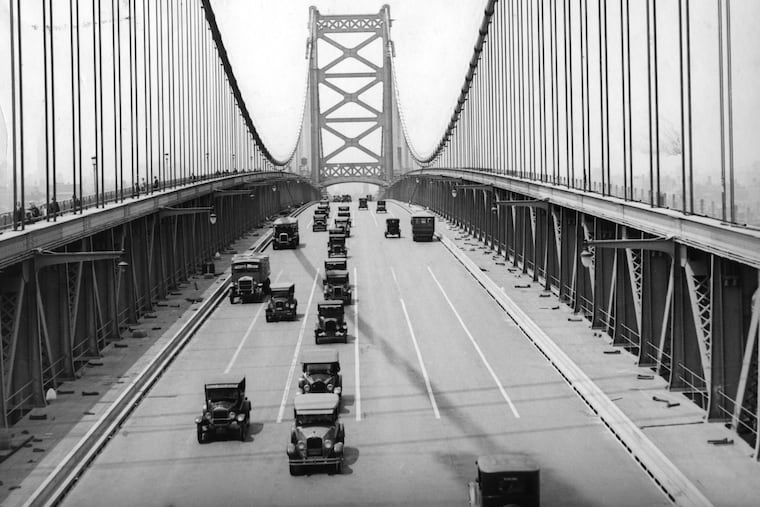
Today, it costs $6 to get out of New Jersey via the Ben Franklin Bridge. But a bitter political battle ahead of its opening a century ago could have made crossing it free.
That’s what Pennsylvania officials hoped in the mid-1920s. Their New Jersey counterparts, however, held steadfast to insisting on a toll system — and ultimately won, seeing as your pocket is a few bucks lighter each time you cross over from Camden.
That skirmish played out prior to the bridge’s official opening in July 1926, and was resolved only months before motorists started crossing it. One hundred years later — a milestone that will be marked with a public celebration Saturday — we have never known a toll-free Ben Franklin Bridge.
Back in the 1920s, the structure was known simply as the Delaware River Bridge — a 1,750-foot technological marvel of the era that took more than four years and $37 million to construct. And for a substantial portion of that time, Pennsylvania and New Jersey fought over the toll issue.
» READ MORE: Spanning 100 Years: See how the Benjamin Franklin Bridge was built a century ago
Here is how The Inquirer and the Daily News covered it:
An early concern
Construction began in January 1922, with the hope of finishing by July 4, 1926 — just in time for the Sesquicentennial, the 150th anniversary of the United States. For a time, that goal seemed to be within reach.
Until around November 1924, when the toll issue first arose. Philadelphia politicians began to oppose charging for use of the bridge, with then-Mayor W. Freeland Kendrick saying the bridge should be “thrown open to the public without charge.”
At the time, The Inquirer reported, tolls on interstate spans “had been wiped out almost entirely throughout the country” over the previous decade. Frederick A. Myers, chair of the Philadelphia Real Estate Board at the time, said the practice was “antiquated” and stood only to reduce the utility of the forthcoming bridge.
» READ MORE: What to know about the closure of the Ben Franklin Bridge this Saturday
New Jersey officials, however, said their hands were tied, as loans used for infrastructure like the Delaware River Bridge were required to be paid back promptly through the charging of tolls. But Pennsylvania officials said state law had no provision allowing the commonwealth to collect or receive toll revenues.
With that, a lengthy political battle began, resulting in a contentious relationship between New Jersey and Pennsylvania officials, and stoppages to bridge work that threatened its timely opening.
The battle gets bitter
Philadelphians were so perturbed by the idea of a toll bridge that The Inquirer ran an April 1925 editorial suggesting all vehicles coming to the city bearing New Jersey tags be charged, while others passed for free. That policy, The Inquirer said, would “quickly bring New Jersey to her senses.”
That suggestion never came to pass, but local officials continued to insist on a free bridge. The structure, said Philadelphia City Solicitor Joseph P. Gaffney, was an instrument of interstate commerce, and without a toll agreement, there was no legal standing for a charge to be assessed.
New Jersey seemed to take particular umbrage with this point, as its representatives on the Delaware River Bridge Commission — the legal entity overseeing the bridge’s construction — demanded that contracts for work on the span be halted until the toll issue was resolved.
The immediate impact was halting a $766,000 contract to pave the bridge. There were still “several million dollars” worth of contracts to be awarded, all of which were paused, The Inquirer reported.
As a result, nearly all new work was paused over the toll question, including electrical work, ornamental work, painting, and other jobs. Pennsylvania officials worried that work would permanently stop, meaning the bridge might never be finished.
Pa. leaders incensed
By mid-1925, Pennsylvania officials were incensed. With neither state backing down, a U.S. Supreme Court case was considered inevitable — which, it turned out, was the case. By July, Pennsylvania legislators decided to file a lawsuit demanding New Jersey “live up to its contract to complete the Delaware River Bridge,” according to reports from the time.
Pennsylvania leaders filed that case in November 1925, reports indicate. Along the way, work on the bridge slowed significantly, bridge engineers said, with the number of workers dropping from 1,200 when the toll standoff began to 651 in December 1925.
But as the issue wore on, perceptions in Pennsylvania began to evolve. By January 1926, organizations including the Philadelphia Chamber of Commerce changed their mind, and urged the city and state to allow toll collection. If the state agreed to allow tolls, the chamber said, the impasse could be avoided.
Weeks later, legislation on a toll agreement was introduced in Harrisburg. Known as the Buckman Bill, the legislation was passed nearly unanimously in the state Senate and House in February 1926. It allowed officials to levy tolls on bridge traffic, serving essentially as a total loss for Philadelphia, where opposition to tolls on the span was the loudest.
With that, New Jersey and Pennsylvania had compromised on the toll issue, and the lawsuit was rendered moot. Tolls, however, were expected to be temporary, lasting roughly 20 years to pay for the bridge’s construction.
The bridge’s opening
In the wake of the impasse, officials agreed to a scheme that gave half of all toll revenue to New Jersey, while Pennsylvania and Philadelphia would get a quarter of the revenue each — a structure that mirrored the payment for the bridge, according to Inquirer reports. Passenger vehicles would be required to pay a 25-cent toll to cross the bridge each way, with a slightly higher rate for trucks. The westbound-only tolling system we know today did not arise until 1992.
After more than four years of construction, the Delaware River Bridge opened July 1, 1926, though it was only “practically” completed at the time, as elements like ornamental work, cable wrapping, and final painting remained. Still, in its first 24 hours of operation, the bridge played host to more than 30,000 private cars, 2,000 trucks, and 1,100 buses. Those figures far surpassed official estimates, general manager Joseph K. Costello said at the time, with initial expectations hanging around 17,000 vehicles of all types.
Months ahead of the bridge’s opening, in March 1926, some officials expressed concern that the toll scheme — then intended to be temporary — would never go away. And by that time, the Delaware River Bridge Commission had already begun a movement to extend the amount of time during which tolls would be collected.
Today, at $6, the Benjamin Franklin Bridge’s toll is equivalent to roughly 32 cents in 1926.
“I want to see this bridge free before I die,” commission member Samuel M. Vauclain said that year. “If you raise the term of years, I am afraid my wish may not be granted.”