Frank Rizzo wanted federal troops to patrol Bicentennial protests. They ‘neither came nor were needed.’
The mayor wanted thousands of Army troops to keep order amid concerns over protests and potential violence. Ultimately, thousands held peaceful demonstrations miles away from the main festivities.
Months before Philadelphia was set to celebrate the United States’ 200th birthday in 1976, Mayor Frank Rizzo was worried.
The city, he said, stood to face massive unrest and potential violence during the Bicentennial parade on July 4. There were, he believed, cadres of radical leftists plotting to disrupt what should be a day of jubilance two centuries after the country’s founding in the place where it was born.
They would come in droves from around the nation, Rizzo said. And to combat them, Philadelphia authorities didn’t just need to be vigilant — they needed thousands of federal troops to patrol the streets and quell the impending chaos.
Those troops, despite Rizzo pursuing their deployment, never arrived. Nor did the bedlam he feared would come. And neither did the throngs of tourists the city expected for the Bicentennial, at least in part because of Rizzo’s warnings.
» READ MORE: The Bicentennial didn’t go as expected. But it wasn’t exactly as bad as Philadelphians say it was.
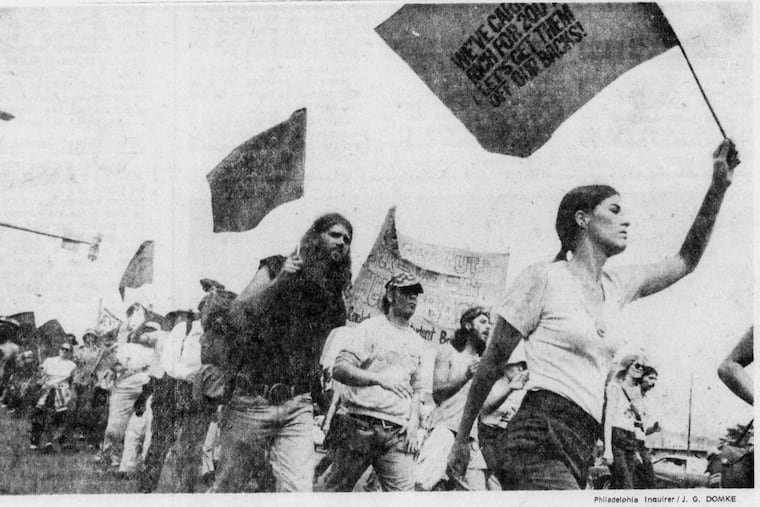
The city, did, however, get plenty of leftist protesters — tens of thousands who held large, peaceful demonstrations in North Philadelphia on Independence Day of 1976. No blood flowed in the streets, and Rizzo, the man who claimed it would, that year became the first mayor in Philadelphia’s history to face a recall effort.
Here is how The Inquirer and Daily News covered it:
Two groups plan protests
Rizzo’s perceived threat of chaos came from two similarly named, yet totally distinct, groups that planned demonstrations for Independence Day. Those were the July 4 Coalition and the Rich Off Our Backs-July 4th Coalition, two organizations that consisted largely of anti-war, socialist civil rights activists who hoped to offer some counter-programming for the holiday.
The July 4 Coalition was larger, with some 100 subgroups making up its ranks, which it claimed would bring 60,000 marchers to Philadelphia for the Bicentennial. Rich Off Our Backs, meanwhile, expected only 5,000 people to show up for its Independence Day demonstration, but was the larger concern for the Rizzo administration because it was considered the more radical group.
Ahead of the holiday, the city had reached an agreement with the July 4 Coalition, which planned to protest dozens of social ills ranging from racism and sexism to unemployment and military spending. Its demonstration would take place in North Philadelphia, miles away from the main festivities in Center City.
Rich Off Our Backs, meanwhile, wanted to hold its demonstration in Center City and was believed to be “dominated by a tiny, one-year-old Marxist splinter called the Revolutionary Communist Party,” The Inquirer reported at the time. The group, reports said, planned to focus on unemployment.
Those plans would have brought the group into direct conflict with the city’s Bicentennial activities, including Philadelphia’s official parade. But after a weekslong court battle, Rich Off Our Backs was denied a permit to parade in Center City, and agreed to an alternate route that would take the march through North Philly.
Rizzo’s call for federal troops
In late May 1976, Rizzo told The Inquirer he would call for 15,000 Army troops to keep order in Philadelphia due to concerns over the planned protests and potential violence.
Federal troops, Rizzo said, would supplement the city’s police force, which would be “spread too thin” due to the number of planned festivities on July 4. Bolstering the police, he added would not included armored vehicles or heavily armed forces, but would consist merely of “bodies” carrying sidearms to quell dissent.
Deployment of federal troops, The Inquirer reported, would require approval from then-Gov. Milton J. Shapp, who supported the effort. And the FBI’s Philadelphia office said it was unaware of any federal investigation into the matter at the time of Rizzo’s announcement.
Both the July 4 Coalition and Rich Off Our Backs called Rizzo’s move “fascist,” and insisted demonstrations would be peaceful. One activist, the Rev. David Gracie, known for anti-Vietnam War protests in the 1960s, said Rizzo’s request harkened back to the city’s treatment of anti-war demonstrators.
And in late June, the Justice Department denied Rizzo’s call for troops, saying it failed to find substantive evidence of the radical activity the mayor feared would occur. There was, the FBI said, no “hard core” indication of impending terroristic activity, and no additional enforcement efforts were necessary.
The day of
On Independence Day 1976, both groups marched through North Philadelphia without incident, The Inquirer reported at the time. There was not a single arrest or reported disturbance, with the only snafu being late starts to both marches.
Rich Off Our Backs, despite the fervor over its planned activities, managed to attract about 4,000 participants, all of whom marched east along Girard Avenue from Broad Street before convening in Norris Square Park in Kensington. The July 4 Coalition held an 18-block demonstration along Lehigh Avenue ahead of a rally at 33rd and Oxford Streets in Fairmount Park.
The coalition claimed to have drawn some 58,000 protesters, but Philadelphia Police, estimated the crowd at about 25,000 people, and observers pegged it at half that size.
“We did it,” Rich Off Our Backs spokesperson Nick Unger said in 1976. “Thousands of working people walking through the city for miles where you couldn’t see the front of the march or the rear of the march.”
Neither demonstration, meanwhile, resulted in any of the bloodshed, destruction, or disruption the Rizzo administration advertised. In fact, The Inquirer reported, both protests “drew little response from onlookers” along their routes, and the police who were deployed — clad in riot gear — were ultimately not needed.
Rizzo’s recall
Rizzo’s treatment of the July 4 protests did not directly lead to efforts to recall him, but it certainly emboldened his critics. The mayor seemed to realize the error at the time, with Rizzo rarely showing his face publicly around Independence Day — a strategy largely believed to have been instituted by his top advisers.
In fact, efforts to recall Rizzo stretched back to April 1976, weeks before his pursuit of federal troops ever surfaced. The recall move was largely due to Philadelphia’s flagging economy, as well as tax increases and a city budget deficit.
An organization known as the Citizens Committee to Recall Rizzo organized a petition, garnering some 145,000 signatures by mid-April 1976. That figured swelled to more than 200,000 signatures following the Bicentennial, but only about 89,000 were found to be valid.
In September, a Common Pleas Court judge found that Rizzo would need to face a recall — a decision later struck down by the Pennsylvania Supreme Court. Rizzo, as a result, was never officially recalled, and the summer of 1976 would be remembered as a “Buycentennial that wouldn’t sell” amid a “call for federal troopers that neither came nor were needed,” The Inquirer reported.
And by late 1976, Rizzo expressed relief that the situation seemed to be resolved.
“I never had any doubts that it would rule in my favor. The law is on my side,” he told The Inquirer. “I’m glad it’s all over.”