A copy of the Declaration of Independence handwritten by Thomas Jefferson will soon be on display
Written in Jefferson’s own hand, and including a more damning condemnation of slavery, the early draft is part of a major new America 250 exhibit at the American Philosophical Society.
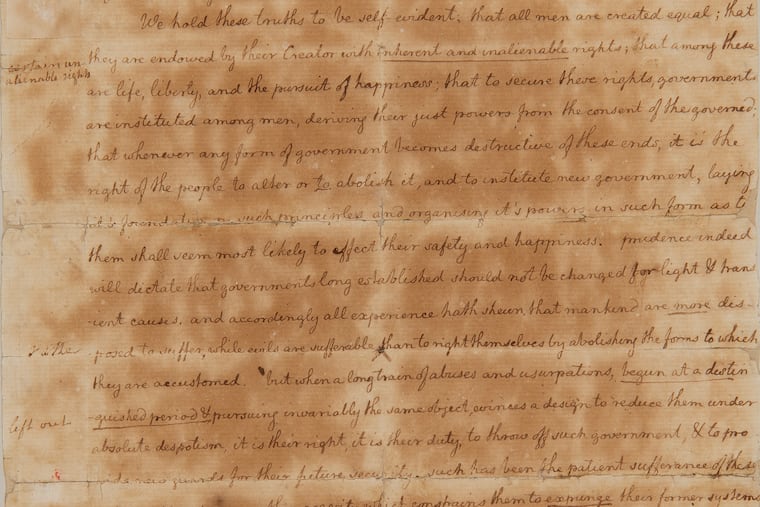
It is known as the “Fair Copy” of the Declaration of Independence — a rare, early, unedited version of the nation’s founding document, drafted in Jefferson’s eloquent hand, and containing a condemnation of slavery by the slave-owning Founding Father.
In 1824, when the founders of the American Philosophy Society, the oldest learned society in the United States and still located next to Independence Hall, were gifted the relic, just years before Jefferson’s death, they were so thrilled to share it, they could think of nothing else but to hang it in the front window.
For years, there it remained, a steadily sun-bleached working draft of democracy visible to all.
Soon, the priceless artifact, a symbol of both the Founders’ contradicting approach to liberty and a young nation’s pride in revolutionary roots, will be on display again. One of five surviving handwritten Jefferson copies, it serves as a crown of the Society’s major America 250 exhibition, billed as likely the largest public display of early Declaration printings ever mounted.
Titled, “These Truths: The Declaration of Independence” — and running from April 10 to Jan. 3, 2027 — the exhibition features 19 rare versions of the Declaration, and dozens of artifacts intimately connected to the nation’s founding, including a massive map of North America, purchased by Benjamin Franklin and hung in Independence Hall in 1776, and a tattered and stained first edition of “Common Sense” by Thomas Paine, the fiery freedom pamphlet that helped sparked a revolution.
By displaying some of its most important copies of the Declaration all at once — including the only surviving parchment copy printed by Market Street printer John Dunlap in 1776 and a complete facsimile of the original commissioned by future president John Quincy Adams in 1823, as the young nation emerged as a world power — the Society aims to show the Declaration as a process, not an event, but a living breathing, flawed, unfinished, freedom document.
“Whether a priceless artifact penned by Jefferson’s own quill or a 12-cent wall hanging, the many versions of the Declaration are its history,” said David Gary, exhibition curator. “We’re bringing those original documents together to trace the arc from the creation of the revolutionary text to its transformation into a foundational symbol of the nation.”
Founded in 1743 by Benjamin Franklin, and with early members like John Adams and Jefferson, the Society has one of the largest collections of early Declaration printings in the country.
The Jefferson original
It’s Jefferson’s faded handwritten copy that most powerfully captures the yet unfilled promise of the founding. The Continental Congress was still wordsmithing the Declaration in the summer of 1776, when Jefferson sat down in his writing Windsor chair (also on display). Annoyed, Jefferson penned five original copies for Virginia friends — including Richard Henry Lee, who had first penned a resolution calling on the colonies to declare independence — underlining places where his original words had been changed.
The changes included some undeniably eloquent rephrasing (“inherent and unalienable rights” became “certain unalienable rights”) to the deletion of the passage where Jefferson, a slaver, excoriates the sale of human beings as a violation “of life and liberty.” The words were struck to appease Southern delegates.
The faded document captures the paradox of a freedom document that left many in chains, said Michelle Craig McDonald, the former director of the Society’s Library & Museum, who helped plan the exhibit.
“You can literally see changes being proposed and remade,” she said. “You see that the Declaration was a process. It wasn’t just a statement. It was a debate. It was a conversation.”
One that still endures.