Lafayette’s prized golden pocket watch will be auctioned in Philly
The Philadelphia-based Freeman’s auction house called the rare find a "once-in-a-lifetime-event."
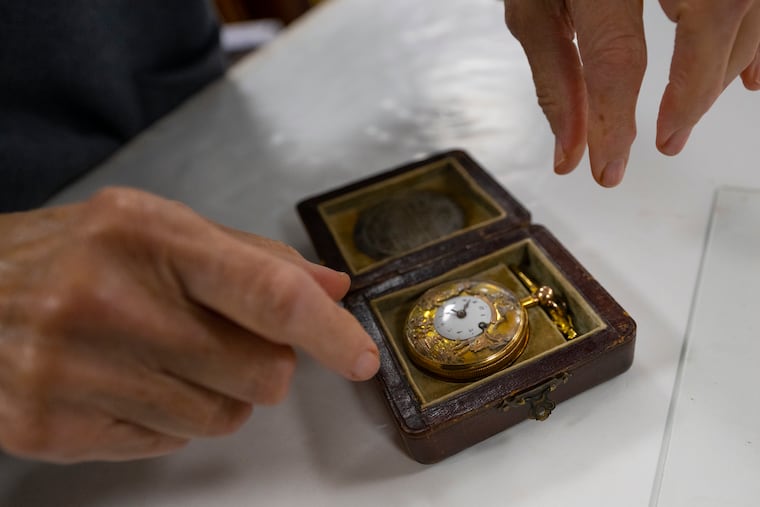
The golden timepiece was gifted to the hero of two worlds.
It was 1805 and the Marquis de Lafayette enjoyed nearly unparalleled fame. Over two centuries later, the Broadway musical Hamilton would dub him “America’s favorite fighting Frenchman.” A dashing volunteer in George Washington’s Revolutionary army, he would go on to liberate his own people in the French Revolution.
It was only fitting, then, that he sported an unparalleled watch.
Showered with gifts on both sides of the Atlantic, the hero of Yorktown was awarded a timekeeper for the ages by the people of France. Embossed with images of Greek mythical figures Orpheus and Eurydice, the 18-karat tricolor gold pocket watch was engraved with Lafayette’s full name and image. A hidden image inside depicted Lafayette’s return to France from America.
It survives with its original tooled leather case, and a gold key to wind it, shaped like a statuette of its owner.
And now it’s up for sale. The Philadelphia-based Freeman’s, an auction house as old as the watch itself, acquired the piece from a private collector in Chicago after it had spent years at Lafayette College, the marquis’ namesake school in Easton.
It will go on auction Wednesday at Freeman’s American Furniture, Folk and Decorative Arts sale, one of dozens this year that mark the house’s 220th anniversary.
Special auctions at Freeman’s
Freeman’s, the oldest auction house in the nation, is in the midst of a rebrand for its anniversary. The fine art and luxury auction house, which includes 16 locations across the country, is considered an industry leader for private and estate collections in the $1 million to $5 million range. Earlier this month, it updated its social media platforms to highlight the most “extraordinary, unexpected items” to ever end up on the Freeman’s auction block.
The list included decommissioned World War I battleships. A rare copy of the Declaration of Independence found in a bookshop attic. The bloody gloves worn by Abraham Lincoln the night he was killed. Masterworks by Vincent van Gogh, Pierre-Auguste Renoir, and John Singer Sargent. A literal Philadelphia post office.
“Few auction houses can lay claim to such a rich legacy,” said Alyssa Quinlan, CEO of Freeman’s.
While celebrating its own anniversary, Freeman’s is also preparing a series of special auctions to commemorate America’s 250th anniversary in 2026, including ones dedicated to Americana manuscripts and items and artifacts connected to Washington and Lincoln.
Now, Quinlan said, it’s turning to the future while selling artifacts of the past.
“We plan to continue bringing art, history, and design to life, and connecting more people with exceptional objects like these for generations to come,” Quinlan said.
Wednesday’s special auction, one of 140 that Freeman’s hosts at its sites across the country each year, features a walking stick monogrammed for business tycoon John Jacob Astor IV, who died on the Titanic; paintings by the Cape Cod folk artist Ralph Cahoon; and a host of other Americana treasures, like an early 1800s map that touts the new Michigan and Ohio territories.
Despite all that, Freeman’s officials believe Lafayette’s watch could be the star of the show.
It is estimated to fetch $25,000 to $50,000. Reginald Brack, head of the watches department at Freeman’s, believes it could go for much more.
“This really transcends watch-collecting,” Brack said. “This will most likely go to a global collector of history and Revolutionary War memorabilia. We feel like this could be a once-in-a-life time event. ”
To the untrained eye, the watch is simply very cool to look at. To a history buff, it’s a link to America’s founding. To a knowledgeable horologist, it’s a marvel of craftsmanship.
Unlike many pocket watches at the time, it chimed the hour with a series of small gongs that sounded like a chugging locomotive. The 18th-century version of an iPhone alarm, more or less — but much more pleasing to the ear.
“It was quite a flex in its time, to be able to tell the time by sound rather than having to look at one’s watch,” Brack said.
Researchers at Lafayette College and Freeman’s believe the watch was important enough to the marquis — no stranger to lavish gifts — that he kept it among his personal items.
Brack, for one, said he gets chills holding the watch and imagining what the legendary Lafayette could have been experiencing in those moments when he heard his golden watch chime.
“A watch is something that is so personal to its owner,” he said. “It’s such a personal item owned by such a global figure.”