A South Philly man was convicted in a prolific arsenic-murder ring on this week in Philly history
On March 22, 1939, spaghetti salesman Herman Petrillo was found guilty of first-degree murder in an insurance scheme in which an estimated 50 to 100 people died.
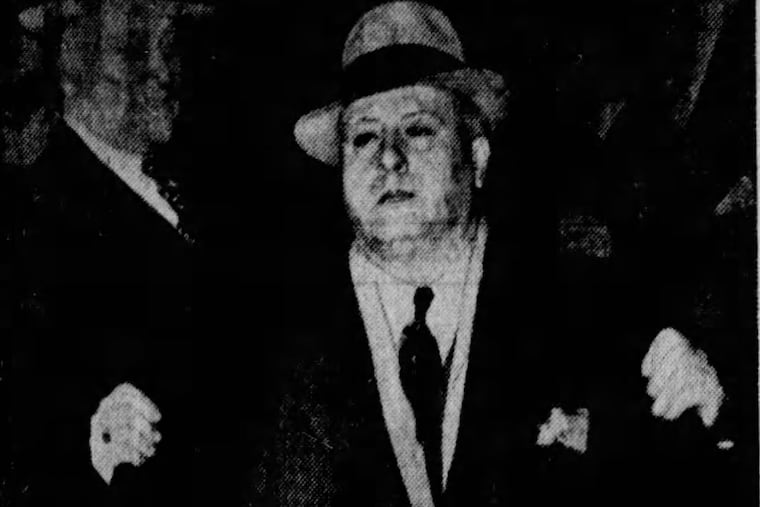
Exploiting the financial stress that followed the Great Depression, two cousins from South Philadelphia initiated a murder-for-hire scheme preying on Italian immigrants that resulted in one of the most notorious crime sprees in city history.
Not all of their victims were even accounted for, but it was estimated that 50 to 100 people died.
Facing their own financial straits through the years, spaghetti salesman Herman Petrillo had become skilled in counterfeiting, while tailor Paul Petrillo had developed talents for insurance scams. They joined forces with another cousin, Morris Bolber, and created a “matrimonial agency” matching widowed women with new husbands, usually hapless Italian immigrants.
But they didn’t do it in the name of love.
The criminal masterminds would initiate life insurance policies for these new husbands, and see to it that they succumbed to “accidental” deaths shortly thereafter. Bolber would help file insurance claims to capitalize on a provision in the policies that allowed for double payment if the death was accidental.
The “accidents” ranged from drownings to poisonings, which led the local press to name the gang “Arsenic Incorporated.”
The scam started to unravel in October 1938. Police were getting suspicious as more immigrants of similar circumstances were dying, their toxicology reports showing elevated levels of arsenic. One victim, a poor Italian laborer named Ferdinand Alfonsi, and a snitch provided the link police needed to confirm a larger criminal conspiracy.
Upholstery cleaner George Myers had approached Herman Petrillo for a loan to save his business. Herman Petrillo said he would pay Myers $500 in cash to kill Alfonsi, after repeated attempts to poison the laborer were unsuccessful. Myers was instructed to hit Alfonsi with a lead pipe and then arrange the body to make it seem as if the dead man had suffered an accident. Uncomfortable with the agreement, Myers alerted the head of the Philadelphia branch of the U.S. Secret Service, which was already eyeing Petrillo for counterfeiting.
An undercover agent posed as a hit man and contracted with Herman Petrillo to kill Alfonsi for the same $500. The agent also tried to get Petrillo to sell him counterfeit money.
Before his death from an unrelated ailment, Alfonsi told police he had applied for life insurance several times, but his wife intercepted the mail and told him he was not approved. Investigators learned after Alfonsi’s death that he had been approved for the insurance, and his wife was the beneficiary of a policy totaling more than $8,000 ($188,000 in today’s dollars).
On March 22, 1939, Herman Petrillo was found guilty of first-degree murder. Paul Petrillo pleaded guilty that December. In total, 24 people were indicted, including the Petrillos, Bolber, and some of the so-called “black widows.” Most were sentenced to life imprisonment.
The Petrillos were sentenced to death and executed.