These ghostly 3D images bring Philadelphia’s 1876 World’s Fair back to life
The stereographs are featured at the Museum of the American Revolution’s World’s Fair Night, which revisits the first time Philadelphia hosted the world.
The world came to Philadelphia for the 1876 Centennial Exposition and took home tons of souvenirs.
Legions of enterprising vendors hawked every conceivable ephemera and novelty at the massive fairgrounds erected in Fairmount Park for the nation’s first World’s Fair, a glittering, grandiose six-month extravaganza marking 100 years of American independence.
Everything from decorative china and glassware, commemorative medals and engraved pocket watches, illustrated guidebooks and gigantic maps, silk-woven ribbons and scarves embroidered with images of George Washington, lithographs showing the illuminated Centennial city and models of the fair’s five main exhibition buildings. For a quarter, fair goers could buy sheet music of the exposition’s sprightly theme song: “Centennial March.”
For the 50-cent price of a ticket, all could be had at Philadelphia World’s Fair, a thunderclap of American industry, ingenuity, and art, where culture-shifting technologies like Alexander Graham Bell’s telephone, the Remington typewriter, and Edison’s electric pen all debuted.
Horticultural Hall sold bananas, an exotic delicacy served in tin-foil for 10 cents, and enjoyed with a knife and fork. Food stalls introduced iconic foodstuffs, like popcorn, hamburgers, Heinz Ketchup, and root beer to the masses.
“Souvenir culture was a massive part of the exhibition experience,” said Alexandra Cade, an assistant curator at the Museum of the American Revolution, which includes artifacts from the Centennial in their collection. “It was a citywide effort to commemrate this event.”
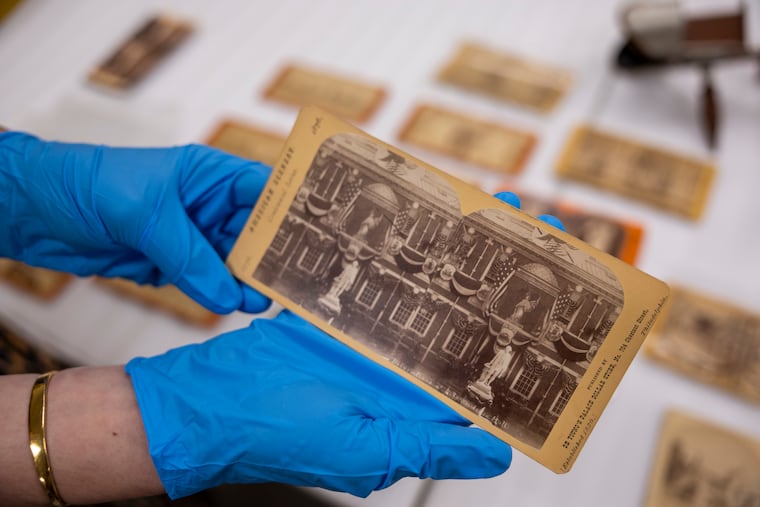
Few Centennial Exposition keepsakes were more popular than the stereoscope viewing devices that sold for less than a buck in Machinery Hall. The 19th-century version of a virtual reality headset, the hand-held wooden viewing devices used prismatic lenses and nearly identical side-by-side photos to display 3D images of the fair.
Stereoscopes, and their mounted photo cards, known as stereographs, became a minor hit of the exposition. Squinting through their stereo viewers, visitors from all over marveled at patriotic scenes that seemed to spring to life.
“It was just this idea that people could take home the experience with them, and continue to sort of relive what they saw, what they heard, what they ate throughout the Centennial experience,” Cade said.
Sold in packs on the fairgrounds for 25 cents — less than $10 in today’s money — and now found on eBay for anywhere from $25 to $150, popular Centennial stereographs featured textured aerial views of the exposition’s 285-acre fairgrounds:
Strikingly vivid scenes from the Main Exhibition building, the largest building at the time, showcasing international products in mining, metallurgy, manufacturing, education, and science. Immersive photos of the fair’s glass-domed art gallery, known as Memorial Hall. (Now home to the Please Touch Museum, it is the only major structure from the exhibition to survive.)
And Philly landmarks too, including haunting images of the inside of Independence Hall. Through the lenses of the stereoscope, the ghostly rooms suddenly appear dimensional and lifelike, and viewers can easily imagine the Founding Fathers doing the work of independence.
The stereographs, part of Cade’s personal collection, will be featured at the Museum of the American Revolution’s World’s Fair Night on May 8. Part of the museum’s special 250th-themed after-hours programming — which previously featured a soirée exploring Revolutionary tavern life — the event revisits the first time Philadelphia hosted the world and celebrated its revolutionary roots. The evening includes historical roundtables and Centennial-themed food and drink, including root beer floats, hamburger sliders, and strawberry banana pound cake. Tickets are available at the door.
Returning to those 19th-century days when Philadelphia first draped itself in bunting and fireworks and hurled itself onto the world stage, the evening also highlights robust Centennial collections of the Historical Society and Philadelphia Museum of Art.
The Historical Society holds a remarkably vast Centennial collection. Stretching across shelves, the archive includes thousands of the Exposition administrative files, architectural plans, photographs, guidebooks, stereographs, and ephemera, like elegant printed invitations to the fair’s opening on May 10, 1876, attended by 100,000 people and featuring a speech by President Ulysses S. Grant
Selena Austin, a programming and communications manager at the Historical Society, and part of the museum’s World’s Fair Night roundtable, has long been drawn to the Centennial, and its lasting impact on America and Philadelphia. A dizzying, patriotic fever-dream carnival that riveted — and took over — the city.
“It was a city within a city,” she said, on a recent afternoon in an archival vault, where the collections are stored.
Laid out on a table were a sampling some Exposition artifacts: Grant’s handwritten speech, a bursting registry from the fair’s Women’s Pavilion, signed by Elizabeth Duane Gillespie, a great-granddaughter of Benjamin Franklin, who helped plan, fund, and organize the women’s exhibition, a signed, “non-transferrable” press ticket; a leather bound guidebook detailing the bills of fare of the expositions nine themed restaurants, including a French bistro, a Vienna Bakery, and a “Restaurant of the South.”
Raw from the wounds of the Civil War and flexing for the world, for better or worse America sought to define itself through the sheer scope and ambition of the fair, she said. An effort at national unity, it was, though, an exclusionary affair. Black people could attend but were largely left out of planning.
“150 years later it evokes the same amount of awe it did when it opened,” she said, adding that the Centennial was not just spectacle. “It was also a space for people to think about the nation’s past, present and future – about how far we came and where we could go.”
For her part, Cade, of the American Revolution Museum, said she hopes the city’s 250th celebrations revive an interest in the Centennial Exposition.
Growing up in Lower Merion, she first became enchanted with the fair riding past the Ohio Building, a surviving state exhibit hall from the fair in West Fairmount Park. She sees it as a snapshot of American history, when Philadelphia offered an aspirational, yet unfulfilled vision of America.
On a recent afternoon at the museum, she fixed a stereograph into a stereoscope, showing Independence Hall decorated in patriotic bunting for Centennial.
“I wish I could have been there to see it,” she said. “But this is as close as I get, because it brings it back to life.”