City Hall clock kept the wrong time on this week in Philly history
On Feb. 4, 1969, the east face of the timepiece started running 20 minutes behind, and a day later it had extended to an hour and 15 minutes late.
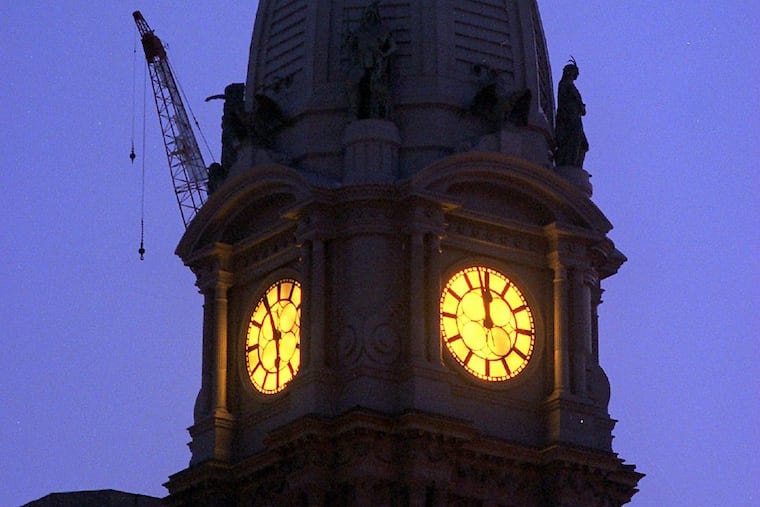
City Hall has rarely been on time.
In the 1930s and 1940s, its four iconic clock faces, just under the bronze feet of William Penn’s 37-foot statue, were, reportedly, regularly out of sync.
And on Feb. 4, 1969, the east face of the timepiece started running 20 minutes behind, as reported in The Inquirer, and a day later it had extended to an hour and 15 minutes late.
East Penn Square was abuzz.
Harry Browndeis, who ran a business nearby, told The Inquirer:
“I guess if everything else over there is going wrong, why not the clock?”
Hands of time
The clock and its four faces were installed on City Hall way back in 1899, and they were very impressive.
And then a half hour after installation, according to The Inquirer’s Daniel Rubin, the clock stopped.
“It was run by a precision German-made master clock, which drove a huge, pneumatic machine that produced 700 pounds of pressure to move hands over the 26-foot-in-diameter faces,” Rubin wrote in 1995.
The clock’s mechanisms were quirky, and its failings were routinely cataloged in the black-and-white pages of the city’s daily newspapers.
For nearly 50 years after its creation, one city employee, Joe Gaskill, looked after the timepiece.
In 1939, the clock was considered the fifth-largest timekeeper in the world, Rubin reported.
And Gaskill endured pressure from the city’s pocket-watch carrying fanatics, a stress hard to imagine today.
In 1947, the pneumatic machine was replaced with a more modern assembly. In 1952, the city began honoring daylight saving time, which required manual resets. And after a while, the errors became less and less newsworthy.
But after a major renovation from 1984 to 1990, the clock’s reliability once again came under question.
And in 1995, according to Rubin, the dial on the east face and the dial on the west face were not matching up.
But as of 2026, the clock faces, seemingly, seem to be in better harmony.
‘Months without trouble’
Back in ‘69, the city workers sent someone up to fiddle with the thing.
They replaced the tiny electric motor that turns gears behind the enormous clock hands. There is one motor for each clock face.
And the malfunctions, traditionally, seemed to come in bunches.
“We go for months without trouble, then all of a sudden we get one or two motors that go out on us,” said Edgar Grim, the city’s communications chief. “Frankly, we don’t know why.”
A new motor was installed on the east face, and just in time for the evening rush.