The last in a long line of Walnut Street costume shops closed on this week in Philly history
The Philadelphia Costume Co. shut its doors on May 1, 1998, ending an era on Walnut Street.
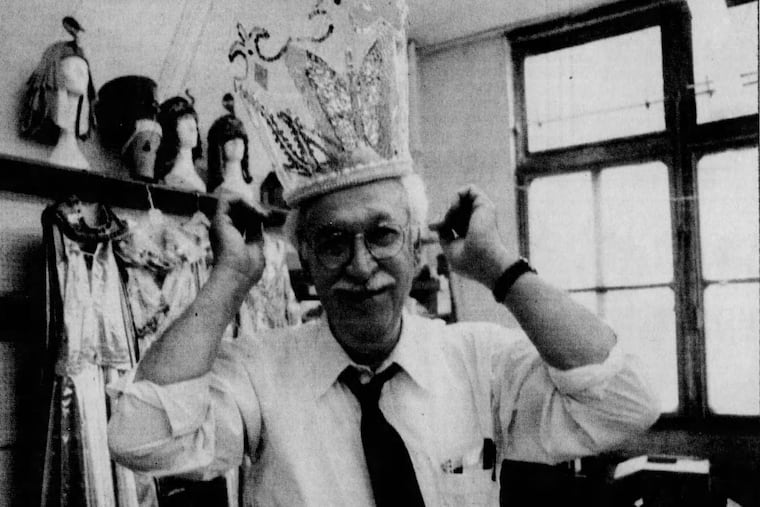
As the curtain closed, the man who had lived for wrapping performers in sequins and adorning them with puffed-up sleeves only saw tragedy.
Benjamin Morelli told the Daily News in 1997 — on the eve of Halloween — that he was “the last of a dying breed.”
And on May 1, 1998, when the 70-year-old costume designer hung up his tape measure and closed the Philadelphia Costume Co. for good, he told The Inquirer: “It’s a dying art.”
At one time, a half-dozen designers called Walnut Street home.
Morelli shook his head.
“Forty-three years in business.”
Strut-wear
In true Philly fashion, it all started with a marriage and the Mummers.
Morelli wed his sweetheart, Tina, after serving in the Army in World War II. They moved into her mother’s West Philly basement, and during the day he designed window displays at Lit Bros. department store.
But at night, he studied hat-making and pattern design and tinkered with cutting tables and sewing machines.
And he got to working on strut-wear.
Morelli partnered with his new brother-in-law, Bob Oranzi (they married twin sisters), and won over string bands by cleverly adding working clocks and functional carousels to polished suits.
As Jimmy Carter moved into the White House, the duo moved to Walnut Street and joined the real costume party.
Those glory years would be defined by the shops clustered around 11th and Walnut Streets, including Waas Costume, Neubauer’s Formal Wear, Pierre’s Uniforms, and Miller Costumier.
This group also includes Van Horn’s (later Brooks, Van Horn’s), which grew out of a Walnut Street embroidery business, and is counted as the first theatrical costume firm in the United States.
History in every stitch.
Final curtain
Morelli designed for Phantom of the Opera on Broadway and Euro Disney productions in Paris. Everything from showstopper gowns for posh ballrooms, to frock suits for opera’s Luciano Pavarotti (“60 chest, 60 waist,” Morelli said in 1998).
And, yes, before Halloween pop-ups became ubiquitous he’d suffer through tacky monster getups and trendy Star Wars gimmicks.
And every year, there were the Mummers.
By the mid-1980s, the shop was working with half a dozen string bands, accounting for at least half of its yearly revenue.
The standard mummer’s costume, consisting of hat, shirt, jacket, vest, trousers, and possibly a cape, ranged from $150 to $800 (or $500 to $2,650 today).
The shop employed designers, cutters, drapers, tailors, and seamstresses, counting 17 employees in its heyday. But by the 1990s, he was the only shop left on Walnut, and most of his workers had died or retired. And Morelli couldn’t take on the extra work himself.
He longed for a new generation to follow the thread.