A city music festival drew 80,000 with Louis Armstrong on this week in Philly history
The annual event made use of a large stadium during the slower summer months post-World War II.
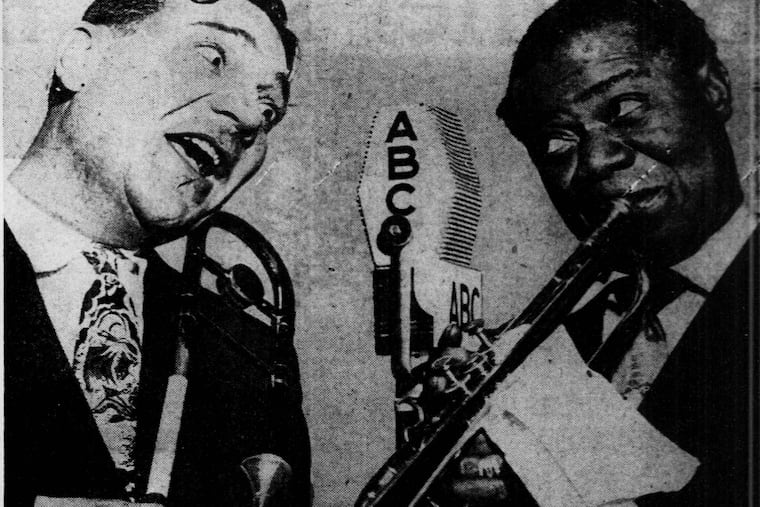
Before Jay-Z at the Roots Picnic or Bad Bunny at Made in America, there was Louis Armstrong at the Philadelphia Music Festival.
Before there was the American Idol competition, there was Philly’s “Voices of Tomorrow.”
Shortly after Germany surrendered, but a few months before Japan followed suit, Philadelphia put on its first true citywide music festival.
In 1945, the city held its inaugural festival, creating an event leaders claimed was for the kids and a distraction from war, and a celebration of Philly’s robust music scene. It also made use of a large stadium during the slower summer months post-World War II.
By 1949, the city was on its fifth event, and the festival had proved to be an opportunity to raise money and spirits.
‘Symposium of the arts’
On Friday night, June 10, 1949, the city’s festival held its fifth iteration.
The Inquirer, which sponsored the event, called it a “symposium of the arts.”
“On a magnificent June night with a great golden moon peeping over the rim of Municipal Stadium, an exited and delighted throng of 80,000 people, largest crowd ever to attend a cultural event in this city, roared their applause last night for the star-studded fifth annual Philadelphia Music Festival,” The Inquirer reported the following day.
The paper said the total eclipsed the previous year’s attendance of 72,000, with acts like jazz legend Armstrong, violinist Jeanne Mitchell, and pianist and vocal improvisationalist Alec Templeton.
These performances included local acts from area high schools, bugle corps, and marching bands.
‘Voices of Tomorrow’
In its annual “Voices of Tomorrow” contest, four young singers rose above a field of more than 2,000 competitors, singing in opera and “other fields” hinting at what was coming in the following decade. Competitors would sing in front of the crowd, which would choose the four winners by applause.
And the nearly four-hour event closed with the playing of “The Star-Spangled Banner.”
Municipal Stadium, which was opened in 1926 for the Sesquicentennial, would be named after John F. Kennedy in the 1960s, and would close in 1992.
The city’s 11th annual music festival in 1955 was its last until the 1960s brought the Philadelphia Folk Festival, Beatlemania, and a cultural revolution.