Philly wants to host the DNC in 2028. Eighty years earlier, it hosted 3 conventions.
Philadelphia was pursuing the national political spotlight in 1948, and landed nominating conventions for the Democrats, the Republicans, and the Progressives.
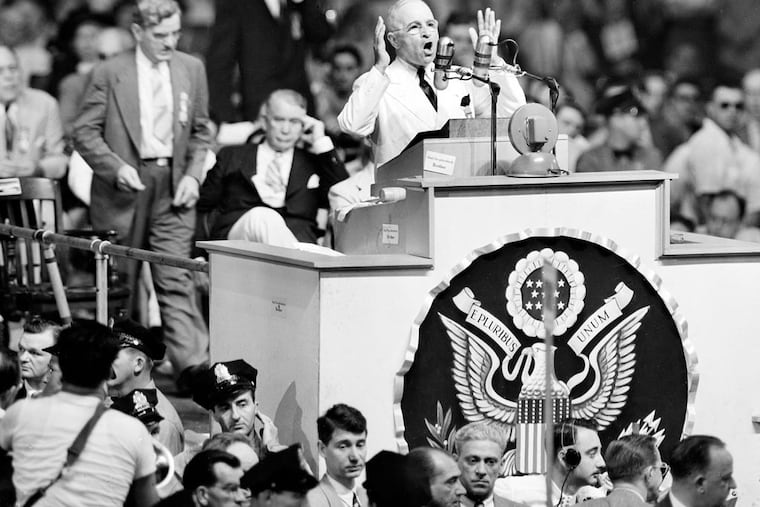
It has been about 180 years since Philadelphia started hosting major political conventions, and we’re on the short list to host yet another Democratic National Convention in 2028 — which would be our first in more than a decade.
But about 80 years ago, Philly played host to not one large political gathering, but three.
The year was 1948. At the time, city leaders were aggressively pursuing the national political spotlight, and got exactly what they bargained for after being selected as the site for not only that year’s DNC, but also the Republican National Convention, as well as the convention for the Progressive Party, a then-popular upstart group that some viewed as nothing more than a cadre of Communist sympathizers.
And, perhaps more significantly, all three conventions took place across about five weeks’ time in the heat and humidity of one scorching Philadelphia summer, occupying a long-gone event space known as Philadelphia Convention Hall and Civic Center. Demolished in 2005, the site today is home to Penn Medicine’s Perelman Center for Advanced Medicine at 3400 Civic Center Blvd.
But eight decades ago, it was the political battleground from which New York Gov. Thomas E. Dewey, incumbent President Harry S. Truman, and former Vice President Henry A. Wallace emerged as 1948’s leading presidential candidates. After that, no major political party held a presidential nominating convention in the city for more than half a century.
Here is how The Inquirer covered that monumental summer:
https://www.newspapers.com/article/the-philadelphia-inquirer/193286571/
Article from Jun 22, 1948 The Philadelphia Inquirer (Philadelphia, Pennsylvania)
Television set the stage
City leaders in 1947 began courting the Republicans and Democrats, ultimately getting their attention after offering $250,000 in funding to each to have their conventions in Philadelphia — plus thousands of hotel rooms and free use of Convention Hall.
But not to be overlooked, at least by convention organizers, was Philadelphia’s place in the then-burgeoning world of television.
A coaxial cable network had recently been established that allowed the nascent television networks to broadcast convention happenings live to an estimated 10 million people watching 18 stations in nine cities along the Eastern Seaboard. Very much a physical network of cables, it ran roughly from Boston to Richmond, Va., putting Philadelphia about smack in the middle of its run — making the city the premier place from which events could be funneled to other areas.
Television was then a fast-growing industry, and a medium that was anticipated to be a “major economic and social force,” reports from the time indicate. Demand for TV sets, incidentally, was also strongly affected by that year’s political conventions — so much so that local manufacturers like the Philco Corp., which operated 17 factories in the region, including a cathode ray tube-making facility in Lansdale, struggled to keep up with demand.
https://www.newspapers.com/article/the-philadelphia-inquirer/193286389/
Article from Jul 14, 1948 The Philadelphia Inquirer (Philadelphia, Pennsylvania)
Hot, hot heat
For convention attendees, the advent of television was not without its problems. Primarily, those complications arrived in the form of an array of powerful lights installed at Convention Hall to enable visibility for broadcasts — and heating up an already toasty venue, thanks to the hot, humid summer Philadelphia was experiencing.
During the first day of the DNC on July 12, for example, temperatures reached the mid-90s, and humidity levels were “something scandalous,” an Inquirer report noted, leaving convention-goers to sweat it out in the un-air-conditioned hall. Television audiences could see the weather’s impact on speakers and attendees live, especially during the DNC, which took place amid a heatwave.
U.S. Sen. Alben W. Barkley (D., Ky.), who would go on to be Truman’s vice president, gave a keynote speech that was considered a rousing success — though, as Inquirer reports indicated, he was “reduced to a quivering mound of perspiration” during its run.
Contemporary accounts indicate that about 100 DNC attendees were treated for heat-related issues, with ailments ranging from dehydration to heat exhaustion. Though fatalities and hospitalizations were not reported, that year marked the last in which major political conventions were held in venues that lacked air-conditioning.
https://www.newspapers.com/article/the-philadelphia-inquirer/193286669/
Article from Jul 14, 1948 The Philadelphia Inquirer (Philadelphia, Pennsylvania)
An unexpectedly controversial DNC
By most accounts the 1948 RNC was a fairly uneventful affair — one that involved extensive planning, policing, and logistics but essentially went off without a hitch. The DNC, which arrived weeks later, however, was something of a surprisingly spicy event.
Initially, Inquirer reports indicate, Democratic delegates appeared to be resigned to a boring, business-as-usual convention, with many having climbed “reluctantly aboard the Truman bandwagon” following refusals to run by Gen. Dwight D. Eisenhower and Supreme Court Justice William O. Douglas. Truman’s candidacy was largely a foregone conclusion by the convention’s start, which turned out to be a correct assumption.
At least somewhat unexpected, however, was a mid-convention walkout by about three dozen delegates from Mississippi and Alabama who strongly objected to a muscular civil rights plank adopted by the party — as well as to Truman’s nomination in general. Those who opposed those elements would go on to be known colloquially as the Dixiecrats. They later would hold their own convention in Alabama to nominate Strom Thurmond as their presidential candidate, largely around a platform of states’ rights to allow the continuation of racial segregation.
That walkout boiled over following Truman’s nomination, with Mississippi Gov. Fielding Wright announcing the incumbent candidate would “not receive a single Mississippi vote” before leading delegates out of the hall. Georgia Sen. Richard Russell was slightly more dramatic, telling attendees that “the South is no longer the whipping boy of the Democratic Party.”
The walkout fell short of expectations, as many delegates from the South “reluctantly but glumly” remained in their seats, The Inquirer reported.
https://www.newspapers.com/article/the-philadelphia-inquirer/193286477/
Article from Jul 24, 1948 The Philadelphia Inquirer (Philadelphia, Pennsylvania)
A Progressive Party footnote
Following extensive coverage of the RNC and DNC, which themselves brought tens of thousands of visitors to Philadelphia, the final 1948 convention from the Progressive Party seemed to weigh on the nerves of Philadelphia residents.
Essentially viewed as a personal celebration for former Vice President Henry A. Wallace, the Progressive Party’s assumed presidential candidate, that get-together was thought of as “less a convention than an irritant,” The Inquirer reported. This was especially true for Philadelphia’s hospitality workers, who had spent weeks serving Republicans and Democrats before the Progressives came to town.
“First we had the Republicans. They were nice, fat, dignified people,” a maid at the Bellevue-Stratford Hotel, where the parties set up their headquarters all summer, told The Inquirer. “Then we had the Democrats. They were nice, respectable working types — a little thinner. Now we have these people, and, poor things, they look as though they haven’t had a square meal in weeks.”
Then, there was the local media, which, after weeks of intense political coverage, appeared to be mostly fed up by the time Wallace and Co. came around. This was, after all, a pivotal year in the Cold War, and one replete with anti-Communist messaging — and The Inquirer, at least, did not take kindly to the perceived anti-anti-Soviet platform adopted by the Progressives.
“The Progressive Party is composed of countless minority and fringe groups looking for a political home,” one report read. “They consist mainly of ‘aginners,’ against this and against that and willing to follow the Communist sympathizers as long as their own pet ideas are incorporated in the party platform.”

Philadelphia has hosted 12 political nominating conventions since 1848, 10 of them for major parties.
- 1848: Whig National Convention
- 1856: American National Convention*
- 1856: Republican National Convention
- 1872: Republican National Convention
- 1900: Republican National Convention
- 1936: Democratic National Convention
- 1940: Republican National Convention
- 1948: Republican National Convention
- 1948: Democratic National Convention
- 1948: Progressive Party Convention*
- 2000: Republican National Convention
- 2016: Democratic National Convention
*Indicates a minor party convention