The forgotten story of the Jews who helped win the American Revolution
A reimagined Jewish museum will host "The First Salute" from April 2026 to April 2027.
It’s a tale of American independence not taught in schools.
For centuries, the story of how a small community of Jews living in America and on a tiny Caribbean island helped tip the scales of the Revolutionary War was largely forgotten — it’s the story of swashbuckling, patriot Jewish pirates who smuggled gunpowder into America.
The Jewish merchants on the lush, windswept island of St. Eustatius, who supplied Washington’s army with the critical contraband, were members of the first international entity to recognize the United States. Their allegiance to the American cause cost them dearly. Targeted for abuse by the British, they were stripped of their homes and wealth, torn from their families and exiled, and had their graves plundered.
In all, it’s a story of how these Jews helped win the war and found America.
Now, it will be told in full in Philadelphia in honor of America’s 250th anniversary in 2026. And right in the heart of Independence Mall.
‘This is an American story’
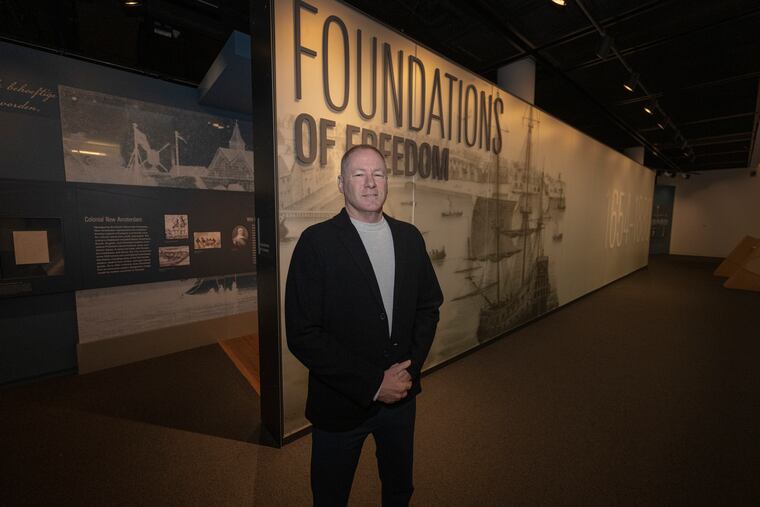
On Thursday, the Weitzman National Jewish Museum of American History announced that the little-known story will be the subject of its landmark exhibition marking America’s anniversary in 2026. The First Salute, running run from April 2026 through April 2027, will fill an expansive, new 4,500-square-foot gallery on the museum’s second floor. Other new galleries planned will feature a permanent exhibition on contemporary antisemitism and exhibits aimed for children, officials said.
Costing about $12 million, and transforming roughly 40% of the museum’s space, the renovations and fresh exhibits represent the first phase of a reimagining, museum officials said. Updates will also be explored for all the museum’s core exhibitions, officials said.
The Weitzman, which is being considered by Congress to become a Smithsonian Institution, opened in 1976, and moved into its current home on Independence Mall in 2010.
Museum CEO Dan Tadmor described the museum’s efforts as a doubling down of its mission.
“We, in a sense, have a renewed purpose in being a trusted sanctuary of truth,” Tadmor said. “This is a museum that opened in 2010, and does not address contemporary antisemitism because, quite frankly, we all mistakenly thought antisemitism in America was in the rearview mirror.”
A new space, set to open later in 2026, will feature the testimonies of Americans who have experienced everyday antisemitism.
Before coming to the Weitzman in January, Tadmor led a $100 million overhaul of Tel Aviv’s ANU Museum of the Jewish People, which bills itself as the largest Jewish museum in the world.
The story of the Jews of St. Eustatius represents the centerpiece of the change to come at the Weitzman, he said.
“This is an American story,” he said. “It happens to be told in a Jewish museum, but it’s an American story.”
“‘Hamilton’ meets ‘Pirates of the Caribbean’”
Tadmor came across the story of the Jews of St. Eustatius while he was still in Tel Aviv. The story had been touched upon by major historians over the decades, he said, but never elevated widely. He was blown away. Fast ships, cannons, decisions that impacted the war. The story had it all.
“Think Hamilton meets Pirates of the Caribbean," he said.
Intrigued by the dramatic details, but unable to do anything with it in Tel Aviv, Tadmor stuck it in his back pocket. Then, he found himself on Independence Mall on the cusp of the 250th, also known as the Semiquincentennial.
Tadmor brought what he knew to Josh Perelman, senior adviser for content and strategic projects at the Weitzman.
Together, they sought guidance from Jonathan Sarna, a preeminent professor of American Jewish history at Brandeis University.
“This is a story that needs to be told,” Sarna told them.
Perelman realized that while pieces of the story had been told, there was a larger narrative out there. Featuring original films, rare artifacts, storytelling, and immersive video, The First Salute aims to connect those threads.
“There were elements to this story that were new to all of us,” said Perelman, the exhibit curator. “Of the many people we have talked to about the exhibition, only a few have known the basics of the story.”
‘History would have been very different’
By 1776, a population of about 400-500 Jewish merchants, descendants of Jews who had been expelled two centuries earlier from Spain and Portugal, had built a thriving community in St. Eustatius. Trading tea and rice, they had built a large Jewish cemetery and synagogue on the small verdant island where a dormant volcano loomed.
With bound ideals of religious tolerance and economic freedom, these members of the Jewish diaspora saw the fight in America as an opportunity to participate in the birth of a remarkable, revolutionary society, Tadmor said. And they staked everything on it. Jews in America fought and died on the front lines. Jews in St. Eustatius smuggled supplies.
“There is a consensus among historians that without the gunpowder, the course of history would have been very different,” Tadmor said.
On Nov. 16, 1776, the friendly American warship Andrew Doria sailed into the island’s busy harbor bearing a copy of the newly signed Declaration of Independence from Philadelphia. Knowing his actions could stoke a response from Britain, St. Eustatius’ governor ordered the island’s cannon to fire a traditional salute of welcome. It was the first international recognition of the United States of America.
By 1781, as war raged on in America, 13 British ships, carrying 3,000 troops, arrived at St. Eustatius. Led by Admiral George Brydges Rodney, the troops were ordered to stamp out merchants and smugglers aiding the colonies. Rodney singled out the Jews for the harshest treatment.
“This rock had done England more harm than all of its most potent enemies,” Rodney wrote in a letter to his wife. “They deserve scouring, and they shall be scourged.”
He ordered all Jewish men on the island to the city weighing house, where goods were weighed and taxed. There, the Jewish men were stripped of their valuables and money. Their homes were seized. Many of the men were banished to other islands without warning to their families. Rodney ordered Jewish graves to be plundered for valuables.
“He clearly had a distaste for Jews, and he brought that with him to St. Eustatius,” Perelman said.
His treatment of the island’s Jews even drew a rebuke from Edmund Burke in Parliament, who declared Jewish people “the people whom of all others it ought to be the care and wish of human nations to protect.”
Meant to be a pit stop, Rodney stayed for months looting, missing his chance to stop the French, who arrived in Yorktown in time to help Washington win the war.
“Rodney is so busy looting and mistreating the Jews that he neglects the second part of his mission,” Tadmor said.
Economically decimated, the Jewish community of St. Eustatius never recovered. Now, their story will live on.
“Their contributions to a world-changing fight for religious liberty and freedom helped create America as we know it today,” Tadmor said. “We’re excited to be able to celebrate the story with all Americans.”