Some young Philly-area workers say they fear remote work more than AI
There are disadvantages to remote and hybrid work, but they can be intentionally mitigated.
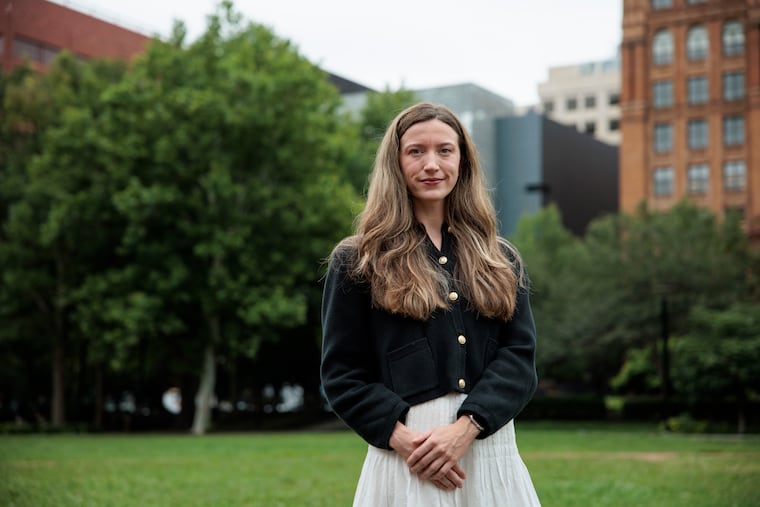
Soon after Aubrey Lee graduated college and moved to Queen Village in 2021, she determined that her burgeoning career in marketing would be aided by time spent in an actual office.
Partly that’s because her first job was fully remote, and she was laid off after only five months. But she also found it alienating to fully work from home, with little chance to interact with coworkers.
So Lee prioritized finding jobs with in-office requirements, and her next one — secured two weeks later — allowed only one day of remote work a week.
“I feel like remote work, especially at such an early point in my career, made me more of a face on a Teams screen than an actual person,” said Lee, who is 27. “I’d also been inside, locked away from my senior year of college during COVID and feeling very isolated.”
Lee said her friends generally agree that working outside the office early in their careers was a hindrance.
“Working remotely can have stunting effects on people’s careers, in terms of both being laid off and not being promoted,” said Lee, whose current job at Publicis Health Media in Old City, is also four days a week in-office.
Remote work has many advantages, especially for those with physical disabilities, parents of small children, older workers, and those caring for elderly relatives. It also reduces time spent commuting and money spent eating at restaurants.
But soon after desks emptied in the face of the COVID-19 pandemic, battle lines began forming over the future of the office.
Workers were generally seen as being in favor of the flexibility that comes with remote work, while many employers and managers wanted people back in the office soon after it was safe.
In recent years, however, nuances have emerged even as hybrid work has come to dominate the American office workplace.
A recent burst of new academic research argues that remote work makes Americans lonelier — especially those who live alone — and that it disadvantages those starting out in the workforce.
Unemployment is relatively high among college graduates and nongraduates, unlike their older counterparts.
Several recent studies argue that the depressed labor market for younger workers — which is often attributed to the explosive growth of artificial intelligence — more neatly matches the rise of remote and hybrid work.
Economists Natalia Emanuel, Emma Harrington, and Amanda Pallais argue that “64% of the recent increase in unemployment among young college graduates is due to remote work.”
They found unemployment among recent college graduates in remote-capable jobs rose early in the pandemic and remains elevated, while those in nonremote capable jobs saw a larger spike in unemployment during lockdown and then a return to the norm.
More experienced remote-capable workers, meanwhile, saw their unemployment levels fall slightly in 2020 and remain lower than pre-pandemic.
“Our overall takeaway is that for young people specifically, it looks like this rise in remote work made it relatively difficult for them to find a job,” said Harrington, assistant professor of economics at the University of Virginia.
The researchers examined hiring at a Fortune 500 online retailer and found that young engineers who worked remotely would get 20% less feedback from their colleagues. They ended up writing lower-quality code, and the company hired fewer younger workers.
“If it’s going to be really hard to build talent internally, one reasonable response is, ‘Well, let’s just not do that,’” Harrington said. “Let’s try to buy talent that has already been built up. That’s consistent with what we’re seeing in the unemployment data.”
Remote work and loneliness
Harrington and Emanuel’s research also has found that remote work increases loneliness by making it harder for people to socialize or make friends in their adult lives, leading to negative effects on mental health.
That resonated with West Philadelphia engineer John Reid’s experience with an almost fully remote job he got in 2022. In his case, the company did have an office, in Valley Forge, but few people actually worked from there.
At first Reid, 38, enjoyed the remote work lifestyle, especially with a new child at home. But as the years wore on, that changed.
“I was mostly remote until late 2025, and I felt like I was getting weird from working at home all the time,” Reid said. “I still had a decent amount of interaction because we live in the city, and I was walking to daycare, but there was less serendipity or new connection than I was used to.”
Today Reid has a new engineering job in Center City, which requires three days a week in-office. He said he would prefer not to go back to fully remote work, nor to a job that was in-office five days a week.
That’s largely the equilibrium that office work has settled into.
After a big push to get workers back to the office in 2022 and 2023, little has changed in recent years. Today, 26% of paid work days in the U.S. are worked from home. That’s up from 7% pre-pandemic, but down from 60% in April 2020.
Some negative aspects of remote work can be salved
There are still plenty of remote work enthusiasts among employees, bosses, and labor experts. After all, hybrid work has become the new norm and many still enjoy fully remote work, with a solid 10% of office workers still working from home, according to Nicholas Bloom, economist at Stanford University.
There are ways to mitigate the negative aspects of remote work, he said.
One recent study by Bloom and his coauthors published by the National Bureau of Economic Research, found that a fully remote firm in Turkey saw “weaker team cohesion, fewer opportunities for real-time coaching and persistent retention problems.”
But a control group of workers who began meeting just one day a month in the office saw increases in productivity and attrition decline by a third.
That suggests even a little team building, and in-person interaction, can go a long way.
When Jake Stein, the CEO of Common Paper, was planning to start his legal technology company before the pandemic, he wanted it to be fully remote. He lives in Society Hill and at his previous company had been frustrated by losing workers to cross-country moves.
He agrees that in-person work is a great bonding experience. Many of his closest friends date to his time at a five-day-a-week office job early in his career. But he doesn’t want to restrict his hiring to the talent pool that’s just within an hour drive of Philadelphia.
Instead, Stein strives to ameliorate the disadvantages of remote work by hosting regular get-togethers, including a weeklong company trip to Mexico City.
Common Paper also offers structured and recurring mentorship for their employees, with software code review and feedback, as well as “lunch and learns” where workers educate one another.
“Things that might happen organically, we’re trying to make them happen on a schedule and with a process,” Stein said. “These are things that you get [easily] in an in-person office. In many cases, they are gettable in a remote setting, but it requires a lot more deliberate effort.”
What about young workers?
Stein said the fully remote model has been successful, although he noted that he does tend to hire more veteran tech workers.
“There’s a bunch of factors, but it’s definitely true that if you look at the average age, it’s for sure higher in the remote setting,” said Stein, who has seven employees.
But he said its hard to know why that’s been the case. It’s probably also true that older workers, with kids or other family responsibilities, are more interested in applying for fully remote jobs.
Bloom agreed that on a larger scale, it’s hard to tell if remote work disadvantages younger people.
It’s probably part of the story, he said, but it’s hard to disentangle from other factors, including pandemic-era over-hiring in sectors like tech and finance, the disastrous effects of remote schooling during the pandemic, and the rise of artificial intelligence.
“Typically in economics when there are four factors, they all tend to be at play,” Bloom said. “They all look similar; they have similar timings, and similar effects.”
Bloom said his research has found little evidence that most workers want to return to the pre-pandemic norm of working in the office five days a week.
At the same time, remote work remains a boon to many, he said.
“Setting aside for young people, remote work almost surely has increased employment because there’s a lot of people that can’t work without it,” Bloom said.