Behind the scenes at world-renowned Martin Guitars
Whenever Christian F. Martin IV hears a Martin guitar, whether it’s the timeworn piece Willie Nelson’s nearly strummed a hole through, or a customer nervously picking a D-300 that looks like fine art and costs $300,000, he beams with pride. Like a father.
Martin is the executive chairman of C.F. Martin & Co., the sixth generation of Martins to create arguably the world’s most-renowned acoustic guitars out of Nazareth, Northampton County. Founded in New York City in 1833 by German luthier Christian Frederick Martin, the company moved to Nazareth in 1839 and has crafted 3 million guitars, all of them intertwined with the family tree.
So when Martin took his daughter to a Post Malone concert in 2020 and watched the artist play a Martin, he smiled from afar. Later, when Malone dragged — yes, dragged — what appeared to be the same guitar across the stage, Martin’s heart dropped.
“I’m freaking out,” Martin said. “I’m looking at my wife, and she’s looking at me like ‘I don’t know.’”
Martin was still processing the trauma of a 145-year-old Martin guitar being smashed in the 2015 Quentin Tarantino film The Hateful Eight. So when Malone smashed the guitar onstage and poured a beer on it, Martin’s heart broke into small pieces, too.
“I need to leave,” he told his wife.
Luckily, before Martin could flee the concert in Hershey to process the trauma, he was told the smashed guitar was a prop, not a Martin.
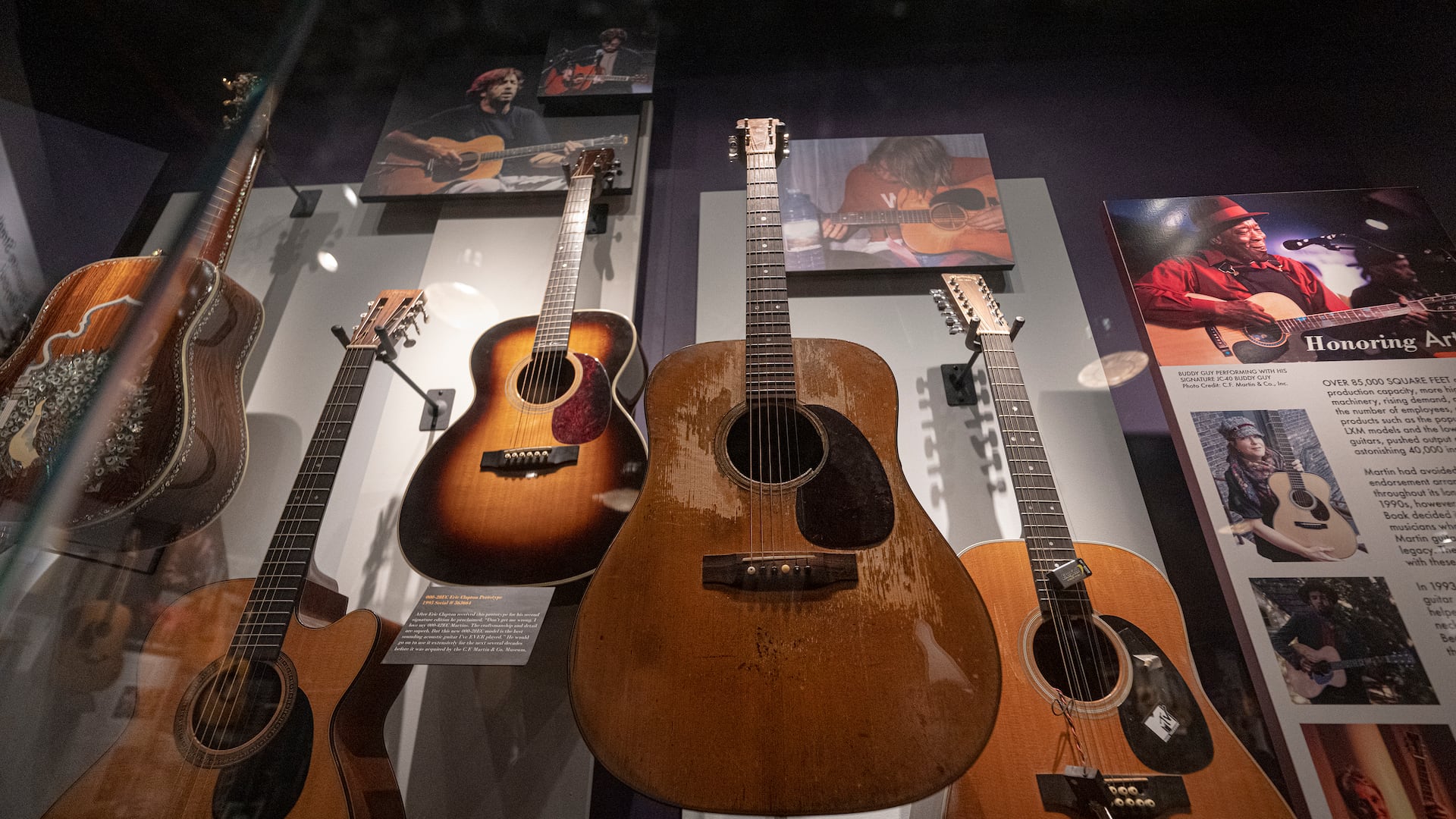
That’s how seriously Martin, and its devotees, takes guitars. On a recent fall weekday in the Nazareth headquarters, tourists were lining up before the building opened for tours, taking selfies. Inside, guitars that belonged to Nirvana frontman Kurt Cobain and Hank Williams, two of thousands of artists who played Martins, sat in glass cases.
(Later that day, Martin flew to London to give a special presentation about the Martin D-18 Cobain played during Nirvana’s famed Unplugged set in 1993.)
“I’ve always just gravitated toward playing Martins,” said Delaware County musician Devon Gilfillian. “When I first started playing, that was just always the goal. The tone is just so perfect and warm. Plus, it’s from Pennsylvania.”
Martin said guitar sales booms are usually tied to specific cultural moments or trends in popular music. Folk music in the 1960s, for example, or the popularity of MTV’s iconic Unplugged series that featured Nirvana, Eric Clapton, Alice in Chains, and countless others.
Today, Martin is still feeling the effects of the COVID-19 pandemic, when many workers were forced to stay home and went looking for something to do. The company is producing approximately 500 guitars per day in Nazareth and a plant in Navojoa, Mexico.
“We’re on a bit of a roll,” Martin said.
“I think it’s important to show people this is where a Martin guitar is made and this is what it takes to make a Martin guitar,” he said. “For many guitar players, coming to the Martin factory is like going to mecca.”
Inside, the factory floor is divided into sections, an assembly line of sorts, with some specialists focusing on fretboards, others on the necks. Some were spraying lacquers, with ventilation masks on, while other lucky employees — musicians themselves — do sound checks, strumming chords for tone. Few guitars are rejected.
The factory is both high and low tech, with robotic arms meticulously sanding bodies while workers use ancient woodworking tools to shape some parts.
That level of specialization, Martin said, makes Martin’s craftsmen the best in the business.
“You’ll see what it takes,” he said. “You’ll see why we’re the best.”
Most Martin guitars are made with various timbers, including a slew of different spruces, along with rarer mahogany and rosewood.
All businesses change, subject to the whims of markets and greater global issues. While the overall design of a guitar hasn’t changed all that much over the centuries, newer and different materials may be in the pipeline, due to issues with climate change and deforestation. The tropical hardwoods grow slowly and are under threat.
Temperate hardwoods like maple and walnut are more abundant, and the company is exploring them, Martin said. The use of alternate materials might be possible, but they would all fall under the same standard: the guitar would need to sound like a Martin.
“We would not use a material that doesn’t work,” he said.
Martin has committed to reforestation projects in Costa Rica and the Republic of the Congo. Martin’s sustainable Biosphere III, with a polar bear design by company artist Robert Goetzl, benefits Polar Bears International and retails for $2,399.
Goetzl has been responsible for most of Martin’s “playable art,” and he cherishes the idea that his art will make art.
“It is art, and it could be hung on a wall, but that would kind of be a shame,” he said on the factory floor, holding a guitar featuring owls and the northern lights. “It’s not cheap. It’s a very real instrument with a beautiful design.”
For many guitar players, coming to the Martin factory is like going to mecca.”
On this weekday, a buyer had come to Martin to possibly purchase a guitar worth more than a quarter-million dollars.
The list of musicians who play Martin is endless, enough to fill a music hall of fame — Nelson and his famous “Trigger,” Bob Dylan, Johnny Cash, Ed Sheeran, Joni Mitchell, and so many others.
“We are very intentional about who we want to work with,” said Thomas Ripsam, who assumed the role of CEO in 2021. ”We don’t really pay artists for playing our guitars, so we are looking for artists who have a sincere connection."
One of them is Billy Strings, a popular, Nashville-based guitarist who combines bluegrass, rock, and even metal.
“When you think of the word guitar, I think of a Martin D-28,” Strings said in a promotional video for guitars that the company designed for him. “It’s so American. It’s like baseball or something.”

- Behind the scenes at world-renowned Martin Guitars
- She left the dating parlors and courting buggies of Lancaster behind. Now she’s learning to date from scratch.
- My mother-in-law gifted me an ugly Eagles table runner. Do I have to keep it?
- Philly named the world’s best place to visit in 2026, apparently | Weekly Report Card
- The best things we ate this week
- How to have a Perfect Philly Day, according to WXPN host Joey Sweeney
- Citywide Quest: Do you know where in Philly these Mummers-themed photos were taken?
- Eat your way through Honolulu, from poke to shave ice | Field Trip
- She needed to leave fast. She bought a four-bedroom house in Strawberry Mansion without any money saved. | How I Bought My House
- Capturing the winter solstice