Peter Paone, a ‘legend’ of Philadelphia’s arts scene for more than seven decades, has died
‘Fearless’ and ‘relentless,’ Philly-born artist was enjoying a late-life renaissance
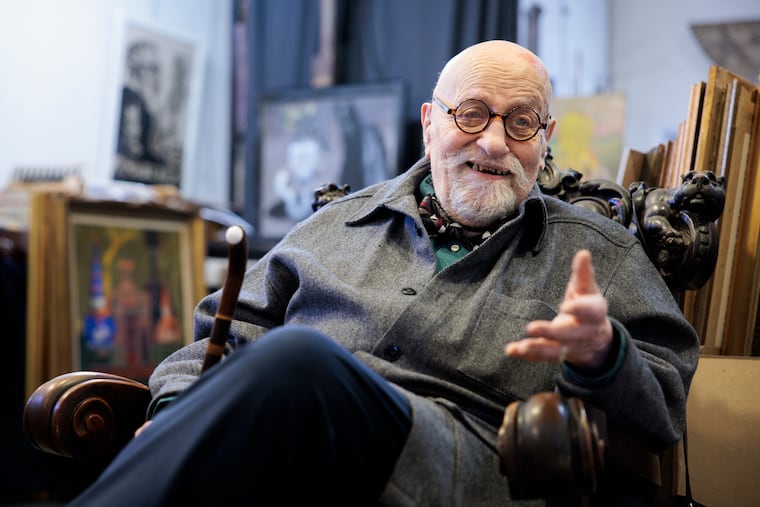
Peter Paone, a longtime pillar of the Philadelphia arts world whose work spanned mediums and appeared in some of the world’s most prestigious art museums, died this week at Jefferson Abington Hospital after a brief illness. He was 89.
Mr. Paone’s death Thursday came as a shock to his many friends and colleagues in the city’s art world, who had come to consider him a “father figure” to Philadelphia artists.
His work appeared around the world, from England to Germany. Stateside, it became part of collections at some of the country’s preeminent venues, including the Philadelphia Museum of Art, the Art Institute of Chicago, and New York’s Museum of Modern Art.
“Peter really became a legend in his own lifetime,” said William Valerio, CEO and director of the Woodmere Art Museum. “And the amazing thing about his life is that he got to know that.”
Indeed, Mr. Paone’s death comes amid a career renaissance of sorts, as his work had been featured recently in a pair of high-profile exhibits at Philadelphia-area venues: “Snowpeople,” at the Woodmere in Chestnut Hill; and “Not So Still Life” at Doylestown’s Michener Art Museum.
Both exhibits debuted last fall and ran until earlier this year, bringing renewed attention both to Mr. Paone’s work and his impact on the city’s arts world.
“He was really being rediscovered, more or less, with this generation,” said Audrey Lewis, a former curator at the Brandywine Museum of Art.
The son of Italian immigrants, Mr. Paone was born and raised in South Philly, where his art career began in earnest at the age of 8.
As a child, he honed his craft at an easel in the basement of the family’s two-story rowhouse, as well as a neighborhood community center. He attended weekly art classes at the Fleisher Art Memorial, and later earned admission to John Bartram High School, a prominent arts school of the time.
At 15, he notoriously finagled his way into the famed Barnes Foundation, scaling the front gate and knocking on the door of the facility, which at the time — 1952 — was not open to the public.
There, arts educator Violette de Mazia reluctantly provided him a glass of water and a personal tour — the start of a friendship that Mr. Paone would credit with spearheading his career as an artist.
After receiving a degree in art education from the Philadelphia Museum School of Art (later renamed the University of the Arts), his early career took him away from Philadelphia.
In 1965, he was the recipient of a prestigious Guggenheim Fellowship. He spent time in Paris and New York, and his work appeared across the world, from London to Vienna to Hamburg.
Curious and gregarious, he was relentless in his pursuit of knowledge, those who knew him said.
Once, in Paris, he knocked on the door of the famed artist Georges Braque — a man he’d never met — with a blunt request.
“[He] said, ‘You’re one of my heroes, I want to get to know you,’” said Valerio.
“Peter was fearless.”
But Mr. Paone was a Philadelphian at heart, and he returned to his native city in the late 1970s, taking a teaching role at the Pennsylvania Academy of the Fine Arts.
It was here that he formally met Alma Alabilikian. Though the two had first encountered each other in a high school art class — at a time when Mr. Paone was already distinguishing himself as a prodigy — it wasn’t until years later that they reconnected.
“I was walking in Rittenhouse Square and I hear this voice holler out, ‘Alma!’” said Alabilikian. “And I couldn’t believe it was the same man.”
They were married six months later, and spent the next five decades in a home near Wissahickon Valley Park.
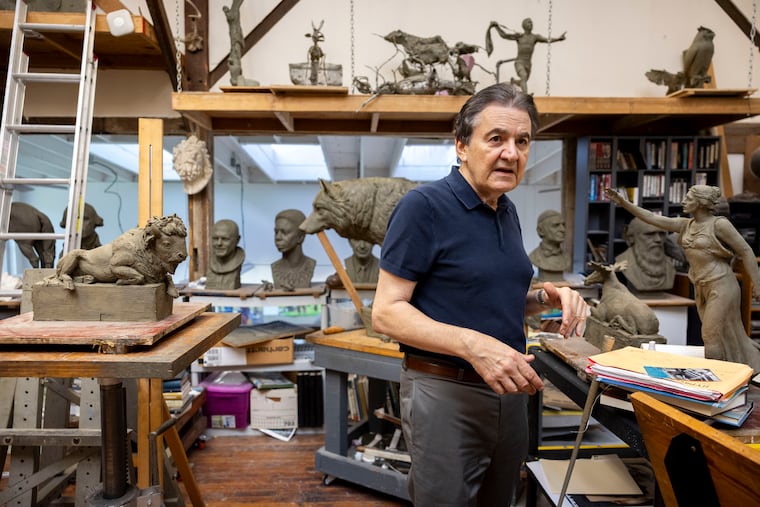
Mr. Paone was most at home in his elegant home studio, where his dedication to craft was absolute. When his wife would nudge him to take a break and go for lunch, he’d decline: “If you’re given a gift,” he’d reply, “it’s your obligation to use it.”
“We call some people gifted,” said Alabilikian. “And I think with Peter, it was just a natural gift that started early.”
As an instructor, he was a mentor to a wide-ranging collection of artists. He taught until 2009 at PAFA, where he created the school’s first printmaking department.
“There’s a lot of artists in this area who will tell you how much they benefited from working with him,” said Ofelia Garcia, an artist and former president of Rosemont College who first met Mr. Paone in the late 1970s. “He had a talent for drawing out people’s imagination.”
Even as he established himself as a teacher and collector, however, Mr. Paone remained a prolific artist in his own right.
Though best known for his paintings, he was skilled in a variety of disciplines — including drawing, watercolors, gouache, and lithography.
In 2019, his eclectic exhibit “Reality Reassembled: The Halloween Paintings of Peter Paone” generated considerable buzz at the Brandywine Museum of Art.
When members of the local arts community would visit him at home in recent years, they would regularly discover new works.
“Making art was such a core part of his life that I don’t think he could conceive of not doing that,” said Laura Igoe, the Gerry and Marguerite Lenfest chief curator for the Michener Art Museum, who worked with Mr. Paone on the museum’s “Not So Still Life” exhibit. “He had a schedule, he was in the studio every day making work, and that was what drove him, I think.
“I don’t think he could think of living another way.”
Until very recently, his wife said, he still spent six days a week working in his studio — buoyed, in part, by the renewed interest in his work.
It was a development, said his wife, that he very much cherished.
“It was a banner year for Peter,” said Alabilikian. “He mentioned it practically every week — ‘Isn’t this amazing, that after all this time that my work is being appreciated, accepted? That people are beginning to understand it?’”
“It had nothing to do with fame and glory,” she added. “He wanted people to see the work, to understand the work. That was all that counted.”
Services are to be held later. A memorial event will also be held for Mr. Paone at the Woodmere Art Museum, though details are still being finalized.