A popular but deadly hiking trail will reopen in the Poconos
The project, according to DCNR, is expected to take anywhere from three to five years.
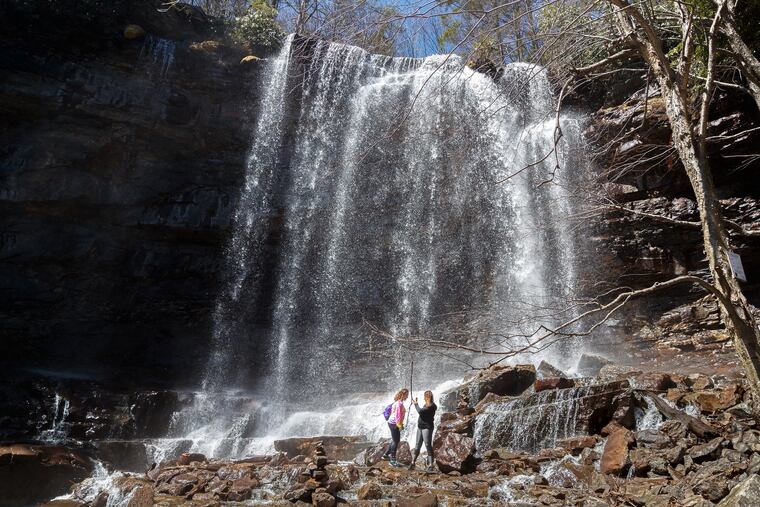
JIM THORPE, Pa. — Long considered one of Pennsylvania’s most popular and scenic hikes, the Glen Onoko Falls Trail was also one of the state’s most dangerous.
Many people have been injured on the steep rocky trail, 85 miles north of Philadelphia, in Jim Thorpe, Carbon County. Others have died. In 1983, David R. Carlyon, 23, of Hazleton, dove across the top of the falls, trying to save his 3-year-old nephew, Ian Russell. Both fell and died. Over the last 50 years, at least 10 hikers have died.
When the Pennsylvania Game Commission closed the trail in 2019, citing safety and trail deterioration issues, Thomas Russell recounted the tragic day his son died.
“I saw him,” he told The Inquirer in 2019. “I saw him clutching at vegetation, at a branch or something, and I guess his hands slipped, or it didn’t hold, and then he was gone.”
Russell did not want the state to close the trail, however.
Now, seven years later, it’s still closed and being transformed into a safer destination. The Pennsylvania Department of Conservation and Natural Resources’ Outdoor Corps has begun a project that will make the trail safer for hikers and more easily accessible to first responders who have to rescue the injured.
The project, according to DCNR, is expected to take anywhere from three to five years. When finished, the trail would reopen and become part of Lehigh Gorge State Park.
Members of the Outdoor Corps have been methodically moving or smashing large boulders on the upper portion of the trail, creating a safer route for first responders to reach injured hikers with UTVs. Many of the trails would be wider when the work is completed.
It’s sweaty, calculating work that often requires heavy hydraulics to move boulders that weigh more than cars. Some of the biggest rocks — most of them sandstone — have earned names, like Belinda, Gertrude, and Turkey Leg.
“When we crush a rock open, that’s the first time the inside of that rock has seen daylight in millions of years,” one Corps worker said.
In 2019, the Pennsylvania Game Commission cited overuse as an additional factor in the decision to close the trail. More than 8,500 people signed a petition at the time to keep the trail open.
Despite the closure and citations issued to hikers found on the trail, it has remained popular, officials said. Officials said the trail is even more dangerous, with hydraulics under high tension to move rocks, during the reconstruction process.
“Even though it’s closed, the public still comes on here,” said Rich Fritsky, regional supervisor for the Pennsylvania Outdoor Corps. “They ignore the signs. They duck under the ropes, but it’s extremely dangerous.”
A hiker had to be rescued just a month after the trail closed, and in 2022, a 72-year-old hiker fell and died there. On a recent tour, two hikers were resting by the falls.
“Last winter, a guy was ice climbing and had to be rescued,” said Timm Berger, the district director for State Rep. Doyle Heffley.
On a recent gathering at the trail rehabilitation site, Berger said Heffley’s office has received countless calls over the years from hikers asking when Glen Onoko will reopen.
“People are anxious,” Berger said.
The popular website AllTrails.com lists Glen Onoko Falls as a difficult hike where proper shoes are required. The trail is a 3.7-mile loop and ascends easily, with flat terrain, for about a quarter-mile beyond the parking lot, following Glen Onoko Run closely. But it grows steeper and rockier as it goes upward, with some narrow ledges that appear to be eroding and some steep drop-offs. Often, hikers need to scramble over wet rocks.
AllTrails also warns hikers that the trail is “temporarily inaccessible,” but many are not heeding the warning.
“It started off fairly easy, but then got fairly difficult,“ one hiker wrote on AllTrails in March. “I can definitely understand why the trail is closed.”