U.S. Army Corps official, congressman say help is on the way for N.J. beach erosion
Zero dollars were earmarked for beach replenishment in 2025 — the first that’s happened since 1996. Up to $200 million annually has typically been awarded.
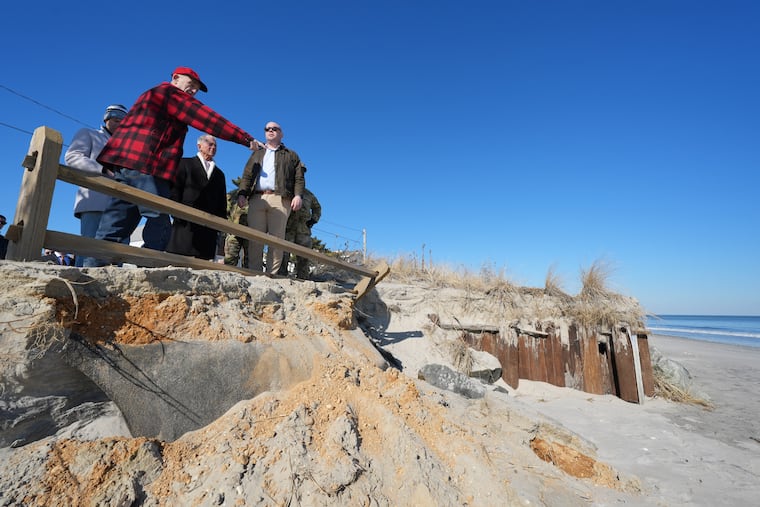
The federal official in charge of the U.S. Army Corps of Engineers visited Ocean City and other Jersey Shore communities Friday, along with U.S. Rep. Jeff Van Drew, pledging that beach replenishment help is on its way.
Adam Telle, assistant secretary of the Army for civil works, came to New Jersey for a tour hosted by Van Drew. The Army Corps manages beach projects and puts up the majority of money. States and municipalities contribute the rest.
“There’s emergency funding that’s available,” Telle said from Fifth Street on Ocean City’s boardwalk, adding that some beaches would see repairs by summer.
Telle said the money does not hinge on legislation and has President Donald Trump’s support.
The Army Corps will evaluate which beaches are in the most severe condition, he said, including Ocean City, which is among the top of the list. Telle and Van Drew did not cite a specific amount of money but indicated millions could be available.
Telle, Van Drew, and other officials visited Strathmere, Avalon, and North Wildwood, which have all been heavily impacted by storm erosion over the last year. The short-term goal this year would be to take spoils from Army Corps projects and spread that on beaches.
They said they plan to draw on a mix of funding, including money still remaining from Hurricane Sandy in 2012, other supplemental funds, and earmarks — language in appropriations bills to direct federal funds to state and local projects.
Van Drew, a Republican, represents multiple Shore towns on the southern tip of New Jersey.
Friday’s tour came on the heels of zero dollars earmarked for beach replenishment in 2025 — the first time that had happened since 1996. Up to $200 million annually has typically been awarded for beach erosion control projects.
Van Drew also introduced a bill last week to establish a new source of continuous beach replenishment money through the Coastal Trust Fund Act.
The bill would pay for ongoing coastal storm risk management by the Army Corps. U.S. Rep. Laura Gillen, a Democrat from New York, is a cosponsor.
According to Van Drew, the legislation would use revenue from offshore energy leases to fund $1 billion a year into Army Corps of Engineers coastal storm management projects.
He said his bill, if approved, would create a permanent source of funding so that it would not depend on yearly appropriations from Congress.
“We need to get a permanent system in place so we aren’t riding this roller coaster,” Van Drew said.
However, he acknowledged that getting any bill approved in Congress right now is difficult.
“It’s going to be a labor of love,” Van Drew said, adding that he is gathering “support from all around the country.”
There is no date for a vote on the bill.
A measure has been introduced by U.S. Rep. Chuck Fleischmann, a Republican from Tennessee, for $23 million to fund coastal replenishment projects this year. That would be supplemented by a Senate bill introduced by U.S. Sen. John Kennedy, a Republican from Louisiana, that would allocate $62.2 million. However, neither bill is scheduled for a vote.
In 2025, multiple New Jersey Shore towns found themselves in a crisis over erosion as Congress and Trump pushed for a huge reduction in the federal budget.
No money was made available for crucial beach nourishment projects. The lack of funding became a political issue in New Jersey, which depends heavily on its beaches for tourism revenue.
For decades, beach projects have been a staple of coastal management in the United States. In 2025, projects were paused in New Jersey, Maryland, and Delaware.
Projects set for Cape May, Stone Harbor, Avalon, Sea Isle, Strathmere, Ocean City, and Long Beach Island were stalled because of the lack of funding. Georgia and Florida also were affected.
In October, Ocean City declared a local emergency over the severe erosion exacerbated by storms like Hurricane Erin and a potent nor’easter in October. The city was left grappling with sand cliffs upward of five feet high after the storms scoured its beaches.
Mayor Jay Gillian and others pushed for urgent state and federal intervention, citing the difficulty of managing large-scale beach replenishments and dune restoration with city resources alone.
Gillian said Friday at the tour stop in Ocean City that he welcomed any help from the Army Corps and Van Drew.
“They’re working for a solution,” Gillian said of Telle and Van Drew. “The permanent funding, that’s huge because it stops the games, and it stops the politics.”
Van Drew represents the largely conservative 2nd District, which spans mostly rural and Shore communities in South Jersey, including all of Atlantic, Cape May, Cumberland, and Salem Counties, plus parts of Gloucester and Ocean Counties. He remains optimistic for funding.
