In the fight over birthright citizenship, the role of ‘birth tourism’ has become a key argument for the Trump administration
Critics say the practice misuses the guarantee of birthright citizenship and can foster immigration fraud.
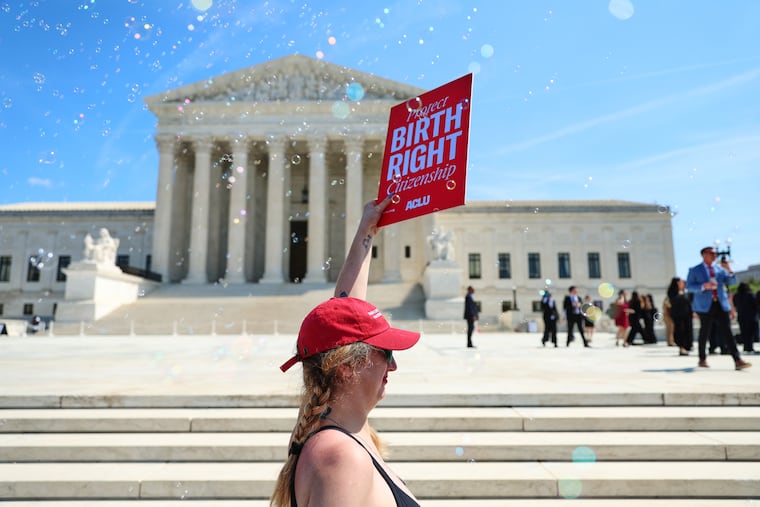
As the Supreme Court prepares to deliver a historic ruling on birthright citizenship ― the legal foundation that confers automatic citizenship on those born in the United States ― the Trump administration has elevated what was once a side issue into a main argument for revocation: birth tourism.
That’s when people from other countries travel to the U.S. for the purpose of giving birth, thereby obtaining citizenship for their babies. On his first day in office in 2025, President Donald Trump signed an executive order to deny citizenship to children born in this country to undocumented parents, specifically to any child whose parents were not U.S. citizens or green-card holders.
During April 1 arguments before the Supreme Court, the administration contended that greater access to the United States by the rest of the world merited a new system of citizenship. With the court poised to rule this summer, the Migration Policy Institute’s Muzaffar Chishti and Colleen Putzel-Kavanaugh took a close look at birth tourism:
Do a lot of people come to the U.S. specifically to give birth?
No. It’s actually rare, despite the outsized role it’s gained in the debate over citizenship. The Migration Policy Institute noted the high estimate of 26,000 births a year, from the Center for Immigration Studies, which advocates for low immigration. That’s a fraction of the roughly 3.6 million children born annually in the United States.
Meanwhile the Centers for Disease Control and Prevention reports that in 2024 about 9,600 babies were born in the United States and its territories to foreign mothers. That includes women who did not necessarily intend to have a baby in the United States.
Still, critics of the practice say that whatever the numbers, birth tourism is wrong. It misuses the guarantee of birthright citizenship, and can foster immigration fraud and tax fraud. They also say it can potentially create national security vulnerabilities, that a person born here but raised in a foreign country could be motivated to act against the U.S.
In arguing to the Supreme Court, Trump Solicitor General D. John Sauer said birthright citizenship has created “a sprawling industry of birth tourism, as uncounted thousands of foreigners from potentially hostile nations have flocked to give birth in the United States in recent decades, creating a whole generation of American citizens abroad with no meaningful ties to the United States.”
It seems like a lot of trouble and expense to give birth in the U.S. Why do people do it?
Many reasons. Citizenship holds promises and rewards, including access to higher education and advanced medical care, the Migration Policy Institute noted. At age 21, citizens can sponsor close family members in other countries to come and live permanently in the United States.
Is birth tourism illegal?
Not exactly. And that’s part of the challenge for policymakers, the institute said. It’s not illegal to give birth while in the U.S. on a temporary visa. However, obtaining that visa specifically to ensure that the child becomes a citizen constitutes immigration fraud. And businesses that charge tens of thousands of dollars to help pregnant women with visas, transportation, housing, and medical care can face penalties if they misrepresent their profits.
In 2020, the first Trump administration created a rule that sought to bar people from traveling to the United States on B-2 tourist visas to give birth. That’s not a perfect solution, but it did attempt to shift the burden to pregnant women to prove they weren’t traveling here to gain citizenship for their babies.
Where in the U.S. does birth tourism happen?
The Northern Mariana Islands, to name one. That’s a U.S. territory in the western Pacific Ocean. It allows visa-free entry to citizens of certain countries. Headlines also arose around “maternity hotels” in Southern California, and over the prevalence of Russian women giving birth in South Florida, the institute noted.
Does this occur in other countries?
Only to a degree. Canada went through a debate over “maternity packages” and “baby houses” being marketed to foreign expectant mothers, the institute noted. Ireland faced similar concerns before it ended birthright citizenship. Since 2005, citizenship there is automatic only if at least one parent is an Irish citizen, a British citizen, or a legal resident who meets certain requirements.
So what’s going to happen next?
The justices seemed skeptical of arguments to end birthright citizenship. It’s been guaranteed in the Constitution since the 14th Amendment was ratified in 1868, after the end of the Civil War. Trump and other opponents argue that it entices people to enter the country illegally, including those coming here for birth tourism. But Trump’s opponents say birth tourism can be addressed by less aggressive means, without undermining what has long been a central tenet of the Constitution.