In court testimony, Bucks County sheriff insists controversial ICE partnership will not affect law-abiding residents
Bucks County residents rallied against Sheriff Fred Harran's partnership with ICE Tuesday ahead of a critical court hearing.

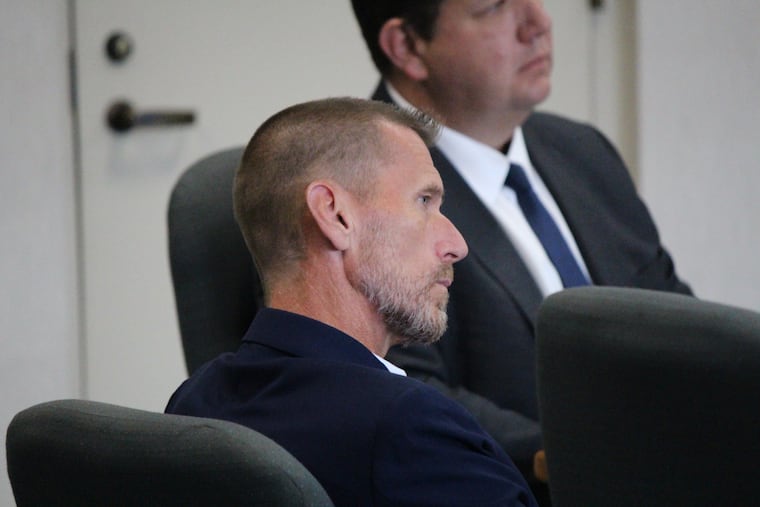
Bucks County Sheriff Fred Harran said Tuesday that he will not allow his deputies to ask law-abiding residents about their immigration status, despite a controversial agreement he signed with U.S. Immigration and Customs Enforcement that would allow it.
In response to a legal challenge from the ACLU and others who worried about racial profiling and fear in immigrant communities, the Republican sheriff spent two hours Tuesday testifying that his department would only check the immigration status of people facing criminal charges or arrest warrants.
“The plan is to be able to issue detainers and check the ICE database for people already in our custody,” Harran said, an assurance he said he had given “100 times” before.
The ACLU and others sued Harran in June, saying he was illegally seeking to have deputies serve as immigration agents. Harran’s testimony Tuesday came as the groups asked the court to issue an injunction to block him from doing so.
Harran said his department did not yet have the technical capability to begin immigration enforcement and had no policy on how to carry out such action, but civil-rights advocates have argued that such enforcement could begin any day, causing irreparable harm to Bucks County communities.
Before the court hearing began, scores of protesters gathered outside the county courthouse to denounce the ICE partnership.
Harran faced steep backlash earlier this year when he became the first law enforcement leader in the Philadelphia area to apply to join the program after President Donald Trump began his second term. On Monday, Harran told the Inquirer his staff was trained and certified under 287(g) but had not yet received the technical capabilities from federal authorities needed to move forward.
In advance of Tuesday’s hearing, advocates from the ACLU, Indivisible, Make the Road Pennsylvania, and the Welcome Project rallied dozens who opposed the program, shouting, “Hell no!” and promising to vote Harran out of office in November regardless of the outcome of Tuesday’s hearing.
“This is dedicated to the immigrants who are being attacked, who have no voice, who feel alone, who feel the world is against them,” said Karen Rodriguez of Make The Road Pennsylvania, an advocacy group.
She then sang a pitch-perfect rendition of “The Star Spangled Banner” — in Spanish.
People held up signs that said, “Keep the immigrants, deport the racists,” and “Immigrants are our backbone, abolish ICE.”
”We do not want ICE in our county," declared Laura Rose of Bucks County Indivisible.
She asked the crowd, “Do we want 287(g) in Bucks?”
”No!" people shouted back.
As the rally drew to a close, Rose urged attendees to sit in on the court hearing, leading dozens of people to line up to enter the Bucks County Justice Center, resulting in an hourlong delay in the start of the hearing.
“Let’s kick Fred Harran’s butt today,” she said.
Immigration enforcement in Bucks County
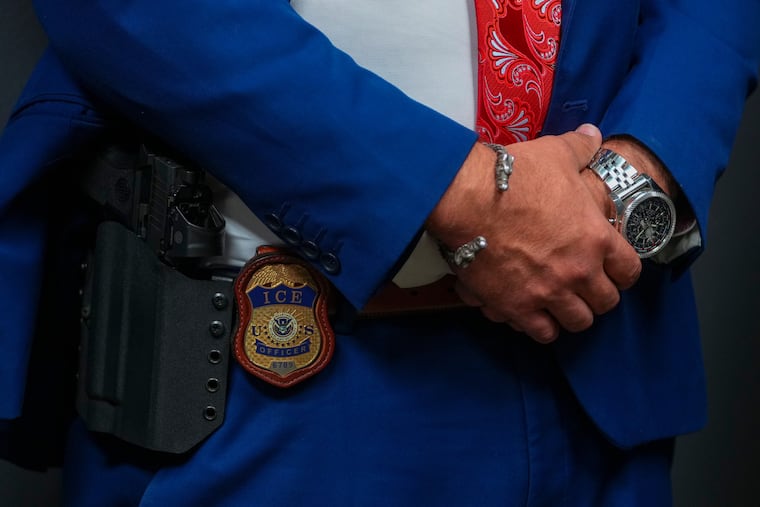
Harran’s alliance with ICE, signed in spring, is part of a controversial ICE program known as 287(g), named for a section of a 1996 immigration act. It’s the umbrella under which state and municipal police departments work to assist the agency in identifying, arresting, and deporting immigrants.
The suit says Harran entered into the agreement without authorization from county commissioners, who have disavowed the sheriff’s actions. Also, the suit says, the agreement would siphon county resources to serve ICE goals while eroding trust between police and immigrant communities.
Harran has defended the alliance, insisting it would make county residents safer. He says it will not be used for broad enforcement or random checks — points disputed by immigration activists — but added that “those who commit crimes must face the consequences, regardless of immigration status.”
Harran describes his department’s involvement as a “narrowly defined initiative focused on public safety,” in which 12 of the department’s 76 deputies would be trained to access a federal database identifying people taken into custody on criminal charges and who have outstanding warrants in Bucks County.
Immigration activists say that’s untrue, that the program would allow sheriff’s deputies to ask anyone about their legal status and to serve warrants for immigration violations, turning local officers into de facto ICE agents.
In testimony Tuesday, Harran insisted that, while the agreement granted broad allowances to his staff, he intended to write internal policy limiting the scope of their abilities.
His staff, Harran said, would “absolutely not” knock down doors, racially profile, or inquire about the immigration status of residents without a criminal record.
“If I can prevent someone from committing crime by way of deportation, sign me up,” Harran testified.
The ACLU of Pennsylvania and the Community Justice Project filed suit on behalf of Make The Road Pennsylvania, NAACP Bucks County, the BuxMont Unitarian Universalists, and Bucks County resident Juan Navia.
As a person of color of Latino descent and having a Hispanic surname, Navia contends that the ICE agreement puts him at increased risk of being subject to warrantless search, arrest, and detention for suspicion of being undocumented, the lawsuit said. As a voter, he has standing to challenge the action of a government official who attempts to usurp the authority of the elected commissioners.
An attorney for Bucks County argued Tuesday that, without the prospective policy in writing, Harran could change his mind with the stroke of a pen.
And Rev. Kevin Jagoe of the BuxMont Unitarian Universalists testified that he’d spent more time counseling congregants since 287(g) was announced in Bucks County, as many worried about the potential fallout of the policy.
“Suddenly, things that were in headlines in newspapers were in our back doorstep,” said Jagoe, who worried Harran wouldn’t stick to his promise of limiting his deputies’ immigration actions.
In 2018, during Trump’s first presidency, Harran sought to partner the Bensalem Police Department with ICE as the community’s public safety director. After steep backlash, the proposal was abandoned.
Elsewhere, the 287(g) has been rejected by jurisdictions that say they pay their police officers to enforce local laws and assist local residents, not to do the work of the federal government.
Still, the number of local and state alliances with ICE grows nearly every day across the nation — currently 1,000 in 41 states, up from 622 in May.
In Pennsylvania, the number of ICE partnerships has surged from 10 to 39 in recent months, the ranks ranging from sheriff’s offices to police departments to constables’ offices.
Seven states, including New Jersey and Delaware, bar the agreements by law or policy.
A 2022 study by the American Civil Liberties Union found what it said were widespread civil rights violations among more than 100 law enforcement agencies that took part.
Some police departments dropped out after Lehigh County and Allentown authorities were successfully sued for keeping a man of Puerto Rican descent in prison — even after he posted bail — so that ICE could investigate whether he was in the country illegally.
It turned out that Ernesto Galarza was born in New Jersey, and his settlement for three days behind bars cost taxpayers $145,000.
Manpower has been a challenge for ICE, which is responsible for carrying out what Trump says will be the largest deportation effort in American history. The agency employs about 20,000 people in the U.S. and around the world, while the undocumented population in this country numbers about 13 million.
Advocates of the program say that is part of why 287(g) is needed, to assist federal agents in the lawful performance of their duties.
Political fallout
Harran’s agreement with ICE has provoked wide dispute in Bucks County, prompting dozens of people to speak in favor and against at public meetings. Some say local taxpayers should not be paying deputies to perform federal functions, while others say migrants who are in the country without permission must be identified and kicked out.
And it has been a driving force in Democrats’ campaign to deny the Republican sheriff a second term.
“This election is really about whether voters want their sheriff to be using taxpayer dollars and deputies’ time doing the Trump administration’s bidding instead of their actual responsibilities,” Danny Ceisler, a Democrat running against Harran, said in an interview.
Ceisler, an Army veteran who held a public safety post in Gov. Josh Shapiro’s administration, contends that Harran has used the department’s already limited resources to torch its relationship with immigrant communities.
The message may be resonating.
A poll released last week that was paid for by a Democratic PAC and conducted by a progressive firm found that Harran trails Ceisler by seven points among likely voters in Bucks County.
While Democrats have focused on Trump and immigration, Republicans have hoped to make Harran’s race about crime.
In social media posts, the sheriff has highlighted his long career in law enforcement as a contrast to Ceisler. And the Bucks County GOP shared a campaign ad that highlighted Harran’s work reducing outstanding warrants while warning against bringing “Philly crime” to Bucks County.
The race will provide insight into how Trump’s second-term policies fare in one of Pennsylvania’s most essential swing counties ahead of 2026.
Advocates on Tuesday promised that their fight against Harran and 287(g) wouldn’t end at the courthouse.
“No matter what happens today, we’ll fight it in November,” Rose said.
Staff writer Fallon Roth contributed to this article.
This suburban content is produced with support from the Leslie Miller and Richard Worley Foundation and The Lenfest Institute for Journalism. Editorial content is created independently of the project donors. Gifts to support The Inquirer’s high-impact journalism can be made at inquirer.com/donate. A list of Lenfest Institute donors can be found at lenfestinstitute.org/supporters.