Bucks County parents of deaf and blind infants are worried about losing a ‘lifeline’ as early intervention contract ends
On Saturday, the Bucks County Intermediate Unit will stop services for hearing and visually impaired babies and toddlers ages 0-2. And it’s unclear where parents will find services next.
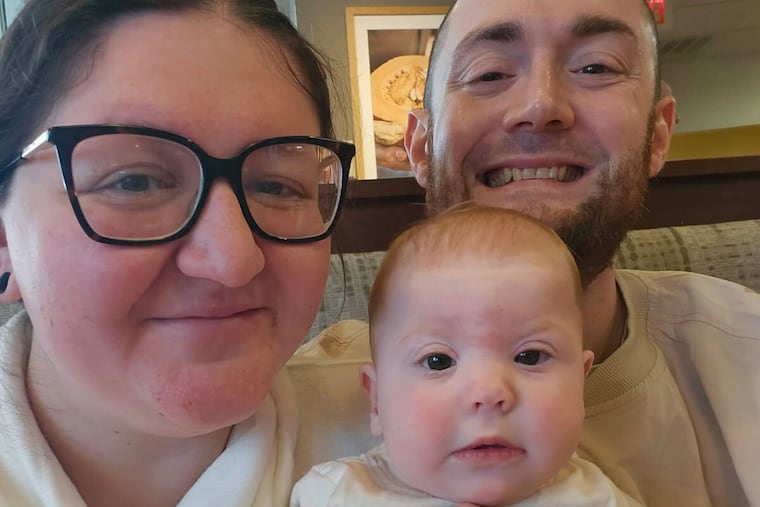
Julia Hess was on the precipice of discovering the extent of the hearing loss in her 9-month-old daughter Jasmine’s right ear, when she learned that crucial support services for her baby and other visually or hearing impaired children in Bucks County would be cut off next week.
Jasmine, affectionately known as Jazzy, is a smiley infant who has maintained a “sweet and sassy” personality even as she’s been diagnosed with Smith-Lemli-Opitz syndrome, a developmental disorder, and undergone three surgeries.
“We can see it in her face in the way that she continues to try even when her body is exhausted and her muscles won’t move anymore,” said Hess, 29, a mental health therapist.
Jazzy has been receiving early intervention services since she was 2 months old from the Bucks County Intermediate Unit, a county-level education agency, including hearing and communication services due to hearing loss in both ears and other developmental delays. Once a week, an instructor travels to Hess’ home and teaches Jazzy how to communicate with the world around her.
The 9-month-old has made significant progress, but could face setbacks starting this Saturday when the Bucks County IU will cease services for hearing and visually impaired babies and toddlers ages 0-2, citing funding and staffing challenges. And it’s unclear where parents will find services next.
“It’s really scary to feel like we are kind of just wandering in the dark,” Hess said.
In Pennsylvania, children with developmental delays and disabilities are eligible to receive services through a state-backed early intervention system — a right grounded in federal special education law.
But officials with the Bucks IU say they’ve been losing money on the program for hearing and visually impaired infants and toddlers, which currently serves 49 kids. While the state reimburses the county for early intervention services, it doesn’t cover “indirect” service time, officials said. That means the IU can’t bill for the time incurred by therapists driving between appointments, documenting services, and preparing a child’s program.
Last year, the gap between what the state reimbursed and what the IU paid to deliver the services was $200,000, officials said.
At the same time, the demand for services for older children also served by the intermediate unit — both preschool and school-age — has been growing, officials said. And with shortages of special education teachers plaguing school districts statewide, ending services for babies and infants allows the unit to redirect its limited supply of teachers for the deaf and visually impaired to serving older children — a group the IU has primary responsibility for serving.
“I think what we’re experiencing is what happens when you have a severe shortage, a growing number of kids that need the support, and antiquated models of funding that haven’t kept up,” the intermediate unit’s executive director, Mark Hoffman, said Jan. 20 at a meeting of the unit’s board, which is made up of school board members from districts across Bucks County.
A Pennsylvania Department of Human Services spokesperson said Monday that provider rates would soon be increased as the result of a $10 million boost in this year’s state budget.
Revised rates “are still being finalized based on this increase and are expected in the coming weeks,” and will be retroactive to July, said the spokesperson, Brandon Cwalina, who said the change would also allow the state to access more federal money.
It was unclear whether the increase would change the situation in Bucks County. Officials with the IU said Tuesday they hadn’t been informed of any funding increases.
Families dependent on services from the intermediate unit are unsure what will happen once the contract expires Saturday.
“They’ve been a lifeline to us … We haven’t had anybody in our family with this,” said Ali Tirendi, 32, of Warrington, noting that service providers not only help kids, but also educate parents, too.
Grappling with staffing and funding shortages
Just 24 days before these crucial services were set to be disrupted, families received correspondence from the Bucks County Department of Behavioral Health/Developmental Programs notifying them that “your current hearing/vision support provider may no longer be available,” according to a Jan. 7 letter from Patricia Erario, county early intervention director, reviewed by The Inquirer.
One of those providers is BARC Developmental Services, a nonprofit agency that provides services to individuals with intellectual disabilities and autism, and uses teachers from the Bucks intermediate unit to carry out its services.
Mary Sautter, executive director of BARC, said the Bucks IU informed BARC on Dec. 8 that they would be terminating their contract with the developmental services agency, ending a partnership that’s existed for decades. She said stakeholders are planning to have a meeting this week to discuss next steps.
“Our hope is that we can find a resolution that minimizes disruption to these vital services so that children can continue to thrive,” said Sautter, adding that BARC is also dealing with staff shortages making it difficult to use their own personnel as providers.
They have one contractor that services 14 kids, but Sautter said they’re looking to expand the contractor’s caseload.
“It’s a very unfortunate situation,” Sautter said.
Erario said that the department would work with agencies to find solutions for families, including virtual options, changing the date or time, or finding an alternative provider if necessary.
Bucks County spokesperson Jim O’Malley said the county “will be working with our partners in the community to restore access to those affected.”
Given staffing shortages, Jill Waldbieser, a Neshaminy school board member who serves on the intermediate unit’s board, said she was extremely skeptical the county would find replacement teachers.
“There’s absolutely no way they’re going to find providers,” said Waldbieser, whose 11-year-old son is deaf.
Waldbieser’s son went without an interpreter for a year in violation of his individualized education plan.
“Even if it’s a day or week” that children go without services, “you can never get that time back,” said Waldbieser, who has been pressing officials for a solution.
Early intervention is valuable for families, and a gap in services could be detrimental, said Casey James, 35, of Warminster, whose 19-month-old has a hearing impairment.
“What families like mine are concerned about are service gaps, delays, being forced into a fragmented system with multiple providers,” James said.
Ashley Dats said it “took us as a shock” to learn services for her 21-month-old daughter, who has severe hearing loss, would soon be interrupted.
“We’re worried,” said Dats, who lives in Doylestown. Her daughter gets a weekly hourlong session with a teacher of the deaf, who works to help her understand spoken language — narrating actions during play, and encouraging her to mimic words — and catch up to her normal-hearing peers.
Even if a new provider is identified, Dats doesn’t know when that will be, or how her daughter will fare with the change. It took two months for her daughter to reengage after a previous switch in teachers, she said.
“There are milestones we’re looking to hit, to show us her brain is processing and understanding” words, said Dats, who worried about losing momentum as a result of the service interruption.
“We don’t want them to get left behind because of funding issues.”