The cherry blossoms are peaking this week in the Philly region
It turns out the winter was good for something as the region is getting to see cherry and magnolia blossoms at the same time.
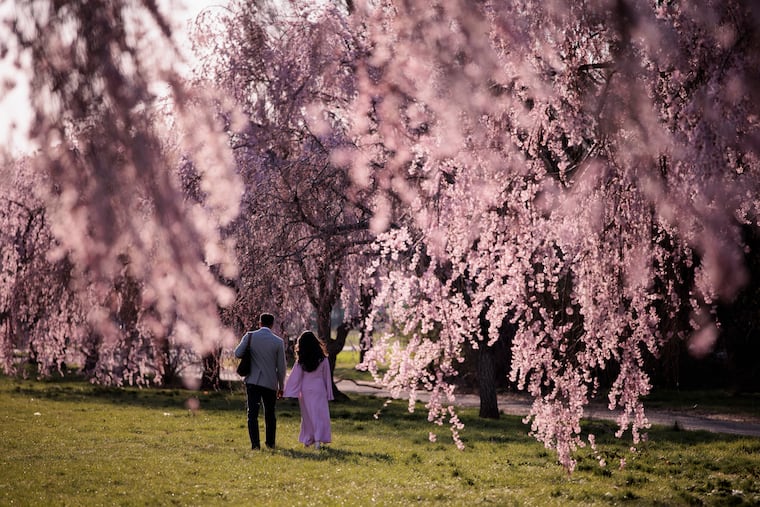
Shrugging off those Arctic freezes and the snow and ice of the vanquished winter, the cherry blossoms are partying in the Philly region, and they may only get better in the next few days, say the experts.
Tuesday’s 80-degree highs and sunshine and the Wednesday sequel (to 83) evidently were the tipping points that accelerated the blooming process in the city and elsewhere, said Sandi Polyakov, head gardener for the Japan America Society of Greater Philadelphia.
“We can expect full-bloom conditions across the city starting now and through the weekend into next week,” he said.
It was as though nature “flipped the switch,” said Pamela Morris Olshefski, plant collections manager at Chestnut Hill’s Morris Arboretum & Gardens of the University of Pennsylvania.
Winterthur Gardens, in northern Delaware, reported Wednesday that blossoms on its 100-year-old Sargent cherries exploded “almost overnight.”
In Philly, the blossoms are at, or near, full bloom in Center City and along Kelly Drive, said Polyakov, with the popular Yoshino cherries the dominating species.
And as an added — and unusual — bonus, said Morris Olshefski, the region is getting to see magnolia and cherry blooms simultaneously. That had something to do with the winter.
The winter was good for something in the Philly region
The cherry trees appear to have been unfazed by what was one of the colder and snowier winters in Philadelphia, characterized by an extraordinarily durable snow-and-ice cover that persisted for over three weeks.
Other blooms, however, were a bit behind this year, said Morris Olshefski, including the magnolias. Typically, they would yield the stage to the cherries, but they’re still around, and they’ve been spared blossom-withering freezes.
In addition, despite the recent dryness and the growing precipitation deficits, “we haven’t seen any evidence that that’s had any impact,” she said. That was related to do that snow cover that provided a long-lasting source of moisture.
With such deep roots, she said, “They can go far and wide to get what they need.”
The winter, she added, “had its perks. There’s always some kind of silver lining.”
The peak has arrived right on time
It isn’t quite a linear process, given the numbers of species involved, but the peak is occurring more or less on schedule, said Polyakov, with the blooming of the Yoshino cherries, which constitute about 70% of Philadelphia’s inventory.
The annual peak in Washington — defined as 70% of the Yoshinos in bloom — occurred March 26, according to the National Park Service, and typically the peak has rippled to Philadelphia a few days later.
Although the Yoshinos of the Washington Tidal Basin are more famous, Philadelphia has an impressive inventory of cherry trees, thanks in part to the government of Japan.
As the nation celebrated its 150th birthday, Japan gave Philly 1,600 trees. The Japan Society planted 1,000 more in a 20-year period starting in 1998 and has planted 250 more for the semiquincentennial.
The show will go on well into April
Still to come are the brilliantly pink Kwanzans, evident around the Philadelphia Museum of Art and in South Philly. They usually peak in late April. More than 1,400 of them line two miles of Chapel Avenue in, where else, Cherry Hill.
The show will close with the most glorious litter of the year as the trees shed their blooms.