The water wars are escalating in the City of Chester’s historic bankruptcy
The sale of water assets remains the key to the city's emergence from bankruptcy.
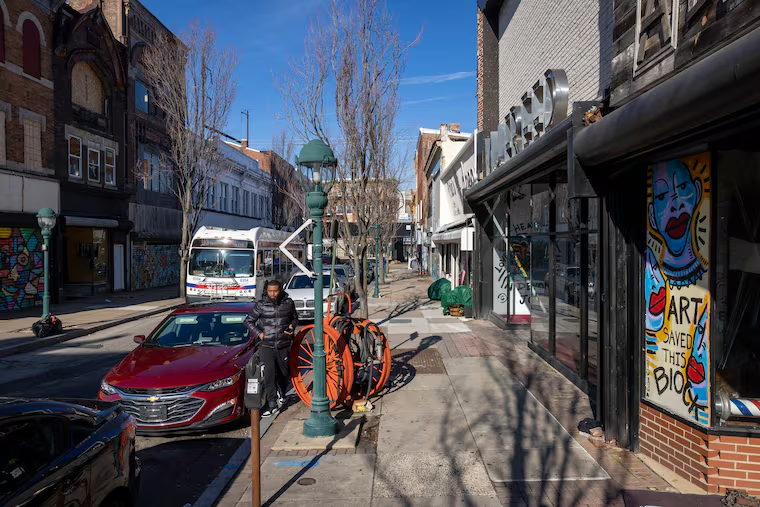
As it approaches its third anniversary, the City of Chester’s historic and contentious bankruptcy also may be approaching a watershed.
In a filing Tuesday afternoon, the state-appointed bankruptcy receiver asked Commonwealth Court to rule on an issue pivotal to the city’s ability to sell water assets that are keys to Chester’s emergence from bankruptcy.
Receiver Vijay Kapoor argued that a narrowly tailored state law passed in 2012 that wrested control of the Chester Water Authority from city government was unconstitutional.
If the judge finds in the receiver’s favor, “It would likely resolve a lot of the legal questions,” Kapoor said.
The water authority, which serves 46 towns in Chester and Delaware Counties and reported $51.7 million in revenues last year, is the centerpiece of the receiver’s plans of creating a regional water authority. Aqua Pennsylvania offered over $400 million for the authority four years ago. The city’s annual budget is around $65 million.
The Environmental Protection Agency estimates that, conservatively, U.S. residents collectively spend $100 billion a year on water.
The receiver’s office has insisted that an owner operate the water assets as a “public entity,” not beholden to stockholders.
Kapoor said that the state law transferring control of the authority was amended at the last minute and passed without debate.
Frank Catania, the water authority’s attorney, countered that the receiver’s office is attempting a hijacking and that the receiver and city officials are asking customers, 80% of whom are outside Chester, for a bailout.
“It’s not like they’re losing something they had,” he said. “They never had it “
Kapoor also asked the judge to force the authority to turn over financial documents to explain its 14% rate increase earlier this month, adding about $70 to the average annual residential bill.
He said the authority had undertaken a costly ad campaign, presumably at ratepayers’ expense, that he said appeared to include racial overtones.
The authority blamed the rate hikes on bankruptcy-related legal fees and lowered credit ratings.
“We’re a water utility,” Catania said, “and we’re also fighting a war.”
The law the receiver is challenging
In his filing, technically a bankruptcy “plan modification,” Kapoor said the 2012 legislation was crafted specifically to refer to the Chester Water Authority and was afoul of state law.
Rather than the five-member board appointed by the city council, it resulted in the creation of a nine-member board with only two representatives from the city and others appointed by Chester and Delaware County commissioners.
The law applied only to an authority that serves “parts of at least two counties” and services an area ”five times larger than the incorporating municipality."
The authority also had to have “projects in more than two counties.” Part of the Octoraro Reservoir, from which the authority draws water, is in Lancaster County.
When will the bankruptcy end?
It was uncertain when the judge might rule, or when the bankruptcy — which as of the end of 2024 had cost the state $11.5 million in legal fees — might end.
The city, which is 80% Black, has been in the state’s “distressed” status since 1995 and entered receivership in 2020.
Kapoor’s predecessor, Michael Doweary, took it into bankruptcy in November 2022. Chester had accumulated a $48 million pension deficit and missed several years of payments.
Kapoor has said that sale of the water assets would be critical to avoiding dramatic cuts in retirement benefits.
Chester’s tax base has declined precipitously in the decades since the city’s wartime industrial heydays, and a casino and an incinerator are key contributors to its annual budget.
Other cities have suffered similar economic trauma, but Chester is a rarity. Of the more than 35,000 towns in the country, only about 30 have filed for bankruptcy.