Conestoga High School quietly suspended a nationally recognized soccer coach who was betting on basketball games with students
Soccer coach David Zimmerman and students were placing "prop bets" on the performance of boys basketball players. The NCAA has sought a federal ban on that type of sports gambling.

The situation at Conestoga High appeared to have been contained — another would-be scandal averted at one of the state’s best secondary schools.
’Stoga’s nationally recognized soccer coach had been caught back in January gambling with students on the school’s basketball games.
Specifically, they had been placing “prop bets” on the stats of individual players, a form of sports gambling that the NCAA has lobbied the federal government to ban.
There was minimal money involved, apparently. Nonetheless, it was gambling.
Not a great look for a highly competitive, image-conscious school that touts its U.S. News & World Report ranking and sends 95% of its graduates to college. Last year, more than two dozen students were accepted at Harvard, Yale, and other Ivies.
The coach, David Zimmerman, who has several state soccer championships under his belt and has taught at the school since the mid-1990s, apologized to the parents of students involved in the betting, according to sources familiar with the situation.
A suspension kept Zimmerman, the former chair of the school’s social studies department, out of the classroom for a few days last winter.
That did not go unnoticed. Mr. Zimmerman almost never misses class.
Yet, the whole thing seemed to have blown over. No public announcement from the school. No news coverage or social media postings going viral.
Many parents in the affluent Main Line school district — including the head of the class parent organization, and even those with children on Zimmerman’s team — never heard anything about the gambling.
And Zimmerman, who in 2022 was named National Boys Soccer Coach of the Year for large public high schools, maintained a stellar reputation among parents and students, as both a teacher and a coach.
But a whisper campaign was underway in the Tredyffrin/Easttown School District.
Someone was gunning for Zimmerman and his bosses. They wanted what happened to be known.
‘Do something to stop this!’
The Pennsylvania Interscholastic Athletic Association, a governing body of high school athletics, received an anonymous letter at its District 1 office about gambling at Conestoga. The district office, which organizes high school playoff games in the Philadelphia suburbs, forwarded the letter to school officials.
Tips started arriving at The Inquirer as well.
“Some shocking things happening at Conestoga High School,” a tipster with a Signal username referencing Greek mythology wrote in January, alleging that a “Pete Rose-like” teacher had been suspended for running a “gambling book.”
“They are trying to bury the entire thing,” the tipster wrote, before deleting the Signal account.
A few weeks later, the newspaper received another tip, this time a handwritten letter signed by a “A Concerned T/E Parent” that said Zimmerman was involved with a “gambling ring.”
“I hope you can do something to stop this!” the tipster wrote.
In March, a 650-word, typed letter addressed to The Inquirer’s sports editor questioned whether the school administration was attempting to “cover up” the gambling.
“Students’ well-being should always be a top priority,” read the unsigned letter, “and it is essential that we work together as a community to prevent similar incidents in the future.”
Only one of the tipsters identified Zimmerman by name, but they all took issue with how Conestoga High and the Tredyffrin/Easttown School District handled the matter. (District officials say that there was no cover-up, and that they administered discipline as in any other case involving teacher misconduct.)
Sensitive to ‘bad publicity’
Located about 15 miles west of Philadelphia on the outer Main Line, the Tredyffrin/Easttown School District is among the wealthiest districts in Pennsylvania — median household income: $172,073 — and Conestoga is a top-rated public high school with strong academic and athletic programs.
Between 2020 and 2024, the school took home 29 Central Athletic League titles, 8 PIAA District 1 titles, and 5 PIAA state titles, according to the 2024 class profile on the school’s site. Nine of those titles were won by its powerhouse soccer team.
Some of the pressure to maintain a reputation for academic and athletic excellence trickles down to Conestoga students.
At Niche.com, a site that compiles in-depth profiles of American schools with reviews and test scores, Conestoga is an A+ school, rated as the second-best public high school in Pennsylvania.
But several recent Conestoga grads cited the tension that comes along with that in their reviews, even as they gave the school high marks overall:
“Extremely competitive and stressful.”
“Their sports are very competitive but also very successful.”
“Huge pressure and hyper fixation on being stereotypically successful.”
“The clubs are super competitive but also help you stay prepared.”
Over the years, Conestoga has also had its fair share of scandal.
Hazing allegations involving the football team made national headlines in 2016 when a freshman player claimed he was assaulted with a broom handle during what the team called “No Gay Thursday.” Three players later pleaded guilty to lesser harassment charges.
That same year, a Conestoga teacher’s aide and coach was arrested on charges of having a sexual relationship with a 16-year-old student. She pleaded guilty and was sentenced to 11 to 23 months in jail the following March.
A month later, it happened again: A Conestoga instructional aide was charged with having a sexual relationship with a student starting when she was 15 years old. He later admitted to the assault and was found dead in a state prison in 2018, reportedly having hanged himself.
And again this spring: A Conestoga teacher was arrested in April on charges of buying medical marijuana for a 16-year old student and having sex with him about a dozen times starting in February.
Ben Shapiro, a 2024 Conestoga graduate who was editor in chief of the school newspaper, the Spoke, said those stories and others over the years have made school leadership particularly sensitive to anything that might cast the school in a poor light.
“They really, really, really do not like bad publicity,” Shapiro said.
Shapiro, now a Northwestern University sophomore majoring in journalism and legal studies, had Zimmerman for psychology his senior year and described him as a “great teacher.”
But Shapiro thinks the fact that a teacher and students were gambling is problematic, particularly in light of recent reporting about online sports betting reaching the high school level and concerns about game-fixing.
“It’s crazy,” Shapiro said of gambling’s expansion to teenage athletes.
And Conestoga’s sports program had already been under increased PIAA scrutiny.
In December 2023, PIAA placed Conestoga on probation for an incident at the boys soccer state championship game that November. Conestoga fans had reportedly used vulgar language at the game, and some soccer players jumped over the fence into the crowd after Conestoga won the championship.
Shapiro, who broke the probation story in the student newspaper, reported at the time that PIAA would “watch the school closely,” and that if any additional misbehavior occurred, Conestoga ran the risk of PIAA taking more severe action — including blocking the school from participating in postseason competition.
‘Not a gambling ring’
So what actually happened here?
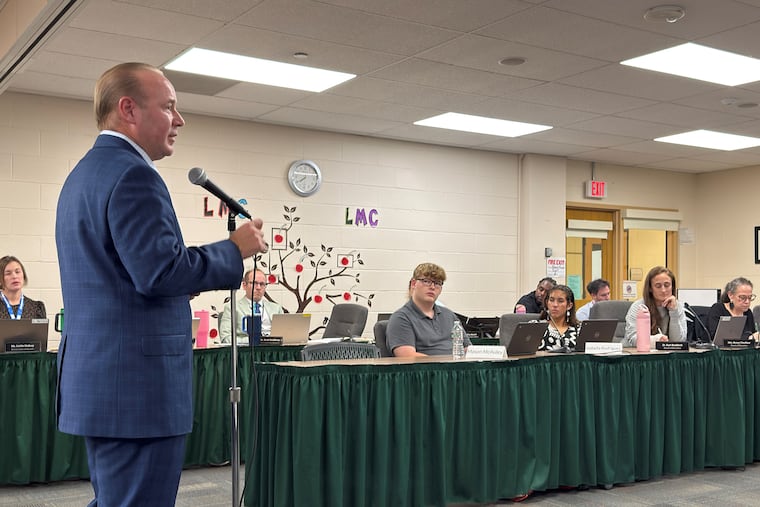
In response to recent questions from The Inquirer, Kenneth Roos, solicitor for the Tredyffrin/Easttown School District, confirmed that a Conestoga employee had “engaged students” in placing wagers on the performance of the school’s athletes — primarily members of the boys basketball team.
Roos said that Conestoga officials learned of the sports betting through “secondhand sources” in January and that the school’s investigation found that the activity began last year “on a limited basis.”
He declined to identify the employee or that person’s position at the school, which he said is the district’s normal procedure. Sources familiar with the situation said it was Zimmerman.
“The district typically does not disclose specifics of discipline and will not vary from that practice for this matter,” Roos said.
Reached earlier this month at his home, Zimmerman declined to comment.
Sean Forcine, coach of the boys basketball team, referred questions about the bets placed on his players to school principal Amy Meisinger. Her office referred questions to Roos.
Roos described the gambling as “guesses and predictions about the performance and statistics of other students in other sports,” also known as prop bets.
The NCAA has sought a federal ban on prop bets because they can lead to player harassment. It is unclear if any of the Conestoga basketball players were aware that Zimmerman and students were betting on them.
“It didn’t go on for very long and it didn’t involve many kids because it was found out about and stopped,” Roos said.
Roos said Conestoga officials uncovered no evidence of widespread gambling, Venmoed money, or other allegations that were mentioned in the anonymous letters. He said the amount of money exchanged is believed to be as little as $10.
“This was not a gambling ring. These were little slips of paper,” Roos said. “The employee didn’t make money and wasn’t trying to make money.”
Despite the small amount of money, the school ordered the employee to cease the activity because it was considered a “type of gambling,” Roos said. The school also notified the parents or guardians of students who were involved.
Conestoga’s 2025-26 code of conduct includes a new section clarifying that “Gambling in any form is not permitted on campus, on District transportation, at any District function, or on any District platform.”
Lyndsay Barna, an assistant executive director at PIAA, said the organization’s main office in Mechanicsburg had not received any information about gambling at Conestoga. Its suburban district handled the matter properly, she said.
“District I received [an] anonymous letter and took the appropriate action regarding the PIAA Policy Regarding Anonymous Calls, Emails, and Letters, forwarding to the school,” Barna said by email on Wednesday. “This was an internal school matter.”
PIAA’s suspension of Conestoga for the 2023 soccer game incident ended on Dec. 7, 2024, Roos said.
Barna declined to comment on whether placing bets on Conestoga games — whether or not it occurred while the school was on probation — would violate PIAA rules or policies. PIAA prohibits district tournaments and players from promoting or advertising sports betting, according to the organization’s handbook.
Harry Levant, the director of gambling policy at Northeastern University’s Public Health Advocacy Institute, said having teachers or coaches condoning sports betting could feed the gambling addiction epidemic among teens and young men.
“If someone in a position of respect and authority is introducing kids to an addictive substance and somehow normalizing that or minimizing its significance,” Levant said, “that person either doesn’t understand the human brain and how addiction works or they’re disregarding their position as a person in authority. Neither would be acceptable to me.”
Levant, a gambling therapist who has testified before Congress on the need for sports gambling regulation, said college-bound teens are particularly prone to become addicted.
He said the amount of money that was exchanged at Conestoga is irrelevant. The rise of sports betting among adolescents, he said, corrupts “something that is inherently a part of being a teenager, the love of sports.”
“We’ve made gambling an integral part of that,” Levant said. “The excitement of the game, the competition of sports, that’s totally gone.”
Staff writer Maddie Hanna contributed to this article.

The Inquirer’s journalism is supported, in part, by the Lenfest Institute for Journalism and readers like you. News and editorial content are created independently of The Inquirer’s donors. Gifts to support The Inquirer’s high-impact journalism can be made at inquirer.com/donate. A list of Lenfest Institute donors can be found at lenfestinstitute.org/supporters.