A disabled Ecuadorian immigrant tried to flag down an ICE officer. Now he faces deportation.
As President Donald Trump pursues an unprecedented mass-deportation campaign, more migrants have been subjected to mandatory detention.
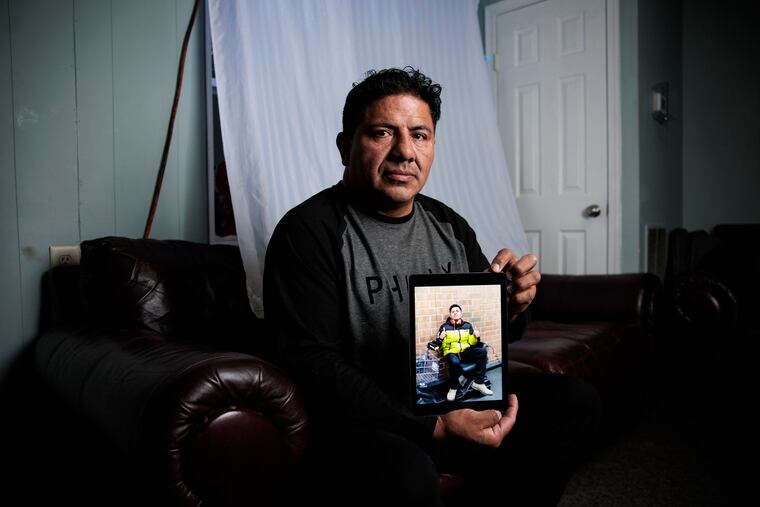
Victor Acurio Suarez is 52 but childlike, born with developmental disabilities that have left him unable to live on his own.
He likes to talk to people, said his brother, who takes care of him. And on Sept. 22, in a Lowe’s parking lot near the brothers’ home in Seaford, Del., he tried to flag down an ICE agent, apparently thinking the officer could help him find work.
Instead, Acurio Suarez, originally from Ecuador, was arrested for being in the country without permission and sent to the Moshannon Valley Processing Center, an ICE detention facility in central Pennsylvania.
Acurio Suarez doesn’t realize he’s in custody, his brother, Lenin Acurio Suarez, said in an interview. He thinks he’s on vacation, provided with three free meals a day and allowed to buy snacks and kick a soccer ball.
But in phone calls from Moshannon, he says that after three months, he’s grown tired of vacation and wants to come home.
In fact, Acurio Suarez faces deportation to Ecuador ― with a key Immigration Court hearing that had been scheduled for Thursday now postponed. When that hearing takes place, he could be granted asylum and allowed to stay in the U.S., safe from the gang violence he fled, or ordered returned to his homeland.
His case, said his attorney, Kaley Miller-Schaeffer, is a prime example of how Trump-administration policy shifts have encouraged ICE to detain even the most vulnerable and to treat potential discretionary relief as irrelevant in a bid to boost deportations.
Her Sept. 30 request to have Acurio Suarez released to the care of his brother while his immigration case goes forward was denied.
Asked about Acurio Suarez’s arrest and detention, ICE said in a statement that they screen and look out for the health of all detainees.
“U.S. Immigration and Customs Enforcement is firmly committed to the health, safety, and welfare of all detainees in custody. ICE’s National Detention Standards and other ICE policies require all contracted facilities to provide comprehensive medical and mental health screenings from the moment an alien arrives at a facility and throughout their entire time in custody.”
At an earlier court hearing, Miller-Schaeffer said, she watched as Acurio Suarez struggled to answer basic questions. He told the judge he didn’t know if he had an attorney or know what an attorney does.
His ability to testify was so limited, she said, that the judge allowed his brother to take the stand to explain his sibling’s experience and situation.
Acurio Suarez can recall big events in his life, she said. He remembers being beaten by gangs who seized on his vulnerability, but he couldn’t tell you exactly when that occurred.
Today, as President Donald Trump pursues an unprecedented mass-deportation campaign, more migrants including Acurio Suarez have been made subject to mandatory detention. That means they’re held in custody during their deportation proceedings, unable to seek release on bond.
That includes immigrants whose only offense was crossing the border without approval, who in the past might have been issued a notice to appear in court and allowed to live in the community while their cases go forward.
That’s helped drive the number of immigrants in federal detention past 65,000, a two-thirds increase since Trump took office in January.
The administration says it is arresting the “worst of the worst,” dangerous immigrants who have committed serious and sometimes violent offenses. But data show 74% of those in detention have no criminal convictions.
That includes Acurio Suarez, who worked at odd jobs in Ecuador before coming to this country in 2021.
According to an ICE report, at 9:14 a.m. on Sept. 22, an ICE team was conducting operations in Seaford, a southern Delaware city of 9,000 where 13% of the population is foreign-born.
The ICE officer wrote that he was looking for a place to park in the Lowe’s lot when a man in paint-stained clothing, Acurio Suarez, approached him. Acurio Suarez waved his hand, signaling the officer to come to him, according to the ICE account.
The officer kept going, then stopped his car and watched Acurio Suarez from another lot. Acurio Suarez tried to hail other cars, and could be seen talking to people who were loading lumber onto a trailer in the parking lot, he said.
It looked like Acurio Suarez was trying to find daily work, which is why he tried to get the ICE officer to stop his vehicle, the report said.
It’s common for undocumented immigrants seeking a day’s pay to wait in the parking lots of big home-improvement stores like Lowe’s and Home Depot, hoping to connect with building contractors who need laborers.
Lenin Acurio Suarez said his brother cannot hold a full-time job, able only to handle small tasks, provided someone is beside him giving directions.
A second ICE officer arrived, and both parked their cars near where Acurio Suarez had left his lunch box unattended. Acurio Suarez walked back toward the officers, and one of the agents approached and questioned him.
Acurio Suarez said he had no identification or immigration documents and was placed in handcuffs. He told the officer he was in good health, the report says.
Records show that four years ago, on Aug. 2, 2021, he and his brother were stopped by the U.S. Border Patrol as they tried to enter the country near Eagle Pass, Texas, southwest of San Antonio.
The brothers were processed separately by immigration authorities. Lenin Acurio Suarez was issued a notice to appear in court and released. His immigration case was later dismissed.
Victor Acurio Suarez was ordered deported and subsequently returned to Ecuador on Sept. 24. But three days later, for reasons that are unclear, the deportation order was found to have been issued incorrectly, and Acurio Suarez was brought back by authorities to the U.S.
In October 2021, he was granted temporary permission to stay in the country. He had filed his asylum case by the time that permission expired a year later.
Asylum cases from Ecuador have surged in recent years, as thousands of people flee violence, political instability, and economic hardship. Gang violence there has rocketed as criminal organizations compete for control of the illicit economy, including extortion, kidnapping, transporting drugs, and illegal mining, according to the Geneva-based Global Initiative Against Transnational Organized Crime.
The group projects that intentional homicides in Ecuador could reach 9,100 in 2025, a 40% increase over the previous year.
That’s a rate of nearly 50 per 100,000 inhabitants, which would continue to give Ecuador the highest homicide rate in Latin America, the organization said. In the U.S. the figure is about five per 100,000 people.
While ICE agents were arresting Acurio Suarez, Lenin was frantically searching the neighborhood, initially not having realized that his brother had left their home. Lenin called local police for help, and officers checked the Lowe’s security cameras. The video showed Victor being taken into custody.
In an interview, Lenin, 49, explained that he has always taken care of his younger brother, since their mother left when they were teenagers in Ecuador.
In this country, Lenin has a job in housing construction that enables him to provide for himself and his brother and to live with others in a rented house. He worries what will happen to Victor if he’s sent back to Ecuador, where there’s no one to care for him.
“Thanks to God I’ve been able to pay rent and food for me and my brother,” Lenin said. “I am grateful for this country, to be in this country. But I want my brother to have a fair life, with me, out of detention. He won’t be able to survive by himself in Ecuador.”