In the age of AI, a Philadelphia Black comic book convention reinforces the importance of creators’ culture
The East Coast Black Age of Comics Convention returns to Philadelphia.
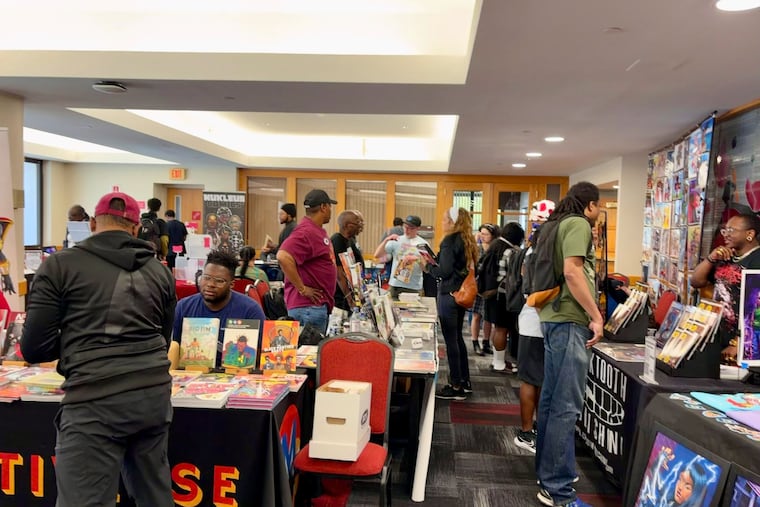
When Chris Williams, 26, and Miles Hubbard, 24, walked the stage as part of the last graduating class of the University of the Arts, their future felt uncertain.
Between dealing with the school’s closure and finding work as illustrators in the age of artificial intelligence, adult life hit them like a brick.
Two years later, surrounded by stickers, posters, and illustrations that they created and were selling at the Temple University Student Faculty Center, Hubbard had a full-circle moment.
He was now welcoming bright-eyed children and adults to see their art at the same East Coast Black Age of Comics Convention that welcomed him beginning in middle school.
“Representation now is more important than ever,” Hubbard said. “Putting your own culture into your work is a bridge that can help others understand why a culture feels the way they feel. AI can’t do that.”
Launched in 2002, the East Coast Black Age of Comics Convention connects Black comic book creators and fans, increases literacy in Black communities, and supports writers and artists.
The nonprofit runs workshops and cosplay gatherings year-round.
Now in its 25th year, the convention scheduled a panel on artificial intelligence, and while most attendees draw and write themselves, few have used AI in their art as a tool, founder Yumy Odom said.
“The overuse of technology dehumanizes us,” Odom said. “AI is pulling from all areas, but you have to have your culture in the art; that is what we are doing, and that’s what’s happening here.”
Board game creator Keith Atkins, 50, has found artificial intelligence to be an inadvertently useful tool.
After spending 14 years designing and manufacturing every part of his own games and boards, Atkins commissioned an artist to create an illustration for a game box. The illustration turned out to have been done with AI.
The South Jersey resident said he didn’t know how to feel at first, but ultimately decided his brainpower and creativity were better placed on every other aspect of his strategy board games rather than the packaging.
“The board took me nine months to create because of all the intricacies in it, from shadows and terrain effects. That’s not AI — I made every detail,” Atkins said. “To come up with the art on the boxes would take me years, and I don’t have the financial budget.”
Atkins has found in AI a tool to promote his work, but still believes that the soul of each game must come from human thought.
Keeping the AI box illustrations has worked for his products because they are not meant to showcase one culture or the experience of people, but rather to provide space for folks to create their own stories and their own cultures within strategy games, he said.
For Williams, the distinction is important.
As the illustrator of a children’s book that talks about food scarcity through the eyes of a boy living in the Southern U.S., he feels AI lacks the human experiences necessary to create stories where people can feel truly represented.
“AI cannot exist without human-made art,” Williams said. “It’s like popcorn. Yeah, you can eat popcorn, but at the end of the day, you are going to have to eat dinner. You need substance, and that’s the real human feeling in art.”