Philadelphia’s new floating art installation finally arrives on the Schuylkill at Bartram’s Garden
FloatLab reaches Southwest Philly after a lengthy trip up the East Coast.
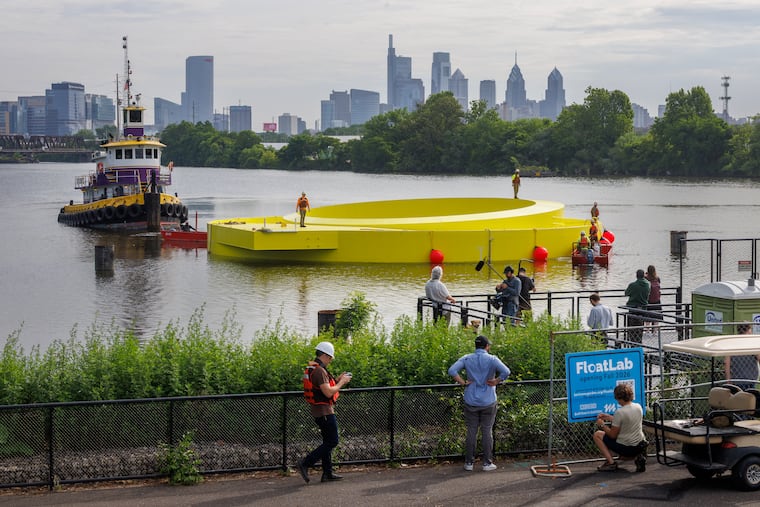
FloatLab, a public art feature that will offer an eye-level view of the Schuylkill, finished its voyage up the East Coast from North Carolina to Southwest Philly on Wednesday.
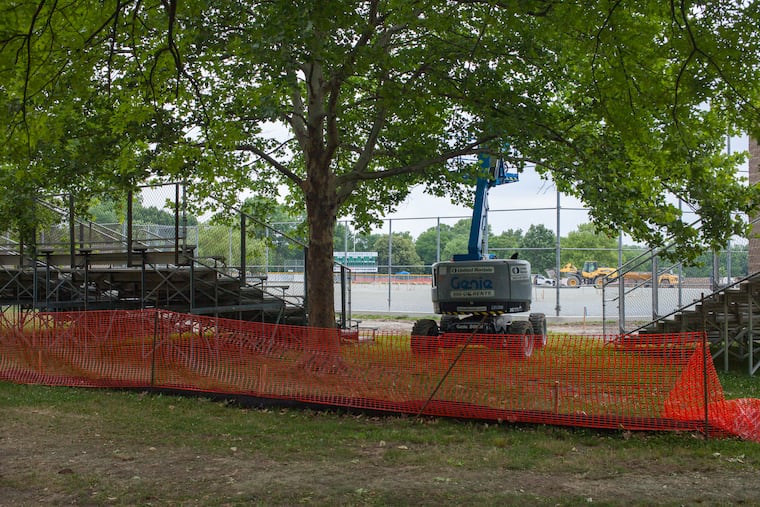
The 75-foot-wide floating structure arrived at its permanent home at Bartram’s Garden amid cheers from officials, who have been waiting 10 years for this project to come to fruition.
Expected to open in September, the semisubmersible structure was created through a partnership between Mural Arts Philadelphia, the nation’s largest public art program, and Bartram’s Garden, Kingsessing‘s 50-acre public park.
Without that partnership, “we couldn’t be here today making FloatLab a part of one of the most vibrant sections of riverfront in the city,” said Maitreyi Roy, executive director of Bartram’s Garden.
The project cost $5.5 million, funded by both public and private assistance from organizations such as the William Penn Foundation, the Pennsylvania Redevelopment Assistance Capital Program, the U.S. Department of Housing and Urban Development, and the City of Philadelphia, among others.
FloatLab represents a collaboration between ecology and art.
Bartram’s Garden’s more than 125,000 annual visitors will be able to participate in outdoor art programs, boating, fishing, and other riverfront activities. Additionally, officials anticipate the space serving as a classroom where students can learn about this section of the Schuylkill’s unique tidal wetland ecosystem.
“The possibilities are endless,” said Jane Golden, the founder of Mural Arts. “It’s really a platform where great things can happen — both that are educational, that are performative, and that are also just about the beauty that is all around us.”
Designed by artist J. Meejin Yoon and Höweler + Yoon Architecture, FloatLab is the country’s first tide-responsive public space, utilizing a ballast system to keep the structure at water level, with a portion submerged underwater. At FloatLab’s highest point, visitors will be positioned above the surface of the river as if they are standing on a dock; however, as they continue along the circular ramp, a declining sectional tilt brings visitors eye level with the Schuylkill.
Judy Hellman, the director of special projects at Mural Arts, said that at the structure’s lowest point, she can reach over the wall and touch the river. “It just totally changes one’s perception of the river and this landscape.”
As crews moored FloatLab to four steel columns on Wednesday, officials with Bartram’s Garden and Mural Arts hugged and shouted “finally!” — indicative of a long-awaited plan manifesting before their eyes. The project originated from a grant received from the William Penn Foundation for implementation in 2016. Then, Mural Arts entered into a contract with North Carolina-based East Coast Steel Fabrication, who oversaw the creation of FloatLab.
FloatLab departed from North Carolina on May 20, a decade after the first grant was obtained, and traveled north via a tugboat called the Island Trader and a barge. After a three-week journey, FloatLab arrived at its destination — the southernmost point of the Schuylkill — where Commerce Construction will complete the installation, which is expected to take approximately six weeks.
Roy emphasized that FloatLab will celebrate the efforts of those who have worked to make the river cleaner, and spark community engagement with the area’s natural environment.
“I firmly believe that people care for and will take care of things that they love,” Roy said. “So the more they have those relationships, the more they’ll speak up when bad things happen. They feel that they are truly stewards.”