Unstable building slows the search effort for 2 missing workers in collapsed Grays Ferry garage
Officials and experts say the structure is still at risk of further collapse, and must be stabilized before rescue efforts begin.
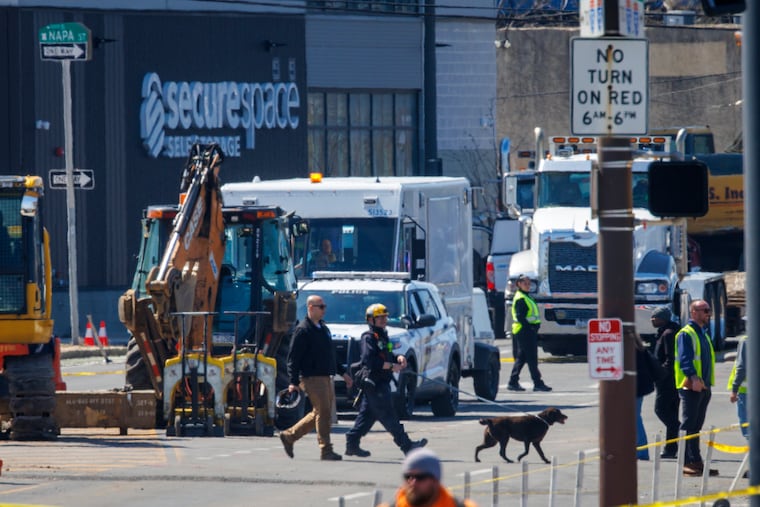
At the site where part of a garage under construction in Grays Ferry collapsed Wednesday, sending concrete and debris crashing to the ground and killing one man, the work of recovering the bodies of two people presumed dead in rubble unfolded Thursday at a measured pace.
The collapse left a structure that officials say is too unstable to enter freely, forcing rescue crews to prioritize safety over speed as they work to reach those missing without triggering another failure.
Rescue crews, operating under the direction of structural engineers, have been working to assess and stabilize the building — a painstaking approach officials and experts say is necessary to prevent further collapse and protect the responders trying to reach the workers who were presumed dead.
The names of the missing men had not been released as of Thursday. Spokespeople for the mayor’s office and the Philadelphia Department of Public Health did not respond Thursday afternoon to requests for information.
On Thursday night, officials said four K-9 dogs were used at the site and officials determined that the missing individuals were dead. As a result, officials said the city will proceed Friday with a deconstruction of the building until it is safe for the removal of the bodies.
While officials have not speculated on the condition of anyone still inside, one expert said rescue efforts are often focused on locating potential pockets within the debris where someone could be trapped and, in some cases, survive.
The garage’s precast construction — slabs cast off-site and stacked in place like a giant puzzle — gives the structure little connectivity, like “a house of cards,” said Glenn Corbett, an associate professor of fire science at John Jay College of Criminal Justice who was part of a team that investigated the World Trade Center disaster, including its collapse and fireproofing failures. That fragility makes the site especially dangerous for rescue crews: Removing one wrong piece can trigger a progressive failure, leaving no safe spaces at all, he said.
At the same time, the slabs could have settled in a way that created voids, where people would be protected from the full weight of the concrete above, said Scott Nacheman, a forensic engineer and architect who has worked with the Federal Emergency Management Agency’s Urban Search and Rescue.
To locate potential pockets, rescue crews may deploy trained canines, sensitive listening devices, and other specialized equipment meant to detect movement and sound, Nacheman said. On Thursday afternoon, a robotic dog could be seen walking onto the site.
Workers will weigh “risk vs. reward,” Nacheman said, when assessing whether they can reach the two men, who are members of Philadelphia’s Iron Workers Union Local 401. “Where there is reward — meaning the viability of survivors — rescue workers take extreme risks.“
Reaching them safely requires patience and, often, distance, Corbett said. Crews may use elevated vantage points, watching closely as debris is removed and adjusting tactics accordingly, Corbett said.
“This is a job for heavy equipment,” he said. “This is not 40 firefighters pulling debris off the pile.”
Throughout the morning Thursday, additional crews and equipment arrived in a steady stream to the site. Pennsylvania Urban Search and Rescue trucks pulled up and crews drove a mechanized conveyor belt into place, as police officers held the perimeter, blocking traffic.
Engineers are typically called in to assess the structure, identifying what can be removed and what must remain in place, at least temporarily, Corbett said. The work becomes less about digging and more about dismantling — a piece-by-piece effort to reach those inside without triggering another collapse.
“We have to very carefully and methodically deconstruct this building for the safety of the people working on it and, ultimately, for the safety of the first responders who will continue to search,” Fire Commissioner Jeffrey Thompson said Wednesday night at a news conference.
For families waiting to learn the fate of their loved ones, the pace can feel excruciating.
“That slow motion is not something the fire department wants to do, but it’s dictated by the situation,” Corbett said.
Other collapse responses have followed a similarly uneven rhythm, where the urgency of the moment gives way to the constraints of the structure itself.
In 2019, when a Hard Rock Hotel under construction in New Orleans partially collapsed, killing three workers, rescue and recovery efforts stretched on for months as crews contended with a building that remained dangerously unstable. Cranes were brought in, repositioned, and at times halted altogether as engineers reassessed conditions.
In 2003, the collapse of a parking garage at the Tropicana Casino & Resort in Atlantic City presented a similar challenge. There, too, the initial rush of response gave way to a days-long process, as officials worked to stabilize what remained before attempting to reach those inside. Crews pulled the last of four bodies from the wreckage almost 40 hours after the building fell.
On Thursday morning, several people stood at the perimeter of the Grays Ferry site, watching the work unfold and lamenting the necessarily slow pace. “Hopefully they are still alive,” one observer said.
Messages of support and hope quickly spread online, too.
“Our deepest thoughts, prayers, and strength go out to our brothers and sisters of Iron Workers Local 401,” a Pittsburgh local of the union wrote on its Facebook page. “To the families of the member we lost and to those still waiting for news of the two missing workers: please know that your extended family in Pittsburgh stands with you.”