Failure of precast concrete roof is suspected to have triggered Grays Ferry parking garage collapse
Catastrophic construction collapses do not occur without failures in either design, concrete casting or connection, experts told The Inquirer.
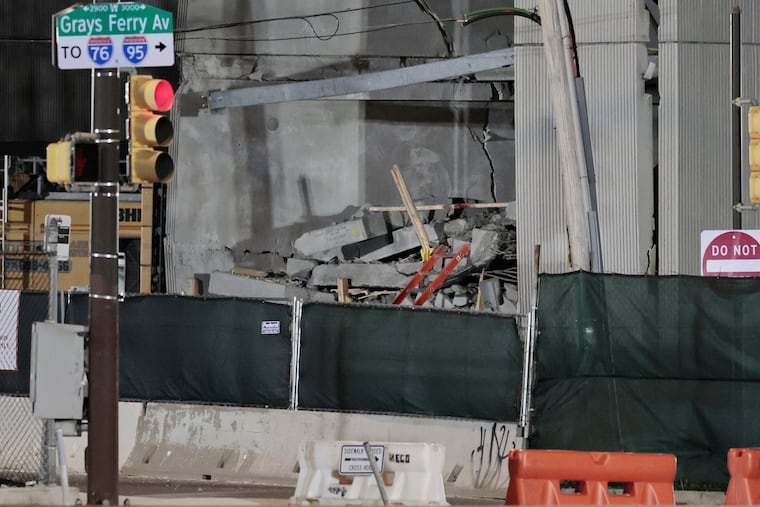
The deadly collapse of the Children’s Hospital of Philadelphia’s parking garage Wednesday started with something common in construction: a section of precast concrete roof.
Many standalone parking garages are built of precast concrete, which is poured off-site. The slabs used to build garages can weigh 100 tons, so if something goes wrong, the consequences can be catastrophic.
While construction accidents with the material are rare, there are several points where an error can occur, especially because precast structures can be unstable before they are finished.
“Compared to cast-in-place concrete, there are many, many opportunities here for errors,” said Abieyuwa Aghayere, a professor of structural engineering at Drexel University. “Starting from the manufacturer to the transportation to the lifting of these heavy elements, to the connections themselves, to the fact that the structure is unstable while you’re building it.”
In Grays Ferry, seven levels of the stair system failed and collapsed onto one another, Mayor Cherelle L. Parker said at a news conference Wednesday night.
“After placement, a precast roof segment failed and fell to the level below, literally triggering a progressive collapse of connected sections across all seven levels,” Parker said.
The collapse killed one worker, and left two others missing and presumed dead, officials said Thursday night. All three are members of Philadelphia’s Iron Workers Union Local 401. Officials have not released their names.
The building is dangerously unstable and will have to be deconstructed, according to Fire Commissioner Jeffrey W. Thompson.
“The structural collapse was contained to the 30th Street side of the stair tower where all seven levels of the stair system failed,” Parker said.
Precast concrete is commonplace
Precast concrete is widely used in the construction of bridges and parking garages, Aghayere said. One of the touted benefits of using precast concrete is that it can speed up construction without negatively affecting quality.
“There are many precast parking garages that are standing as we speak,” he said. “It’s not like it’s a corner-cutting exercise. It’s a legitimate method of construction.”
These concrete slabs are manufactured off-site, where facilities can control temperatures that make for predictable pouring and curing times, unlike concrete poured on-site, where temperatures might be uncooperative, Aghayere said. That gives it safety and quality advantages because concrete is weakest when it is being poured.
For parking garage projects, hundreds of slabs weighing upward of 100 tons are made with what is called embedded steel and are then welded together on-site.
The subcontractor on the Grays Ferry garage project is Ohio-based Precast Services Inc., according to Parker. Workers were in the process of installing the structure’s floor decking and roof segments when the collapse occurred.
The Philadelphia Department of Licenses and Inspections outsources inspections of precast concrete projects due to their highly specialized nature, which is beyond the scope of the agency’s regular work.
The city is responsible for managing the program, ensuring that there is a special inspector for the project and that the building plan is being followed.
For CHOP’s garage, a local branch of GAI Construction Monitoring Services was tasked with the regular inspections of the concrete installation.
Neither GAI or Precast Services Inc. immediately responded to a request for comment.
Drexel’s Aghayere said using precast concrete requires strict quality-control measures from manufacturing process to transportation and assembly.
Issues with precast often involve problems with connections themselves if they were not well embedded or issues with the structure’s stability, which could mean there was poor bracing on-site during connection.
There is also the possibility of a mishap occurring during the point of connection, such as an issue with a crane where control of a slab is lost.
“It’s just because many hands are in the cookie jar here, quality control at every stage of that has to be assured, so that collapse doesn’t happen,” Aghayere said.
Aghayere said it would be ideal for a special inspector to be on-site during installation as an added precaution, though it does not guarantee a construction accident will not take place.
“I want to know what failed, which system is the one that failed,” said Nicole Fuller, executive director of the Philadelphia Area Project on Occupational Safety and Health. “It’s probably something that was out of the workers’ control, if it’s precast and is being manufactured somewhere else.”
Previous garage collapses
A 2003 incident during the construction of a parking garage next to the Tropicana Casino & Resort in Atlantic City killed four workers and injured 21.
A 2010 Pennsylvania State University report found that a lack of sufficient temporary supports during the installation of partially precast segments caused a structural support column to fail there, causing five levels of attached decking to collapse.
Andrew Duffy, a catastrophic-injury attorney at Saltz Mongeluzzi Bendesky, said the CHOP garage collapse was a “preventable tragedy” that was “eerily similar” to the 2003 top-down collapse of the Tropicana garage.
“You need a major failure where somebody royally screwed up to have these collapses,” said Duffy, whose firm represented victims of the 2013 Salvation Army building collapse in Philadelphia and the 2021 Surfside condominium collapse outside Miami, in addition to the Tropicana collapse.
Duffy said the Occupational Safety and Health Administration would have six months to issue citations for any violations of federal regulations, followed by a final report.
As soon as the search and rescue operation is completed and the building is stabilized, OSHA will likely begin laying out the pieces in a field so they can be cataloged and examined.
Investigators will look closely at the manufacture, transportation, and connection of the concrete, Duffy said.
“Catastrophic construction collapses do not happen without failures in either design, casting, or connection,” he said.
Why CHOP wants a garage
The construction of standalone parking garages is relatively rare in Philadelphia, as local tax and regulatory policies have made them unprofitable.
CHOP’s proposed 1,005-vehicle project is the largest garage planned in the city right now. One architect on a city-appointed panel estimated the project cost at $100 million.
Although the plans stirred controversy in the neighborhood and among environmentalists, the healthcare institution insisted it needed more parking capacity because public transit was considered unreliable for its employees.
CHOP has a new patient tower slated for opening in 2028, and the garage was meant to be online to support it by then. Last year, a CHOP spokesperson said the garage was anticipated to be open by fall 2026.
News researcher Ryan W. Briggs contributed to this article.