Philly-area Haitians brace for possible deportations as protected immigration status nears its end
Haitians could be sent to a homeland that the U.S. government says is too dangerous for Americans.
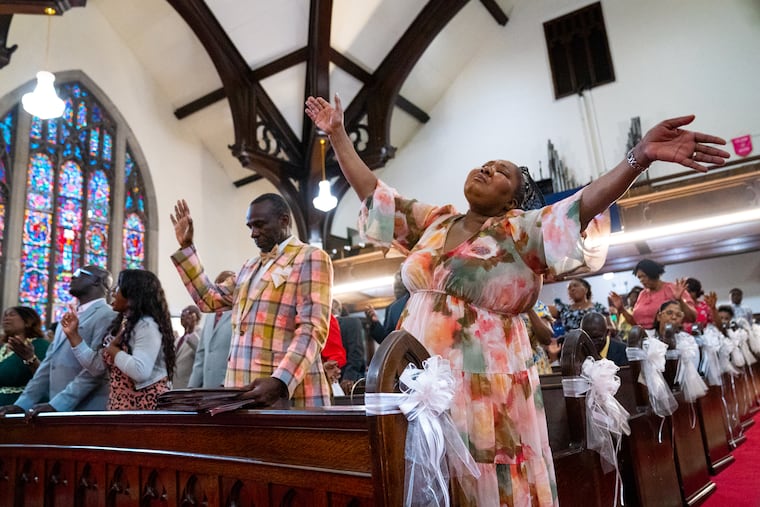
After taking the pulpit at the First Haitian Church of God of Prophecy on Sunday, the Rev. Frantz Ulysse immediately spoke to the calamity that confronts families in his congregation:
The end of the special immigration status that for years has allowed thousands of Haitians to live and work in Philadelphia and across the United States with their homeland in chaos ― ruinous natural disasters, governmental collapse, and gang violence that has displaced more than a million people.
“We, as Haitians, we are in trouble,” Ulysse told worshipers at the Olney church. “We need to pray, because our God is a faithful God, and I believe he’s going to do something for us. … Our homeland, Haiti, it is not a safe place to go back to right now.”
Prayers have been buttressed by petitions and by pleas to Congress to help before it’s too late.
President Donald Trump is poised to return roughly 350,000 Haitians to a country that the U.S. government says is too dangerous for Americans, after the Supreme Court ruled last month that he could end temporary protected status for immigrants from Haiti and Syria.
TPS is a humanitarian status that the U.S. can grant to foreign nationals whose nations are embroiled in war, environmental disasters, epidemics, or other extraordinary circumstances. It provides work authorization and protection from removal, but no path to permanent residency or citizenship.
Among Philadelphia’s 11,000-strong Haitian community, disbelief over the court decision has turned to misery and fear, advocates say.
The U.S. State Department has told Americans to stay out of Haiti, issuing its highest “Do Not Travel” advisory and warning those who insist on going to prepare a last will and testament.
Many Haitians ask: How can Haiti be safe for my family if it’s not safe for others? Some face the prospect of separation from spouses and children who are U.S. citizens. Some will not step outside their homes to go to work, church, or school, afraid that federal agents could be watching, advocates said.
“A lot of people are suffering now,” said Clifford Solomon, a church usher who is the father of four American children and whose wife is about to deliver a fifth. “A lot of my family is here [under TPS], my friends, my neighbors, all of them.”
The Trump administration insists that “temporary” means temporary. The president tried and failed to end TPS for Haiti, the poorest nation in the Western Hemisphere ― two-thirds of residents live in poverty ― during his first term.
While running for president in 2024, he falsely accused Haitian immigrants in Springfield, Ohio, of eating cats and dogs, and blamed those in tiny Charleroi, Pa., set on the Monongahela River about 20 miles south of Pittsburgh, of causing “massive crime.”
The court decision did not immediately terminate TPS for people from Haiti and Syria, but started the process for implementing an order that typically takes 32 days. Once TPS ends, holders revert to their previous immigration status, meaning those Haitians who were undocumented or have no other protection will be subject to arrest and deportation.
Meanwhile, U.S. Citizenship and Immigration Services says work authorizations for Haitians will expire on July 24.
“We are seeing the impact on the community in Pennsylvania, in Philadelphia, and across the country,” said Guerline Jozef, founder of the California-based Haitian Bridge Alliance, a national nonprofit. “The fear of deportation, the fear of family separation, the fear of losing everything.”
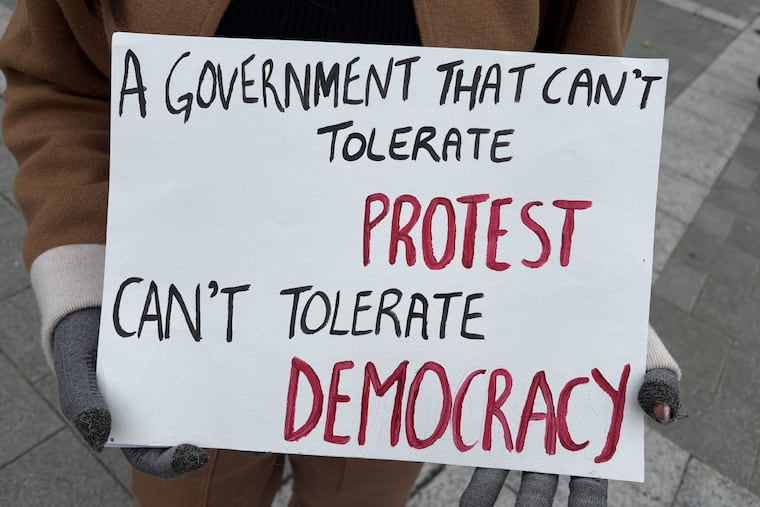
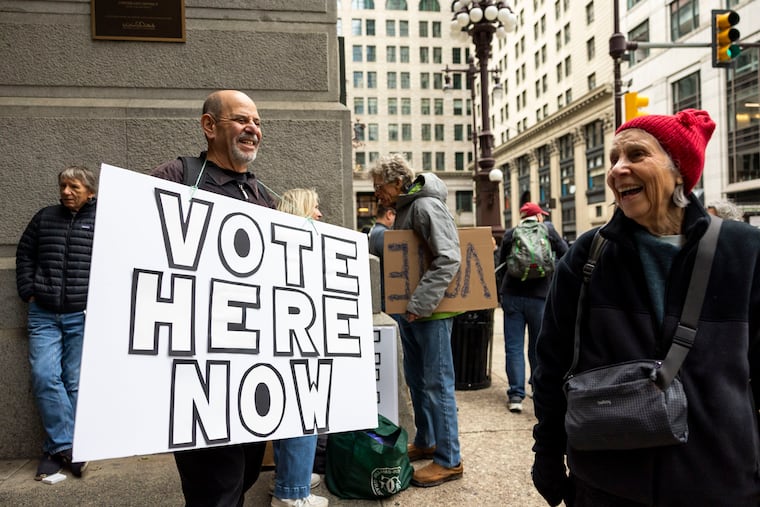
The alliance has helped commence a series of pro-TPS rallies led by labor unions, faith leaders, and immigrant rights groups in cities from San Diego to Boston, proclaiming that “families who have built their lives, careers, and communities in the United States deserve stability, dignity, and protection — not fear and uncertainty.”
Yet uncertainty rules, and many Haitians with TPS are investigating options even as they hope for relief from Congress.
Esaie Pierre, founder of Men Anpil, a Philadelphia-based nonprofit that helps Haitian migrants, said he is assisting people who want to apply for asylum in the United States. Others who come to him are considering where else in the world they might be able to live.
One young man is thinking about Chile, Pierre said.
“They are not wanted here, but have established some kind of life here,” Pierre said. “We’ve assimilated. I’ve assimilated.”
The events that led to this moment began in January 2010, when Haiti suffered a massive earthquake ― the 7.0-magnitude seism followed by a 6.1-magnitude aftershock ― that, as the National Immigration Forum put it, fundamentally altered the nation’s trajectory.
Estimates of the death toll ranged from 100,000 to 300,000 people, while about 1.5 million were forced into unsanitary, overcrowded camps. The damage crippled the government.
Three days after the initial quake, the Obama administration announced that undocumented Haitian immigrants in the U.S. would be granted TPS.
Thousands more would be welcomed over time under humanitarian programs, and become eligible for TPS, as Haiti grew mired in crisis ― a deadly cholera epidemic the same year, Hurricane Sandy in 2012 and Hurricane Matthew in 2016, and a 7.2-magnitude earthquake in 2021 that killed more than 1,000.
That year the assassination of President Jovenel Moïse ― elected four years earlier amid allegations of fraud and corruption ― saw the collapse of basic government functions and the rise of armed gangs.
“You send them back, it’s like you’re signing a death sentence for them,” said Esther Emmanuel, a church soloist who has family members here under TPS. “We’re asking God to do a miracle and to hear the cries of his people, and to also soften the hearts of Congress.”
Today the United Nations estimates that 90% of Port-au-Prince, the capital and largest city, is under the control of criminal groups, the violence having left thousands dead and displaced more than 1.4 million people.
The State Department warns of robberies, carjackings, and sexual assaults. It advises U.S. citizens who go to Haiti to establish plans in case they are kidnapped ― including a “proof of life” protocol, so family members can ask specific questions to kidnappers as a way to determine if their loved one is still alive.
“The only general hospital in Port-au-Prince has been closed for over two years,” Jozef said. “There’s no infrastructure in Haiti for people to be received. … We find ourselves as a community without a home, without a home to go to, without a home to stay in.”
Talie Cerin, who lives in Philadelphia’s Cobbs Creek neighborhood, was visiting Haiti at the time of the 2010 earthquake. She watched her childhood home crumble.
She has lived here under TPS, graduating from Immaculata University, then earning a master’s degree in education from Eastern University, and now working as the founder and lead editor of Woy Magazine, an internet publication about Haitian experiences.
“The toughest part about being a TPS recipient is the ambiguity,” Cerin said. “The confusion keeps you from making long-term plans. It traps you in a prison of conjecture, whispers of ICE raids, and stories of people in detention centers.”
Her sister, Lunise Cerin, was born in Philadelphia but lived in Haiti from age 5 to 16 before returning here to attend high school and college. The worry of losing her sister, and possibly their home, has been disorienting, Lunise Cerin said, generating “an enormous cloud of grief.”
Her family has lived in Philadelphia since the 1980s, she said, and for them the end of TPS would mean the end of an established, multigenerational life.
“Are we going to be gone?” she wondered.
Many at the First Haitian Church of God of Prophecy ask the same.
The pastor’s office has been deluged with phone calls. Some people tell Ulysse that they might as well die, that returning to Haiti is impossible, but trying to stay here without TPS means they cannot work to pay rent or to buy food for their children.
“They don’t know what to do,” Ulysse said. “I let them know God is the same yesterday, today, and forever, to trust the Lord. … Me, my heart is telling me something good is going to happen.”