Clearing of encampments along the Delaware River in South Philly begins after several false starts
About 40 people were estimated to be living in an area slated to break ground on a 620-unit apartment tower in 2026.
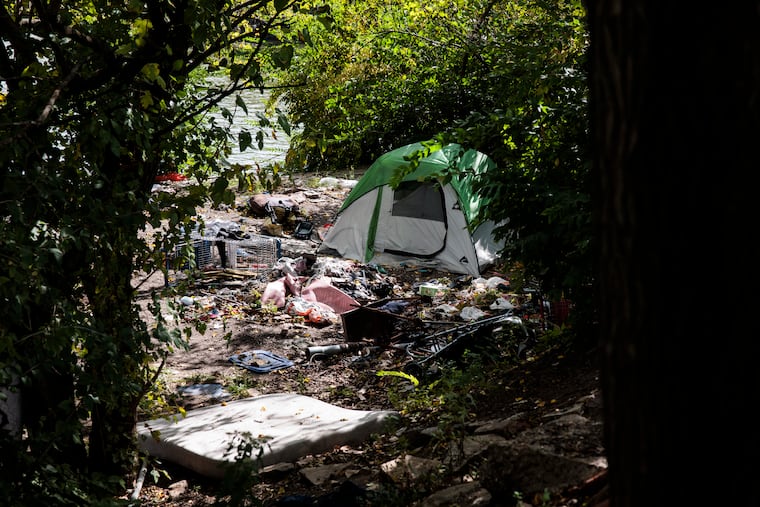
The swarm of police, private contractors, and dumpsters appeared early Tuesday morning.
Equipped with an excavator, they were there to raze a string of homeless encampments in South Philadelphia that stretched from the rear of the Giant store on Christopher Columbus Boulevard to Washington Avenue. Volunteers who brought food and supplies to the less than half-mile strip of the Delaware River Trail estimate that roughly 40 people lived there in tents and makeshift shelters, some of them for years.
Residents and volunteers had seen the laminated pages tacked onto trees, giving residents deadlines to leave on multiple occasions in recent years. Often, those deadlines were postponed or mini-clearings took place, like one in April that was limited to two smaller areas. But the tenor of this week’s clearing felt different with news that 1341 S. Christopher Columbus Blvd., which city records show stretches across two piers along the trail, is slated to break ground on a 620-unit apartment tower in summer 2026.
Police this week warned encampment residents they would be taken in for trespassing if they didn’t leave. The city said the area hugging the trail is private property and it’s up to the owners to secure and maintain their parcels.
“I’m just trying to not get arrested,” said Russell Bullock, 46. “I find this to be a safe haven.”
The razing of camps, which continued on Wednesday because of the amount of people’s belongings involved, is the latest in a yearslong push-pull between people facing homelessness and the property owners along the trail who want them out.
» READ MORE: Apartment tower planned for Columbus Boulevard could be the first of three
Among the homeless population, the piers along the Delaware River waterfront in South Philly have long been seen as a safer alternative to living in Center City or Kensington. And while encampment residents say they are not immune to violence in South Philly, their system offers some protections and the liberty a shelter wouldn’t. People can cook their own food, keep their pets, and pick up late-night gig work because they don’t have to worry about curfews.
But businesses and trail users have complained about the sprawl and trash produced by the encampments. What’s more, some of the piers face the risk of collapse.
Creating “density” for the Reed Street lot is part of Brevet Capital Management’s apartment tower pitch to Pennsport residents. The firm’s attorneys have posited that active use is the only thing that will keep people from coming back.
Brevet will pay into Philadelphia’s Housing Trust Fund to tap into zoning bonuses that will allow for a taller building and has committed to the upkeep of that stretch of trail. To limit access in the meantime, Brevet plans to place additional signage and fencing, company representatives told Pennsport residents last week.
“Alongside our community partners, we are committed to prioritizing safety and ensuring everyone is treated with dignity,” a spokesperson for New York-based Brevet said Tuesday.
As dumpsters full of camping gear, bikes, cookware, suitcases, and electronics were swapped for new ones Tuesday, some residents stayed in their tents, hoping the contractors would pass over them.
Chet Bumstead, who declined to share his age, gave in to the idea that many of his belongings would be lost. Even as volunteers offered their trucks to help residents move or go to storage units, Bumstead declined so as not to be a burden. He was prepared to leave with the clothes on his back, a business-casual outfit of khakis, a button-up shirt, and his saddle bag.
“There’s always been this sword of Damocles hanging,” he said of the threats of sweeps.
Tammy Donahue, a former resident of the encampment who found a temporary couch-surfing situation two weeks ago, was on site Tuesday to help people pack. Having 40 people living along the bike path is untenable, she said, but people are not there by choice. They need housing.
“There’s ways to go about it, in a way that can be healthy and not so traumatic,” she said of the clearing. “Homelessness doesn’t go away just because they’re moving.”
The Philadelphia Office of Public Safety, which did not take part in clearing out and disposing of people’s belongings, was also on site with a handful of other city workers Tuesday, offering “medical, housing, behavioral health, addiction treatment, and animal care and control services,” according to a spokesperson.
“The City of Philadelphia is prepared to provide social services to unhoused individuals during the developer’s dismantling of an encampment on their private lot at Reed Street and South Columbus Boulevard,” said a public safety office spokesperson, adding that at least five people accepted some form of city services.
By Wednesday morning, roughly half the shelters and belongings had been cleared. The excavator resumed its work while many homeless people remained in their tents. There were no city workers around this time.
Closer to the Washington Avenue side of the bike path in a grove of trees, Rebecca Axerosa, 43, tried to load up a shopping cart with as many essentials as possible.
Until last year, Axerosa ran Pretty Princess Jersey and Pretty Princess Philly, a children’s entertainment business where she would dress up as characters and do face paintings. Because of her old job, she can hem, take in, and mend clothes, which has made her a go-to resource on the trail. She said she likes to keep all sorts of things in her area because there’s always a need.
For a moment on the first day of the clearing, it seemed like someone from the Philadelphia Office of Homeless Services could help Axerosa get into a shelter, but she wasn’t going to leave her pit bull behind. Axerosa was able to stay the night because the independent contractors didn’t make it to her side before nightfall. But as contractors picked up work the next morning, Axerosa resumed the process of packing.
She didn’t know where she was going to lay her head down at night, though she imagined she probably wouldn’t do much sleeping in order to stay safe. Like others who reject shelter services, she’d had bad experiences at facilities in the past. For a moment, she wondered if encampment residents had any legal rights or a way to delay the clearing, but then she got back to packing.
“Do I have time to complain?” she asked. “No, man, I’m trying to figure out what I’m gonna eat today. Am I eating trash or not? I’ll be here until I’m not.”
Staff writer Jake Blumgart contributed to this article.