It’s time to address ICE activity at the Philly courthouse, elected and community leaders say
“We are saying ICE out of Philadelphia," said Councilmember Rue Landau. "Out of our courts, out of our city.”
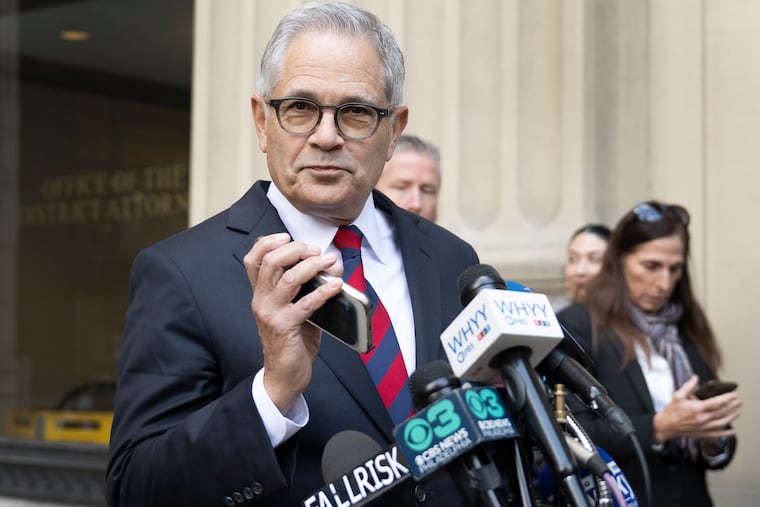
Some elected city officials and community leaders called for ICE to get out of Philadelphia on Wednesday, saying agents had become a threat to safety and to the orderly administration of justice.
They asked the court system to establish rules and protections for immigrants seeking to attend proceedings at the Criminal Justice Center ― which advocates say has been allowed to become an ICE “hunting ground.”
They asked for state court administrators to meet with the district attorney, the sheriff, the chief public defender, City Council members and others, and suggested that in the meantime, court staff must be better trained to understand the difference between court- and ICE-issued orders, that they do not carry equal weight nor require equal obedience.
“People should be able to come to court without fear,” said Keisha Hudson, chief defender of the Defender Association of Philadelphia. “Without fear that doing what the law requires will put them at risk.”
District Attorney Larry Krasner ― whose office led the news conference, and who reiterated his pledge to prosecute ICE agents who commit crimes ― said victims and witnesses are not showing up for cases. And community leaders said residents’ lives were being diminished.
“Across Philadelphia, the increase in ICE raids is tearing the fabric of our community,” said Thi Lam, deputy director of the Southeast Asian Mutual Assistance Association Coalition, which serves refugees and immigrants, leaving people afraid to go to work, to seek medical care, and to take their children to school.
“As Philadelphians, we demand policies that protect due process,” he said. “We object to the violent way that this immigrant process has turned. We invite all Philadelphians to speak up. Speak up, Philadelphians!”
ICE officials did not immediately reply to a request for comment.
The news conference at the Salt and Light Church in Southwest Philadelphia came as protests and confrontations continue in Minnesota and other cities over the fatal ICE shooting of a Minneapolis wife and mother, Renee Good. Daily ICE activity and arrests in Philadelphia and surrounding towns continue to rile and frighten immigrant communities and those who support them.
Krasner called the shooting of Good “murder,” and said “that collection of people who left their Klan hoods in the closet” to become ICE agents will face prosecution for any crimes committed in Philadelphia.
Meanwhile, in Atlantic City on Wednesday, Mayor Marty Small and other officials gathered to support local immigrant communities, and to assert their willingness to ensure that ICE agents “continue to do the job under the legal letter of the law.
“Some of the footage that we’ve seen has been horrifying, and I understand, and I empathize with that community. And as your mayor, this city has your back,” Small said, flanked by Atlantic City Police Chief Jim Sarkos, Director of Public Safety Sean Riggin, and Cristian Moreno-Rodriguez from the immigrant advocacy organization El Pueblo Unido of Atlantic City.
Atlantic City police, they noted, do not assist ICE in immigration enforcement. Under the 2018 Immigrant Trust Directive, New Jersey state and local police agencies are limited in how they can cooperate with ICE.
Riggin clarified, however, that local police will assist ICE in cases where agents are in danger or a crime is being committed.
“We will respond, we’re going to assess the situation, and we’re going to act accordingly in compliance with that directive,” Riggin said. “So, just because somebody sees us with ICE does not mean we’re doing immigration enforcement.”
In Philadelphia, immigrant advocates have made the courthouse and Sheriff Rochele Bilal a target of protest, insisting that ICE has wrongly been given free roam of the property.
The group No ICE Philly has castigated Bilal, saying that by not barring U.S. Immigration and Customs Enforcement from the courthouse — as judges and lawmakers in some other jurisdictions have done — she has helped enable the arrest of at least 90 immigrants who were trailed from the building and arrested on the sidewalk.
That group and others say ICE agents have been allowed to essentially hang out at the Center City courthouse, waiting in the lobby or scouring the hallways, then making arrests outside, a pattern they say has been repeated dozens of times since President Donald Trump took office in January 2025.
Many people who go to the courthouse are not criminal defendants ― they are witnesses, crime victims, family members, and others already in diversionary programs.
The sheriff says her office does not cooperate with ICE, does not assist in ICE operations and does not share information with ICE. Last week she garnered national headlines and condemnation for calling ICE “fake, wannabe law enforcement” and for sending a blunt warning to its officers.
“If any [ICE agents] want to come in this city and commit a crime, you will not be able to hide, nobody will whisk you off,” Bilal said in now-viral remarks. “You don’t want this smoke, cause we will bring it to you. … The criminal in the White House would not be able to keep you from going to jail.”
On Wednesday she said her office follows the law, and would obey orders from judges or statues from lawmakers concerning courthouse security.
The news conference followed an announcement of the Defender Association of Philadelphia’s new initiative to help people facing immigration consequences both inside and outside the justice system.
The agency’s Immigration Law Practice is expected to grow to up to 11 staff members, arriving as the Trump administration pursues aggressive new enforcement and even minor legal cases can put undocumented city residents at risk of detention, family separation, or deportation.
Councilmember Jamie Gauthier told news reporters that guardrails must be set around ICE behavior at the Criminal Justice Center, and that the agency “is making us less safe by scaring away witnesses.”
Councilmember Kendra Brooks said constituents were phoning her office, asking how to get ICE out of their neighborhoods.
“ICE needs to get out of our city, for the safety of all of us,” Brooks said, calling on the city government and the court system to act. “Something needs to be done. … People can’t safely come to courts ― that’s a threat to all of us.”
Councilmember Rue Landau asked people to imagine a domestic-violence case, where victims and witnesses were afraid to go near the courthouse.
“We will not have some masked, unnamed hooligans from out of town come here and attack Philadelphians,” she said. “We are saying ICE out of Philadelphia. … Out of our courts, out of our city.”