Montco school officials expensed international trips, including a 14-day African safari
Agency leaders expensed $40,000 worth of international trips since 2023. Said one analyst: “Contemplate the optics.”
The Montgomery County Intermediate Unit’s mission is to support schools in the county with early childhood intervention, professional development, and bulk-purchasing programs that save taxpayers’ money.
In recent years, however, the Norristown-based intermediate unit has also served as an international travel agency of sorts — for its own leaders.
Expense reports obtained by The Inquirer through a Right-to-Know request show that, since 2023, the Montco IU’s executive director, Regina Speaker, and its assistant executive director, Sandra Edling, have used public funds to book about $40,000 worth of professional-development travel to three continents.
That includes a 14-day African safari that cost about $18,000.
“Travel from towering Mount Kenya to the wild expanses of the Serengeti to witness the drama of the bush unfolding around you,” reads the online brochure for the trip Speaker and Edling took to Kenya and Tanzania in the summer of 2023.
The expense reports show that Speaker subsequently used her IU credit card to fly to South Korea and Singapore for 11 days last spring. Edling used hers to purchase a trip to Central Europe in the fall, before the intermediate unit canceled it amid funding concerns.
Some of the credit card charges lacked receipts or did not state a destination, or provide any indication that they involved overseas travel. Yet, they were approved by two presidents of the Montco IU board and a now-retired assistant executive director. The 21-person board is composed of members from each school district board in the county.
The trips raise questions about how forthcoming the IU’s executive staff has been with the board about its spending, as well as the level of oversight provided by the board.
In a recent interview, Speaker defended the trips as legitimate professional-development outings. She said she followed the proper procedure for spending money the board had already budgeted for that purpose.
“Everything was signed off on by the board president and clearly communicated,” she said. “There was nothing underhanded about it.”
Jennifer Wilson, who served on the intermediate unit’s board from 2017 to last November, first learned of the trips from an Inquirer reporter last month. She said some looked more like “vacations” that shouldn’t have been covered by the publicly funded IU.
“We never got notice [Speaker] was going on these trips at all,” said Wilson, who still serves as vice president of the Hatboro-Horsham School Board. “In my home school district, the superintendent tells us if he’s going out of town for the weekend.”
Public finance experts also questioned whether taxpayers should pay for professional-development trips that include extensive leisure time, such as giraffe feeding and guided tours through the Great Rift Valley.
Marguerite Roza, director of the Edunomics Lab at Georgetown University, said those types of expenses could leave taxpayers feeling cynical about how their money is being spent.
“We use examples like this to warn people that these are public funds,” Roza said. “You need to make sure your expenditures make sense and are justified, but also, contemplate the optics.”
The Montco IU, one of 29 state-mandated agencies in Pennsylvania, has a $198 million budget and 848 employees. It receives a mix of local, state, and federal funding, and provides support services to more than 200 public and private schools.
Speaker, who was named executive director in 2020, has been thinking on a larger scale.
“Our big mission is to be part of the global community,” Speaker, a former Great Valley School District superintendent, said in explaining her travel bills. Her base salary last year was $298,000.
The trip to Kenya and Tanzania, Speaker said, culminated a yearlong academy for education leaders run by the School Superintendents Association, known as AASA.
“Everything was through the lens of leadership,” she said of the trip. “It was about that process of survival of the fittest, and how are you a leader, and what do you prioritize.”
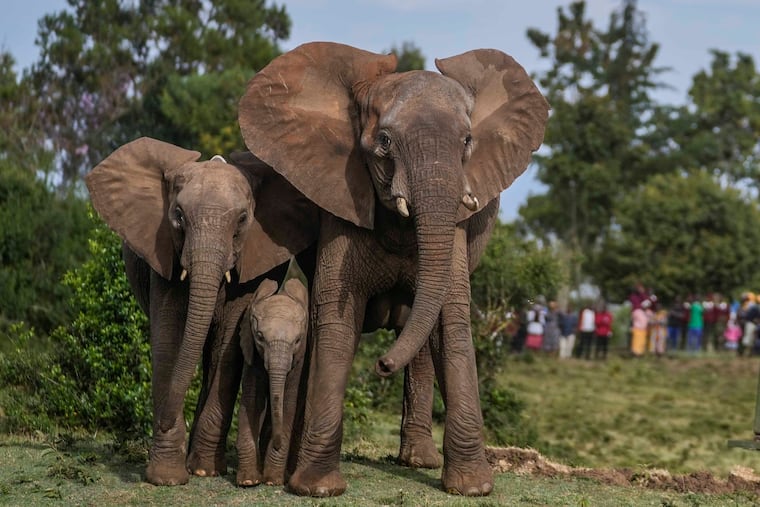
The itinerary included six sightseeing tours and eight wildlife drives in search of zebras, monkeys, lions, baboons, cheetahs, hippos, elephants, wildebeests, and “the exceedingly rare black rhino,” as well as 11 nights in “handpicked hotels.”
Speaker noted that the trip featured a visit to a tribal school.
Expense reports show that in March 2025 Edling used her procurement card for about $7,000 related to what is described on the purchasing log as a “conference.” The documents do not name a location or offer specifics.
In response to questions from The Inquirer, Speaker said that Edling’s expenditure, which was approved by another assistant executive director in the office, was for a 10-day trip to Germany, Switzerland, and Austria in October 2025 sponsored by AASA, the superintendents group that put together the African safari.
“The whole idea was to bring her up to speed on the leadership component,” Speaker said of Edling, who previously served as the IU’s chief financial officer. Edling’s base salary last year was $215,000.
That trip, according to the online brochure, was to include a tour of Munich, quick-tempo Viennese waltz lessons, an underground train ride into Austria’s ancient Hallein Salt Mine, a “journey to crazy King Ludwig’s fairy tale castle of Neuschwanstein,” and an alpine hut dinner.
“Ascend into the Alps for an evening of true Swiss hospitality,” reads the itinerary. “As you feast on beautiful views from your hosts’ mountain chalet, enjoy traditional food, entertainment and fun Swiss games and activities.”
School visits were planned on day five and day nine, according to the itinerary.
Speaker said that she subsequently froze all travel last year because Pennsylvania’s four-month budget impasse held up a large portion of the intermediate unit’s funding. The IU didn’t know if it would be able to pay its staff. The cancellation also came after The Inquirer had requested the records. Speaker said the IU was able to get a refund for that trip.
Edling said that while she didn’t get to go on that trip, meeting with education leaders abroad is a justifiable public expense.
“We believe we need to grow the global partnership concept. Other intermediate units are also working on that,” she said. “As an educational service agency, we have to be at the forefront of what’s next, what’s new.”
Lara Wade, AASA’s director of communications, said in an email that her group is involved in planning the trips, but does not track whether participants bill taxpayers or pay their own way.
“From AASA’s perspective, these international delegations are designed as professional learning experiences for senior education leaders,” Wade said. “They include school visits and meetings with education leaders, but they’re not intended to mirror classroom-style professional development or be evaluated solely by the number of hours spent inside schools.”
A recurring theme
Justin Marlowe, director of the Center for Municipal Finance at the University of Chicago, said questionable spending is a recurring theme at intermediate units and other regional educational agencies around the country.
They receive a lot of public money and are often given wide latitude in how to spend it.
“The presumption is that everything is going to be on the up and up,” Marlowe said.
At the same time, these organizations operate largely outside of public view and are overseen by board members who are not always as engaged as they are in their home school districts. Intermediate unit board meetings are open to the public but rarely draw much interest.
“They don’t get the same level of scrutiny from taxpayers,” Marlowe said. “The stuff they do is not on people’s radar in the same way.”
Still, he said, “I don’t know if I’ve seen African safaris.”
Roza, the education finance expert at Georgetown, said board members have to be able to trust the judgment of executive directors and superintendents because they cannot review every expense. She said the safari, in her opinion, is a “misuse of public funds.”
“If I was a board member and my superintendent was taking trips like this, I’d be like, ‘I think I just lost confidence in you,’” Roza said, after reviewing the itineraries for the African and Central European trips.
Roza compared the trips to those that made news in Clark County, Nev., in 2024. School district officials there spent more than $150,000 to attend job fairs and conventions around the country, including in Hawaii, with little to show for it.
“Just because it’s legal doesn’t mean it’s advisable or a good use of public funds,” Roza said.
Juliane Ramić, the former Montco IU board president who in 2023 approved Speaker’s credit card charges for the Africa trip, said this month that she could not recall if she was aware at the time what the charges were for.
The records The Inquirer obtained show that some of the expenses Speaker submitted for that trip lack supporting documentation, even though she included receipts for routine business expenses.
For instance, Speaker in May 2023 included a receipt for a $54.47 lunch at Redstone American Grill. But the $9,342 in purchases related to the safari only included what appears to be a screen grab from her phone showing the amount of money charged to the card.
The only mention of Africa in the records came months later when she purchased a Tanzanian eVisa for $139.
Ramić did not sign off on the expenses until August and September 2023, after Speaker and Edling had returned from Nairobi.
Ramić, who now serves as the Montco IU board’s treasurer, said board members are focused more on big-picture issues, such as whether the unit’s programs are working correctly.
“There is no onboarding or training for serving on an intermediate unit board,” Ramić said. “There is no guidance. There are gaps there.”
In April 2025, with a new board president in place, Speaker traveled to South Korea and Singapore, as part of a leadership academy run by the Association of Educational Service Agencies. The registration cost $13,000, paid in two installments with Speaker’s IU credit card.
Records show that one of the payments, in December 2024, apparently was not approved. That month’s expenses were not signed or dated by either Speaker or Janet Flisak, then the board president.
Both lines are blank. Flisak, who has since left the board, could not be reached for comment.
Ramić said she does not believe Speaker or Edling did anything wrong, but the board has requested more information from their office about travel expenses going forward. She said she intended to follow up with the board to see if new policies are needed to better monitor IU operational expenses.
‘It’s a personal trip’
Not everyone who flew to Nairobi in 2023 billed their employer.
Lee Ann Wentzel, who retired last year as superintendent of the Ridley School District, also went on the African safari, as well as an earlier trip to Israel that AASA sponsored. She paid for both trips herself.
“Some people look at it as a vacation, others work-related,” Wentzel said. “I think both things can be true.”
Wentzel said she did not use Ridley district funds because her trips were too last-minute to include in her long-term professional development budget. But, she said, other superintendents are justified in using public funds.
“Speaking to locals, learning about their personal education journeys and how different the government schools are vs. the religious and private schools, and what services are offered, that’s something you’re not going to see unless you go to international settings,” Wentzel said.
Janet Fike, superintendent of the Morris-Union Jointure Commission, a state-established educational service agency in New Jersey, also went on the Africa trip. In a detailed account written for the New Jersey Association of School Administrators’ website, she described it as a “bucket list” trip that she had dreamed about for decades and explained how “a safari Jeep became our home on the road.”
“The majestic Amboseli National Park, in the backdrop of Mt. Kilimanjaro, or ‘Kili’ as it is called in Africa, beckoned,” Fike wrote. “On this game drive, we saw the elusive cougars, cheetahs, plentiful wildebeests, elephants, and more giraffes, my favorite! Each species was more spectacular than the other.”
Fike said recently that she paid for the trip out of pocket, instead of charging it as a business expense to the Morris-Union Jointure Commission.
“I paid for my own trip because it’s a personal trip,” Fike said. “And I took vacation days.”
Inquirer staff writer Kristen Graham contributed to this article.

The Inquirer’s journalism is supported, in part, by the Lenfest Institute for Journalism and readers like you. News and editorial content are created independently of The Inquirer’s donors. Gifts to support The Inquirer’s high-impact journalism can be made at inquirer.com/donate. A list of Lenfest Institute donors can be found at lenfestinstitute.org/supporters.