Another partial government shutdown has started. Why is this one different? Here’s what we know.
The TSA and some other parts of the Department of Homeland Security are affected, but ICE is still funded by the Big Beautiful Bill.
Another partial government shutdown began Saturday, with lawmakers at an impasse. But this one is different.
With congressional Democrats refusing to approve funding for the Department of Homeland Security, the last of that agency’s funding has run out.
It all stems from party-line disagreements surrounding ICE and immigration enforcement.
When a funding lapse triggered a partial government shutdown on Jan. 31, Congress made a compromise: It approved spending bills for all agencies, except for DHS.
DHS received two weeks of funding to give Congress more time to negotiate Immigration and Customs Enforcement changes, a push Senate Democrats have repeatedly made after federal immigration and border agents fatally shot two U.S. citizens in Minneapolis last month.
Now those two weeks are up and Congress is still in a standoff. Democrats want to see more guardrails regarding how ICE agents identify themselves, barring them from wearing masks, and requiring name badges. But Republicans say those practices would add too much risk to the job.
Since all other government agencies have already been funded, DHS is the only one affected by the shutdown.
Here’s what that means.
What’s a partial government shutdown?
A partial government shutdown happens when Congress has funded only certain federal agencies, leaving others in limbo. Some parts of the government close while others keep operating.
In this case, it comes down to who has funding and who doesn’t. DHS is the only agency without approved funding. The agency’s fiscal year ends Sept. 30, meaning it currently stands without funding for seven months or until Congress reaches an agreement.
When did government funding expire?
Funding for DHS expired Friday at midnight. A shutdown began Saturday at 12:01 a.m. after Congress and President Donald Trump’s administration failed to reach an agreement.
What changes with the partial shutdown?
Not much in the eyes of the general public, according to CNN.
Nearly all DHS workers remain on the job, but many won’t get paid until the shutdown ends.
But DHS officials who testified before a House panel on Wednesday warned that a funding disruption could mean delays to states seeking reimbursements for disaster relief costs, delays in cybersecurity response, and missed paychecks for agents who screen bags at airports, which could lead to unplanned absences and longer wait times.
DHS is home to agencies including the Transportation Security Aadministration, Coast Guard, and Federal Emergency Management Agency, which are all affected.
What have Pennsylvania politicians said?
Sen. John Fetterman (D., Pa.) said he “absolutely” expected a shutdown. He broke with most Senate Democrats, voting to approve funding and avoid a shutdown in a measure that failed, and arguing that delaying funding DHS won’t impact ICE since the agency has received separate funding.
» READ MORE: Sen. John Fetterman said he ‘absolutely’ expects a DHS shutdown as ICE negotiations stall
Earlier this month, some members of the Pennsylvania delegation to the U.S. House of Representatives, including Chris Deluzio, Chrissy Houlahan, Brendan Boyle, Madeleine Dean, Mary Gay Scanlon, Dwight Evans, and Summer Lee, penned a letter to Fetterman and Sen. Dave McCormick (R., Pa.) asking them to vote against passing the spending bill unless ICE reform is secured. (Both senators voted in favor, but it failed.)
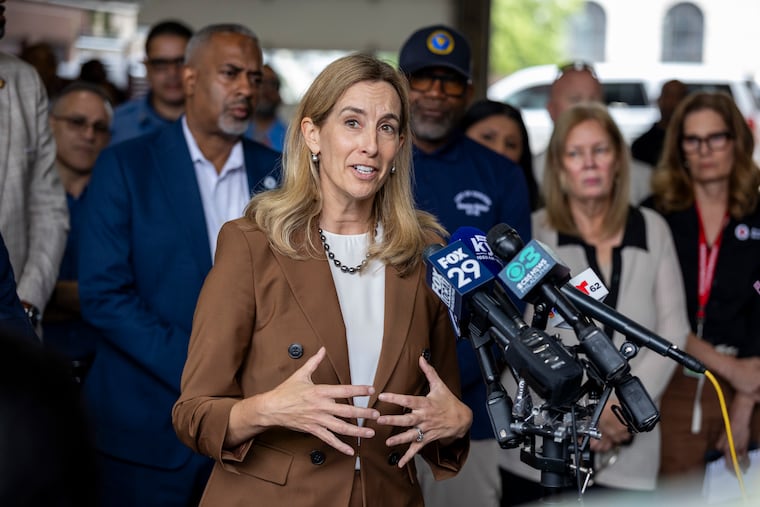
Houlahan, a Democrat from Chester County, criticized ICE last week and emphasized a need for immigration reform.
“We are a nation of immigrants, but ICE is clearly not reform. ICE is undertrained. ICE is vastly, vastly overfunded,” she said. “They have a budget that is larger than many countries’ entire defense budgets.”
Where does Congress stand right now?
The House had already done its part and approved funding. The chamber is in recess until Feb. 17. But Senate Democrats are pushing back on its approval without immigration reforms. That leaves the Senate with few options if it cannot pass the current measures.
The Senate adjourned Thursday for a Presidents’ Day recess after a motion to advance DHS funding failed 52-47, mostly along party lines. Democrats also blocked an attempt to extend funding for another two weeks.
Lawmakers left town, some traveling to the Munich Security Conference in Germany, others to meetings nationwide and overseas.
The chambers are not scheduled to return until Feb. 23, though that could change if a deal is reached in the meantime. But senators on each side say bipartisanship during an election year seems unlikely.
So in short: We could be here for a while.