REBUILDING A BOARDWALK
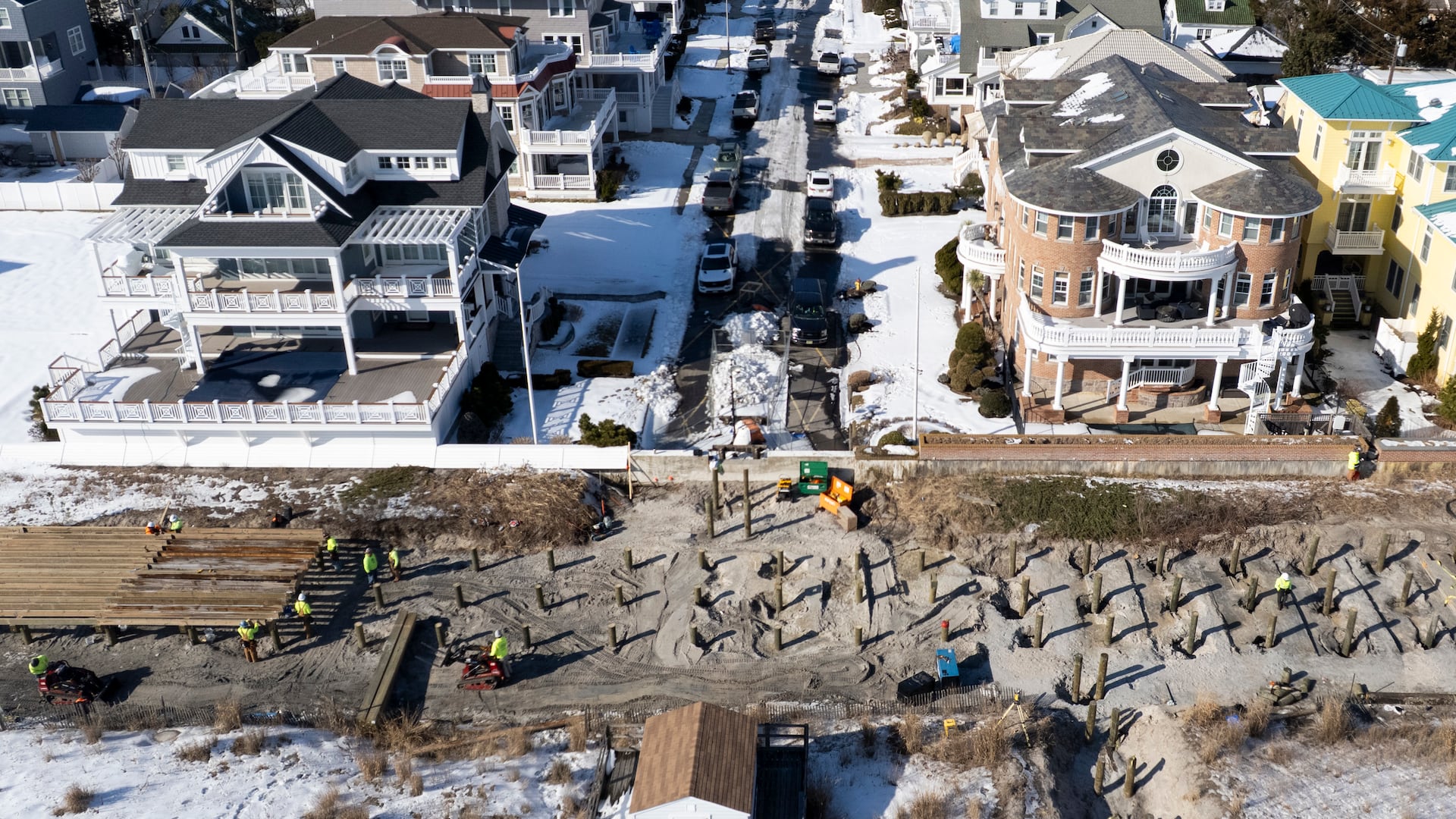
VENTNOR, N.J. — They demolished the existing boardwalk from the tennis courts to the fishing pier, north to south, and now they are building their way back up.
Financed mostly with federal funds granted to New Jersey from the COVID American Rescue Plan, Ventnor and other Shore towns like Ocean City, North Wildwood, Atlantic City, and Wildwood have set out to redo or upgrade their iconic pathways.
Ventnor is using $7 million in federal funds and bonded for about $4 million more, officials said.
Will this stretch of boardwalk reconstruction be done by Memorial Day?
“It’s always a worry,” Ed Stinson, the Ventnor city engineer, said in an interview late last month. “We’ve had multiple meetings with the contractor [Schiavone Construction], one as recent as three weeks ago. In all the meetings, he’s said it’ll be complete and open before Memorial Day.”
The reconstruction has delivered a seven-block offseason interruption in a walkway that is popular year-round.
Work will stop for the summer, city officials say. In the fall, a second 13-block section, from Suffolk Avenue to the Atlantic City border at Jackson Avenue, will begin. There is currently no funding or plan for the boardwalk from Cambridge south to the Margate border, said Stinson.
The biggest change people will notice is that the original and distinctive angled herringbone decking pattern of the boardwalk is being replaced with a straight board decking. Ultimately, it came down to cost over tradition.
“There was discussion about it,” said Stinson. “There’s additional lumber that’s wasted when you do the herringbone, and the labor to cut that material. The additional material costs were significant. It’s a waste of tropical lumber. The only reason to go herringbone is tradition and appearance.”
Other differences are changes in lighting (lower, more frequent light poles) and some enhancements of accessible ramps. The existing benches, with their memorial plaques, will be back.
To demolish the boardwalk, the contractor cut the joist and the decking in 14-foot sections, “swung it around, carried it over to the volleyball court,” Stinson said, on Suffolk Avenue.
“That’s where they did their crushing and loading into the dumpsters. They worked their way down and followed that with the pile removing.”
The other massive job was excavating the sand that had accumulated under the boardwalk. “They screened it, cleaned it, and put it down there,” on the beach in piles. It will be spread around above the tide line, Stinson said.
Once the excavation was down, the pile driving crew set out beginning at the south end and working their way toward Suffolk Avenue. “Then the framing crew came in and started framing,” Stinson said. On Feb. 2, the third team began its work: the decking crew.
The weather has slowed the pace, Stinson said. “They were doing about 20 to 24 piles a day,” he said, a pace that dropped to about nine piles a day after the snowstorm and ice buildup.
The framing crew installs pile caps, 8-by-14 beams that run across the boardwalk atop the pilings. The decking crew follows behind them, installing the wood, a tropical wood known as Cumaru. The use of Brazilian rainforest lumber at one time inspired protests, but that has not been an issue this time.
Ventnor’s boardwalk, which links to Atlantic City’s famous walkway, dates to 1910. It was rebuilt twice before: once after the hurricane of 1944 and again after the March storm of 1962. Margate, on the southern end, never rebuilt its boardwalk after 1944.
Stinson said the tropical wood is noted for its “denseness and durability. It does not last forever.”
In all, $100 million of American Rescue funds was set aside by Gov. Phil Murphy for a Boardwalk Fund and awarded to 18 municipalities, including, as Stinson said, “anybody who has anything close to a boardwalk.”
Brigantine, with its promenade, received $1.18 million. Ocean City, in the process of rebuilding a portion of its north end boardwalk, received $4.85 million.
The two biggest recipients were Asbury Park and Atlantic City, each receiving $20 million. Atlantic City has completed a rebuilding of its Boardwalk to stretch all the way around the inlet to Gardner’s Basin. Wildwood, with $8.2 million, has undertaken a boardwalk reconstruction project, and North Wildwood, receiving $10.2 million, is rebuilding its boardwalk between 24th and 26th Streets, combining the herringbone pattern with a straight board lane for the tram car.
Although the timing of the reconstruction was no doubt prompted by the availability of the federal funds, Stinson said Ventnor’s boardwalk had shown signs of age.
“We’ve been into some significant repairs on the boardwalk,” Stinson said. “Those have increased every year. We were getting into pile failures. It was due. I don’t know if the city would have tackled it without the [federal] money.”