Camden County wants to spend $400M to make Cooper River swimmable and improve other waterways
Officials are planning a referendum Nov. 3 asking voters to increase the county’s open space tax to secure permanent funding.
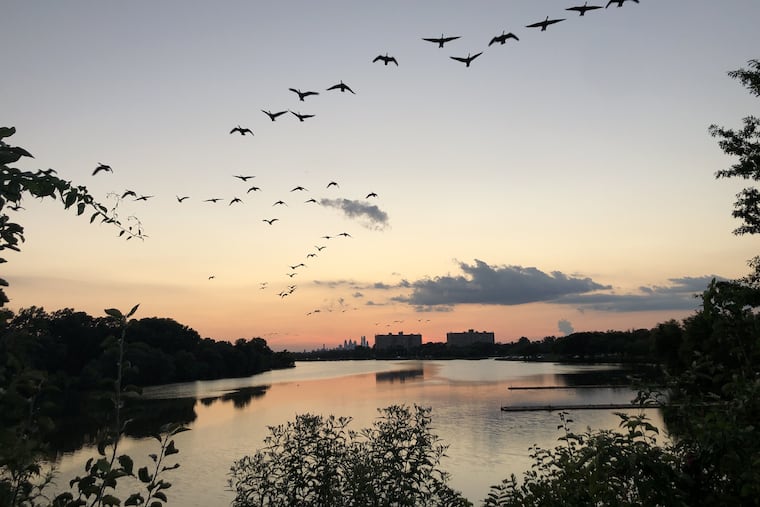
Camden County officials announced a $400 million master plan Tuesday to protect the county’s network of rivers, lakes, and streams such as the Cooper River.
They are hoping voters will approve a referendum in the fall to help pay for it over the next decade.
That waterway network is threatened by aging infrastructure, stormwater runoff, industry, and changing regulations that have left it degraded. A comprehensive plan is imperative, officials said.
An ultimate goal, they say, is that residents may one day be able to swim safely in Cooper River Lake without a health risk.
“Repair. Replenish. Recreate,” County Commissioner Jeffrey Nash said. “Those three words summarize the generational change that Camden County is about to embark on to improve the quality of our water bodies.”
County, state, and local officials made the announcement at the Camden County Municipal Utilities Authority headquarters in Camden, backed by representatives from various environmental groups and nonprofits.
To raise the money, officials are assembling federal, state, and government grants and loans, as well as help from private nonprofits.
Voters could be key
But they also said a planned voter referendum on increasing the county’s open space tax to $0.03 per $100 of assessed property value is key to secure permanent funding. Voters will weigh in on Election Day, Nov. 3.
The rate would nudge up from $0.02. That means someone with property assessed at $500,000 would pay $150 a year toward open space, up from the current $100.
Waterways that would see increased protection include:
Cooper River Lake, which spans Camden, Pennsauken, Cherry Hill, Collingswood, and Haddon Township.
Kirkwood Lake in Lindenwold.
Atco Lake in Waterford Township.
Pennsauken Creek, which runs through Pennsauken, Maple Shade, and Cherry Hill.
Big Timber Creek, which spans multiple towns.
Evans Pond and Wallworth Lake in Cherry Hill and Haddonfield.
Nash said the county’s population growth over the last 100 years can be attributed to people drawn to the waterways. But increased population also resulted in the need for more sewer lines and attention to aging infrastructure.
“We stand at a crossroads, and we have a choice to make: Either we’re going to shrug our shoulders and pass this problem on to the next generation, or we’re going to do something that is generational,” Nash said.
The cost breakdown
The plan calls for:
$200 million to fix aging combined sewer systems that overflow during storms.
$75 million for dredging and other methods to reduce sediment.
$50 million for rehabilitation of sanitary sewer systems across multiple towns.
$50 million to restore recreational lake areas.
$25 million for green infrastructure.
And it includes an unspecified amount for continued planning, monitoring, and management.
Scott Schreiber, executive director of the Camden County Municipal Utilities Authority, called the plan “a comprehensive strategy that addresses every major factor affecting the health of our rivers, lakes, and streams.”
He said it represents a new way of thinking about water quality by coordinating across towns, rather than planning by one municipality at a time.
“Water doesn’t recognize political boundaries or municipal borders,” Schreiber said.
The biggest chunk of money will go to address combined sewer overflows (CSOs), which are now antiquated. A combined sewer system collects rainwater runoff and household sewage into one pipe. Normally, it can transport all of that to a sewage treatment plant. But storms can bring so much water that they can exceed the system’s capacity. When that happens, untreated stormwater and wastewater flow into bodies of water, such as the Delaware River.
Schreiber said projects are being designed and built to capture and treat much more stormwater before it reaches the Delaware.
Separately, money will be used to repair and rehabilitate aging sewer systems, reducing leaks and groundwater infiltration that pollutes waterways.
He said the infrastructure money will also be used to install rain gardens, permeable pavement, and bioswales, which are typically sloped channels covered with vegetation and designed to capture or slow stormwater.
The county will start a regular dredging operation to remove decades of accumulated and contaminated sediment in lakes and ponds to improve aquatic habitat, restore ecological function, and create overall healthier waterways.
And the county plans to restore recreational lakes by improving public access, bolstering shorelines, and boosting overall water quality.
Officials plan to finance part of the plan through the New Jersey Water Bank, an independent state authority that provides low-interest loans for water quality infrastructure projects.
However, Schreiber said, the voter referendum will be key. If voters approve it, the referendum would provide $7 million per year that could be used to pay off that debt and pay for other improvements.
‘Vibrant waterfront communities’
Don Baugh, founder of the nonprofit Upstream Alliance, which has helped Camden County build its first water trail, called the master plan a major step.
“I feel like I should pinch myself,” he said. “This is the dream of restored waterways, swimmable waterways, kids playing in the water, and vibrant waterfront communities.”
Daniela Solano-Ward, mayor of Collingswood, one of five towns that border Cooper River Lake, said the new coordination by the county is vital.
“Collingswood can do very little to alter our geographic reality,” she said. “We are bordered by Cooper River to the north and Newton Lake to the south. Ultimately, protecting urban watersheds has fallen to local government. But with 35 municipalities in Camden County, the weight of this lift is too heavy for any one of us to shoulder alone.”