Walt Whitman wrote famed poetry by this South Jersey lake. Now, it’s a nature preserve.
The famed poet called Laurel Lake “the prettiest lake in either America or Europe.”
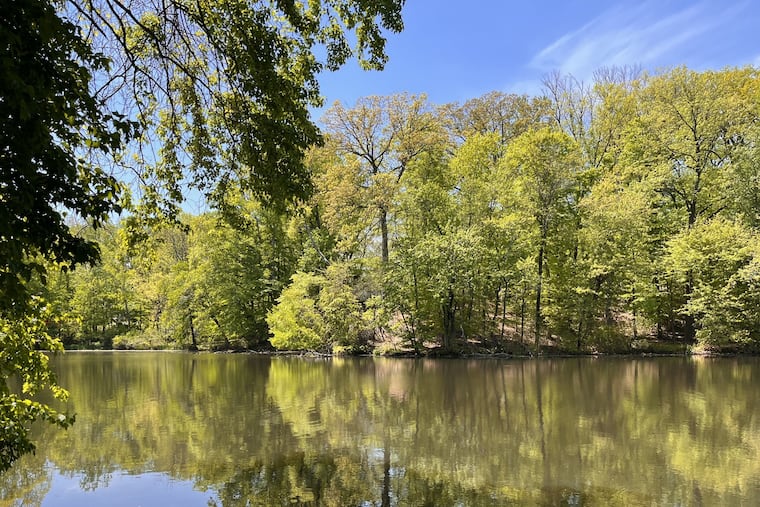
In his latter years, Walt Whitman spent summers at Laurel Lake, which he called “the prettiest lake in either America or Europe.”
He tapped the waters of nearby Crystal Spring, a natural underground spring, to treat his arthritis and rheumatism.
In more recent years, the land around the lake has been vulnerable to littering and potential development.
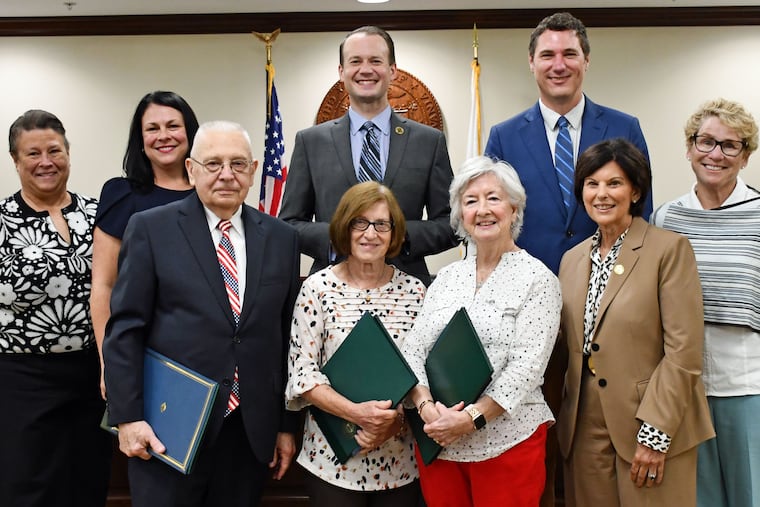
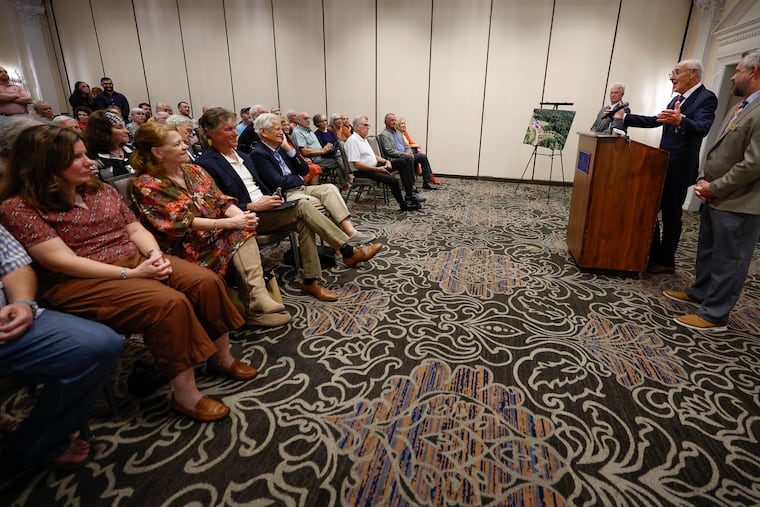
On Friday, officials formally dedicated the new Laurel Lake Preserve, a 3½-acre woodland along Laurel Lake, ensuring the property will remain protected.
The lake is fed by Big Timber Creek and is located in the small borough of Laurel Springs.
The land was purchased with funding by the state and county for $382,500 in January from the Kuehner family, who had owned it for a century and worked to have it preserved.
The state and county has deeded the land to the South Jersey Land & Water Trust, which will manage it.
“We couldn’t have asked for a nicer day to be here to celebrate this,” Christine Nolan, executive director of the trust, said under sunny skies as trees reflected on the lake.
The Whitman connection
Though the preserve itself is relatively small, officials said its conservation will have an outsized effect because of its location in a residential neighborhood, direct access to the lake, containing an intact woods, and, of course, a historical connection to Whitman.
The preserve runs atop a hill that looks down on the lake. It’s heavily forested with maple, oak, elm, and other hardwoods.
Camden County Commissioner Jeffrey Nash called it a “hidden gem.”
“It is now our turn to make sure that we preserve ... the beauty of this property, and as stewards, to pass it on to the next generation,” Nash said.
Whitman, who lived in Camden from 1873 until his death in 1892, spent summers in a farmhouse on Maple Avenue now known as the Whitman-Stafford House near the lake. He was buried at Harleigh Cemetery in Camden and his tomb is a public attraction.
Though Whitman first published his famed Leaves of Grass in 1855, he continued to revise it, and a final edition was published just before his death. He made some of those additions while inspired by Laurel Lake.
Ally Brody, a project manager for the New Jersey Department of Environmental Protection, said Whitman fittingly wrote a passage about the lake on “the last day of April and first day of May” after observing “an unusual melodiousness of blackbirds.”
“Never before have I seen, heard or been in the midst of and been so flooded and saturated with them and their performance as this current month,” the bard wrote.
How Laurel Lake became a preserve
The land had been the focus of conservation efforts for more than a decade.
“It’s been an amazing, gratifying, epic journey,” said Elizabeth Kuehner Smith, a member of the family that held the property for so long. “It took a borough, a county, a state, and a village of very kind and committed neighbors, advisers, friends and mentors, but we got here.”
Kuehner Smith said her grandparents acquired the land in 1925. In 1976, her father allowed the property to return to a natural state.
The family, Kuehner Smith said, wanted to see it preserved and waited patiently for years rather than sell it off for development.
The property became known as Whitman Woods as the family and government officials sought a deal and created an informational website.
According to the Whitman Woods website, Whitman penned parts of Specimen Days, an eclectic collection of prose written over two decades, at Laurel Lake. The collection includes writings on the Civil War, his recovery from a stroke, his travels through the American West, and passages on trees and animals.
Laurel Lake also inspired poetry for later editions of Leaves of Grass.
Laurel Springs Council President Jim Redstreake said he grew up three blocks away and frequented the lake as a youth.
“I spent a lot of my time right here on this piece of land, fishing, boating, even swimming in this lake up until I was about 15 years old,” Redstreake said.
“I’d like to thank the Kuehner family for their patience and vision for the conservation of this land,” he said.